Air Force Museum
WWI Production
The United States entered World War I with no combat-ready air arm and adopted an enormous production program. Congress appropriated hundreds of millions of dollars, factories expanded, workers learned unfamiliar processes, and American planners tried to supply pilots, mechanics, engines, aircraft, and spare parts at the same time.
In depth
Ambition, production, and bottlenecks
The original goals proved unrealistic. American factories produced large numbers of trainers and Liberty engines, but only one American-built airplane type—the DH-4—reached combat units in France. The record is not simply failure or success; it reveals how design changes, tooling, materials, workforce training, quality control, and shipping constrain rapid mobilization.
History & service
When the United States entered World War I, it had no military air arm capable of fighting an enemy. It did have, however, an untapped pool of men and materials to which England and France, bled almost dry after years of war, looked hopefully. France proposed that an American "flying corps" of 4,500 planes, 5,000 pilots and 50,000 mechanics be readied for the Front in 1918.
To meet its overwhelming expansion schedule for the Aviation Section, the United States was forced to take drastic action to acquire raw materials. For example, more than 27,000 officers and men were assigned to the Spruce Division (working in forests and lumber mills) to supply sufficient wood for building planes. Since castor oil was needed for lubricating airplane engines, 100,000 acres of land in the southern United States had to be planted in castor beans.
Also, to acquire material for lining flying clothing, 450,000 Nuchwang dog skins were purchased from China.
America's greatest technological contribution to the war effort was the development and mass production of the 12-cylinder Liberty engine. During a five-day period beginning May 29, 1917, Mr. J.G. Vincent of Packard Motors and Mr. E.J. Hall of Hall-Scott Motors redesigned an experimental 8-cylinder engine previously built and tested by Packard. Weighing only 710 pounds but delivering 410 hp, the Liberty far surpassed all other aviation engines in the world.
Production lines were set up by various automobile manufacturers and by the end of 1918, they had built 17,935 Liberties, 5,827 of which had been sent to Europe. The engine was destined to be a mainstay in the U.S. Air Service for 10 years following WWI.
Details that tell the story
Congress made a major wartime aviation appropriation in 1917 · Production plans included aircraft, engines, spares, pilots, and mechanics · American-built DH-4s reached combat in France · Trainers and Liberty engines formed much of the successful output
The second front was the factory and the flight line
Air power required far more than aircraft leaving a factory. Engines, radios, weapons, fuel, spare parts, tools, trained personnel, and suitable airfields had to arrive together. A machine grounded by a missing component could contribute little, however impressive its specifications. Maintenance and supply determined how much of a force was actually available on a given day.
The Second World War made this relationship visible on an extraordinary scale. Production expanded while aircraft designs continued to change. Training organizations had to turn large numbers of recruits into competent aircrew and specialists. Units then operated in climates and conditions very different from those in which the machines had been designed. Improvisation on the flight line worked alongside formal technical orders and a vast replacement system.
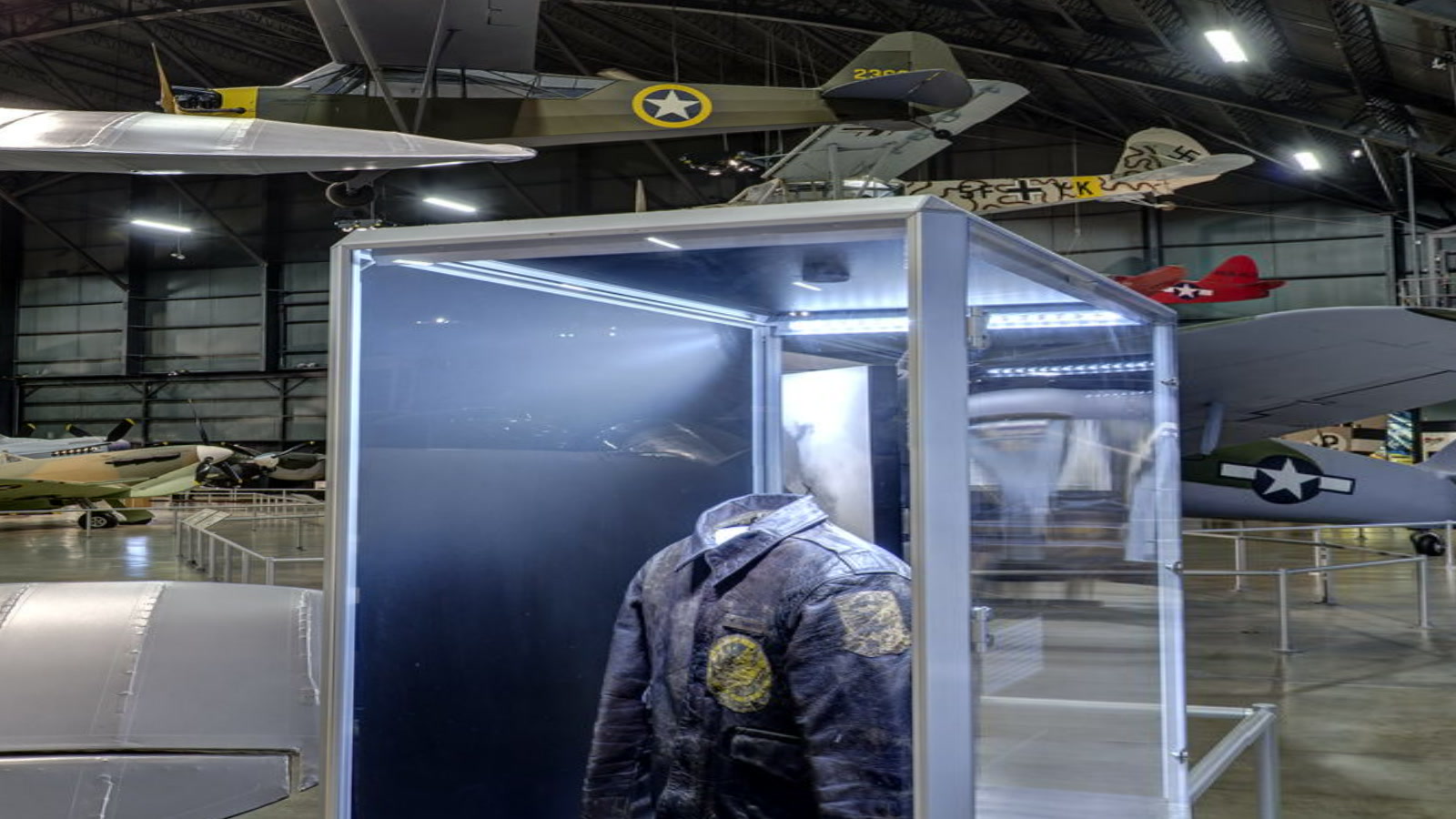
The smaller artifacts deserve attention within that story. A tractor moved aircraft and loads around an airfield. A jacket or oxygen mask helped a crew member function in an exposed environment. A trainer allowed procedures to be practiced without consuming a combat aircraft's life. These objects connect the spectacular mission to repeated daily work. Their history broadens the meaning of service: victory depended on people who built, supplied, repaired, taught, recorded, and cared for others, as well as those whose actions became famous in combat.