Air Force Museum
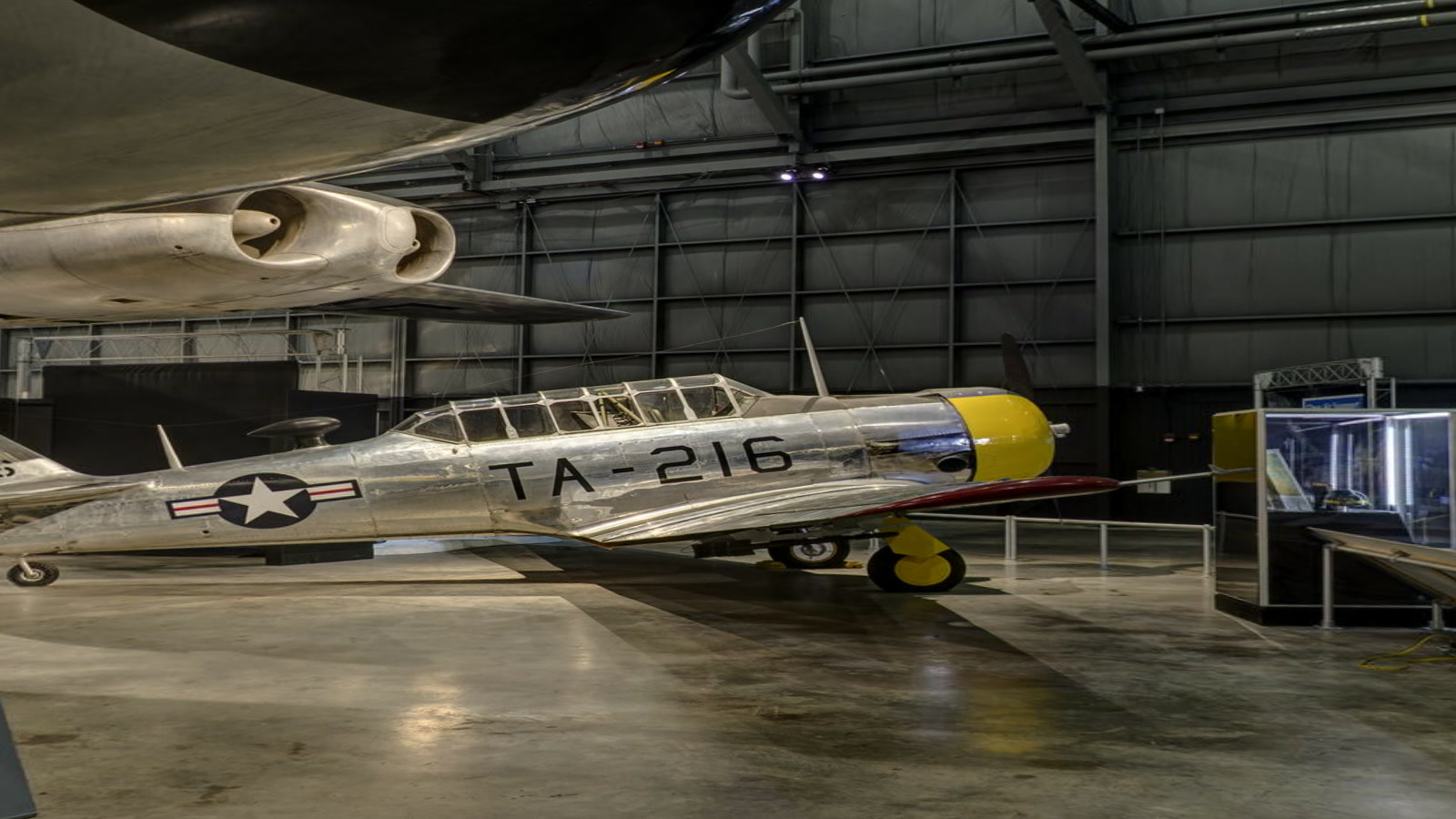
T-6D Mosquito
T-6 Mosquito crews orbited near the front to locate targets and direct fighter-bombers onto them. The propeller-driven trainer was slower than the jets it controlled, but that was an advantage when a crew needed time to observe terrain and communicate with ground forces. Mosquito crews marked targets, often with smoke rockets, and described attack runs by radio.
In depth
The story behind the display
Their work translated a complex landscape into usable instructions. It depended on visual recognition, calm radio procedure, and the ability to remain exposed near the battlefield.
History & service
During the Korean War, airborne forward air controllers (FACs) chose the T-6 as the best available aircraft because it could operate from small, rough airstrips and was easy to maintain. More importantly, the T-6 was faster and more rugged than the light liaison aircraft they initially flew.
Even though this World War II trainer was not designed to fly in combat, it performed well in its role as an airborne FAC (or "Mosquito"). The T-6, originally known as the Texan, was the sole single-engine advanced trainer for the USAAF during WWII, and 15,495 were built between 1938 and 1945. The T-6 continued to train pilots in the newly formed USAF.
The T-6D on display at the museum (S/N 42-84216) flew as an early Mosquito with the 6147th Tactical Air Control Group during the first two years of the Korean War. Ironically, it was converted to a mosquito spraying aircraft in 1952. Two years later, the USAF transferred it to the fledgling Republic of Korea Air Force (ROKAF). After retiring this aircraft, the ROKAF placed it on display outside for several years.
Details that tell the story
Adapted from the North American T-6 trainer · Carried a pilot and observer · Used smoke rockets to mark targets · Directed faster fighter-bombers
The aircraft in figures
Maximum speed: 206 mph · Range: 1,000 miles with a 55-gallon drop tank · Span: 42 ft. · Length: 29 ft. 6 in. · Height: 10 ft. 10 in. · Weight: 5,617 lbs. loaded · Serial number: 42-84216
Air power in a limited war
The Korean War brought early jet combat into the same theater as piston fighters, large bombers, helicopters, and transports. Different technologies served different needs. Fast fighters contested the air, while other aircraft attacked supply routes, supported troops, carried equipment, gathered information, and evacuated casualties. The mountainous terrain and severe weather made those tasks especially demanding.
The conflict also exposed the limits of air power used within a larger political and military struggle. Aircraft could damage bridges and transportation networks, but opposing forces adapted, repaired, dispersed, and moved under cover. Supporting troops required communications and coordination close to the ground. Maintaining operations depended on suitable bases and an extensive flow of supplies.
The surviving artifacts show why a gallery cannot be understood through jet fighters alone. A tent, vehicle, radio, flight nurse's equipment, or rescue helicopter belongs to the same operational history. The stories of individual airmen are compelling because they took place within that complicated setting. Cross-links to the Second World War and later Cold War galleries reveal both continuity and change: familiar aircraft found new roles, jet performance expanded, and rescue systems developed further. The war ended in an armistice, making its history one of service and sacrifice within an unresolved division as well as one of technological change.
