Air Force Museum
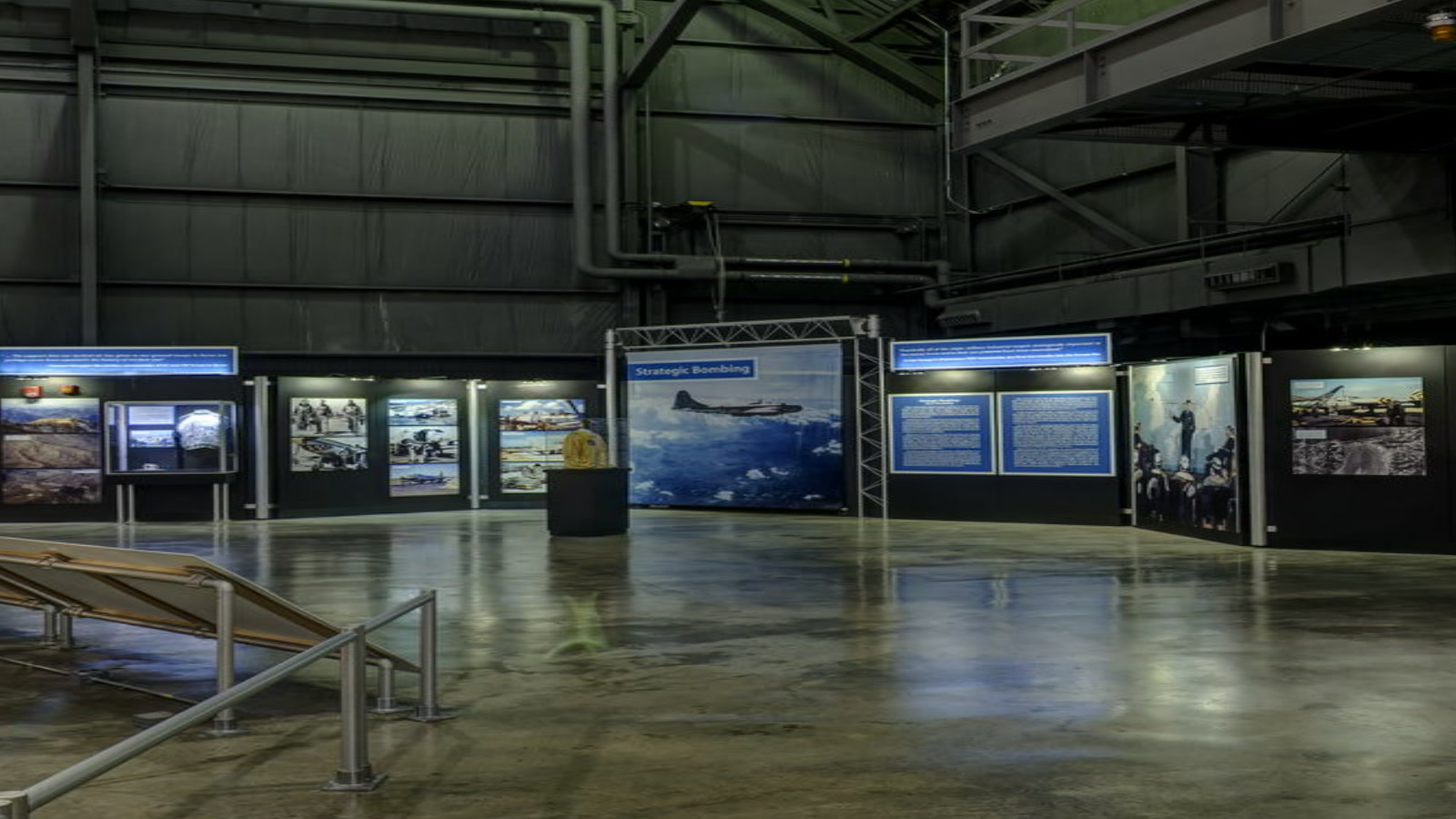
Strategic Bombing
Strategic bombing in Korea targeted industry, transportation, supply systems, and infrastructure while strategy changed with the course of the war. B-29s began with daylight attacks but moved increasingly to night operations after encountering MiG-15s and heavy defenses. Targets included rail yards, bridges, airfields, factories, and power facilities.
In depth
The story behind the display
The campaign demonstrates both the reach and the limits of bombing. Destruction could disrupt movement and production, yet repair, dispersal, concealment, political restrictions, and the resilience of people and systems complicated its effects.
History & service
1917 also saw the Italian bomber come into its own as an important and effective weapon. As production of new aircraft increased, additional squadrons were equipped, trained and deployed against the Austro-Hungarians. The first night raids were conducted in early January and soon became a regular practice. Daylight and night missions of 30 and more Capronis became common, and targets, more and more frequently, were chosen for their strategic importance.
Shipyards and docks at Trieste and Pola were badly damaged in a series of attacks, for example, and attacks were made on targets as distant as Fiume and Vienna.
Gianni Caproni, not content to design and build his successful series of bomber aircraft, made serious efforts to develop and advocate a viable doctrine for their employment in combat. In a series of letters and memoranda to leaders of the Allies, he provided a well developed rationale for bombing such enemy targets as industrial plants, port facilities, railway bridges, junctions and marshaling yards, as a means of eliminating an enemy's capability to sustain a war effort.
Naturally he offered the Caproni 3-engine bomber as the ideal aircraft for the task. In point of fact, it was the only bomber the Allies had during 1916 and 1917 that was being produced in sufficient numbers and possessing the necessary performance to sustain an intensive bombing campaign. There is considerable evidence that Caproni's effort had substantial influence on the U.S. decision to undertake production of Caproni bombers as a major element of the U.S. war effort.
And in fact, a Liberty engine powered version was put into production in the United States, but only five had been produced before the war ended and production was halted.
Details that tell the story
B-29s carried much of the heavy-bomber mission · Operations shifted increasingly to night · Targets included transportation and industrial systems · Results were shaped by repair, dispersal, defenses, and political limits
Air power in a limited war
The Korean War brought early jet combat into the same theater as piston fighters, large bombers, helicopters, and transports. Different technologies served different needs. Fast fighters contested the air, while other aircraft attacked supply routes, supported troops, carried equipment, gathered information, and evacuated casualties. The mountainous terrain and severe weather made those tasks especially demanding.
The conflict also exposed the limits of air power used within a larger political and military struggle. Aircraft could damage bridges and transportation networks, but opposing forces adapted, repaired, dispersed, and moved under cover. Supporting troops required communications and coordination close to the ground. Maintaining operations depended on suitable bases and an extensive flow of supplies.
The surviving artifacts show why a gallery cannot be understood through jet fighters alone. A tent, vehicle, radio, flight nurse's equipment, or rescue helicopter belongs to the same operational history. The stories of individual airmen are compelling because they took place within that complicated setting. Cross-links to the Second World War and later Cold War galleries reveal both continuity and change: familiar aircraft found new roles, jet performance expanded, and rescue systems developed further. The war ended in an armistice, making its history one of service and sacrifice within an unresolved division as well as one of technological change.
