Air Force Museum
Chosin Reservoir
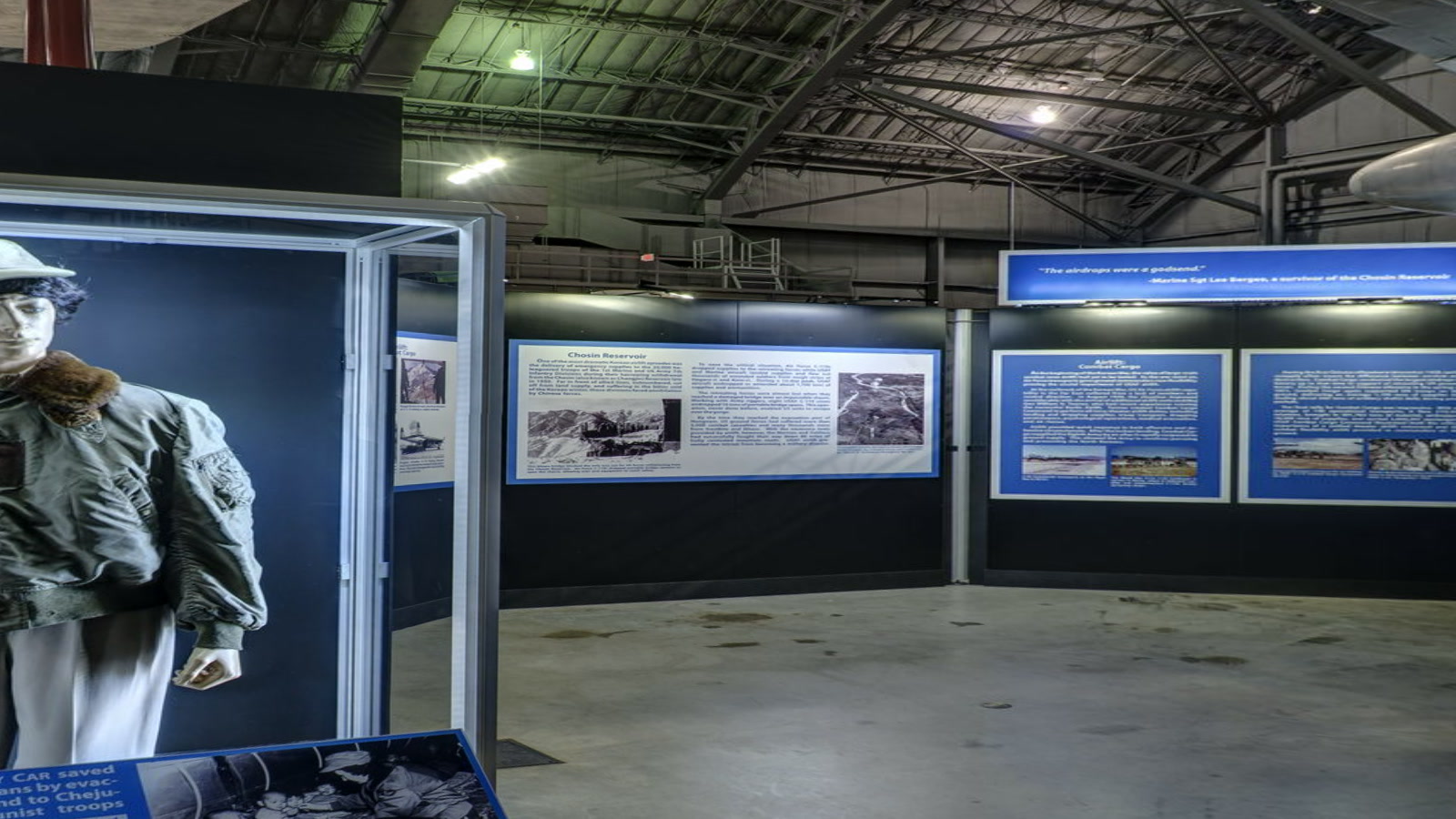
During the Chosin Reservoir campaign, air support, resupply, evacuation, and an emergency bridge airdrop helped forces withdraw through extreme cold. United Nations troops around the reservoir faced Chinese forces, mountainous terrain, and temperatures that affected weapons, vehicles, aircraft, and people. Marine, Navy, and Air Force aircraft attacked enemy positions, delivered supplies, and evacuated casualties from small airstrips.
In depth
The story behind the display
When a destroyed bridge blocked the withdrawal route, C-119 crews dropped portable bridge sections by parachute. Engineers assembled the spans, demonstrating how airlift could solve a precise ground problem only through detailed planning and cooperation.
History & service
One of the most dramatic Korean airlift episodes was the supply of the 20,000 beleaguered troops of the 1st Marine and U.S. Army 7th Infantry Divisions during their harrowing retreat from the Chosin (also known as Changjin) Reservoir late in 1950. Far in front of allied lines, outnumbered, cut off from land supply and suffering in the bitter cold of the Korean winter, these divisions faced annihilation by Chinese forces.
To ease the critical situation, Air Force C-119s dropped supplies to the retreating forces while USAF and Marine C-47s landed supplies and flew out thousands of wounded soldiers from rough strips at Hagaru-ri and Koto-ri. During a 12-day peak, USAF aircraft airdropped or airlanded about 1,700 tons of supplies and ammunition.
The retreating forces were almost lost when they reached a damaged bridge over an impassable chasm. Working with Army riggers, eight USAF C-119 crews airdropped 16 tons of portable bridge spans. This operation, never done before, enabled US units to escape over the gorge.
By the time they reached the evacuation port of Hungnam, U.S. ground forces had suffered more than 5,000 combat casualties and many thousands more from frostbite and illness. With the necessary tools provided by airlift, however, the Marines and soldiers had successfully fought their way down 80 miles of hotly contested mountain roads. USAF airlift prevented the retreat from becoming a military disaster.
Details that tell the story
Campaign fought in extreme winter conditions · Aircraft provided close support, supply, and evacuation · C-119s airdropped portable bridge sections · Engineers assembled the bridge to support the withdrawal
Air power in a limited war
The Korean War brought early jet combat into the same theater as piston fighters, large bombers, helicopters, and transports. Different technologies served different needs. Fast fighters contested the air, while other aircraft attacked supply routes, supported troops, carried equipment, gathered information, and evacuated casualties. The mountainous terrain and severe weather made those tasks especially demanding.
The conflict also exposed the limits of air power used within a larger political and military struggle. Aircraft could damage bridges and transportation networks, but opposing forces adapted, repaired, dispersed, and moved under cover. Supporting troops required communications and coordination close to the ground. Maintaining operations depended on suitable bases and an extensive flow of supplies.
The surviving artifacts show why a gallery cannot be understood through jet fighters alone. A tent, vehicle, radio, flight nurse's equipment, or rescue helicopter belongs to the same operational history. The stories of individual airmen are compelling because they took place within that complicated setting. Cross-links to the Second World War and later Cold War galleries reveal both continuity and change: familiar aircraft found new roles, jet performance expanded, and rescue systems developed further. The war ended in an armistice, making its history one of service and sacrifice within an unresolved division as well as one of technological change.
