Air Force Museum
Life in Korea
Daily service in Korea unfolded through cold, heat, mud, dust, tents, improvised facilities, long shifts, and separation from home. The operational story depended on people maintaining aircraft, building runways, forecasting weather, preparing food, handling fuel and ammunition, operating communications, treating patients, and protecting bases. Their work continued whether or not a combat mission drew public attention.
In depth
The story behind the display
Photographs, letters, uniforms, tools, field equipment, and oral histories preserve the texture of that life. They show how humor, routine, fatigue, friendship, fear, and adaptation existed alongside the larger movements of the war.
History & service
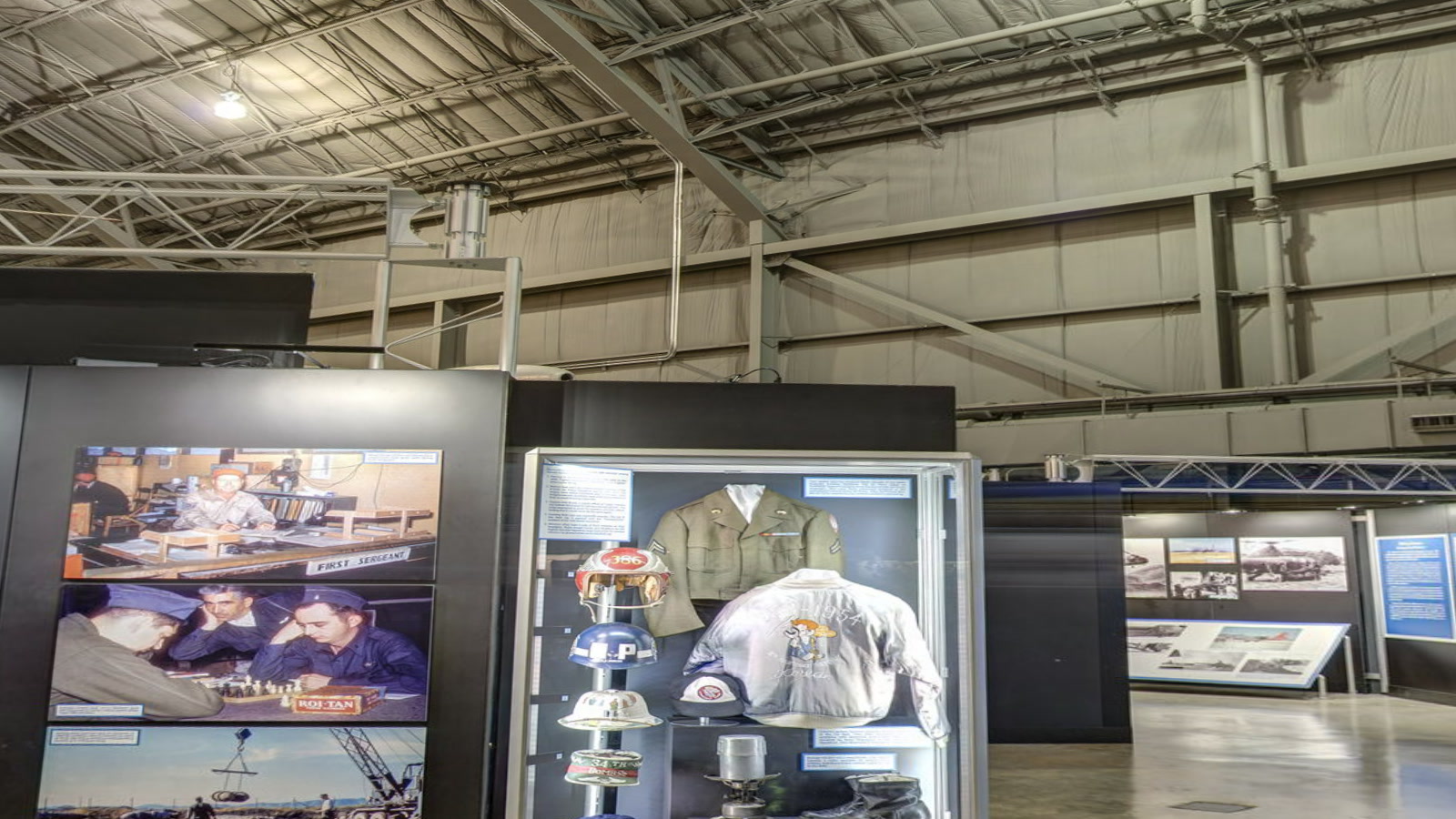
Life on the K-bases remained fairly basic throughout the Korean War. USAF personnel generally lived in tents with wooden or concrete floors and stored their meager possessions in furniture cobbled together from scrap wood or crates. These tents were blistering hot in the summer and freezing cold in the winter. The vast unpaved areas on air bases were dusty when dry, and they turned to mud with spring rains.
While aircrews did their best to fight boredom between tension-filled missions, maintenance personnel worked long hours in poor weather conditions to keep worn and damaged aircraft in service.
Korean winters were notoriously cold. Robert Loomis, a radio operator on mobile transmitters, had these boots custom-made for use in the field.
Col. F.S. Kamykowski, 6131st Maintenance and Supply Group, used this arctic survival kit stove to heat canned rations and provide warm water for shaving and washing.
Ike jacket worn by Cpl. Edwin Stangle of the 809th Engineer Aviation Battalion. The Air Force relied on SCARWAF (Special Category Army Personnel with Air Force) engineers, who were Army personnel assigned to the operational control of the Air Force. After the Korean War, the Air Force created its own units for airfield engineering.
In theater, US armed forces personnel used MPCs -- Military Payment Certificates -- instead of actual US money in order to protect the local currency and discourage the black market. These MPCs could be exchanged for US currency when a service member returned to the States.
Personalized artwork on headgear was common among Airmen during the Korean War.
1. Painting field caps was especially popular. The top of this field cap is painted with the "Thunderbirds" emblem of the 34th Bomb Squadron.
2. Helmet liner worn by Corporal Robert Johnson of the 6154th Air Police Squadron during 1951-1952. The stripes were added sometime later in his tour--rank insignia was not commonly used while close to the front lines to avoid drawing sniper fire.
Details that tell the story
Personnel worked from permanent bases and temporary facilities · Seasonal weather ranged from severe cold to heat and monsoon rain · Ground-support specialties sustained every flying mission · Personal records add experiences often absent from operational reports
Air power in a limited war
The Korean War brought early jet combat into the same theater as piston fighters, large bombers, helicopters, and transports. Different technologies served different needs. Fast fighters contested the air, while other aircraft attacked supply routes, supported troops, carried equipment, gathered information, and evacuated casualties. The mountainous terrain and severe weather made those tasks especially demanding.
The conflict also exposed the limits of air power used within a larger political and military struggle. Aircraft could damage bridges and transportation networks, but opposing forces adapted, repaired, dispersed, and moved under cover. Supporting troops required communications and coordination close to the ground. Maintaining operations depended on suitable bases and an extensive flow of supplies.
The surviving artifacts show why a gallery cannot be understood through jet fighters alone. A tent, vehicle, radio, flight nurse's equipment, or rescue helicopter belongs to the same operational history. The stories of individual airmen are compelling because they took place within that complicated setting. Cross-links to the Second World War and later Cold War galleries reveal both continuity and change: familiar aircraft found new roles, jet performance expanded, and rescue systems developed further. The war ended in an armistice, making its history one of service and sacrifice within an unresolved division as well as one of technological change.
