Air Force Museum
Willy Quarter Ton Jeep
The jeep, first used by the U.S. military during World War II, was an all-purpose vehicle for reconnaissance and cross-country travel. Development began in the 1920s, and in 1940 the Army Quarter Master General invited bids on a 1/4-ton four-wheel-drive truck. After testing models submitted by the American Bantam Co., Willys-Overland Motors and the Ford Motor Co., the Army chose the Willys design.
In depth
History & service
The jeep, first used by the U.S. military during World War II, was an all-purpose vehicle for reconnaissance and cross-country travel. Development began in the 1920s, and in 1940 the Army Quarter Master General invited bids on a 1/4-ton four-wheel-drive truck. After testing models submitted by the American Bantam Co., Willys-Overland Motors and the Ford Motor Co., the Army chose the Willys design. More than 639,000 jeeps were built by Willys and Ford during WWII.
Although the origin of the jeep's name is obscure, many believe that it was an abbreviation for general purpose vehicle. The jeep had a four-cylinder 60-hp engine and weighed 2,200 pounds. It had both two- and four-wheel drive, six forward speeds and two reverse speeds, and a top speed of 55 mph. In addition to its usefulness as a cross-country vehicle, the versatile jeep could be adapted to pump air or water; pull anti-tank guns, howitzers or even plows; haul a 1/2-ton load; or even ford streams or flooded areas in water up to 40 inches deep.
The vehicle on display was built in 1952 and transferred to the museum in 1963.
The second front was the factory and the flight line
Air power required far more than aircraft leaving a factory. Engines, radios, weapons, fuel, spare parts, tools, trained personnel, and suitable airfields had to arrive together. A machine grounded by a missing component could contribute little, however impressive its specifications. Maintenance and supply determined how much of a force was actually available on a given day.
The Second World War made this relationship visible on an extraordinary scale. Production expanded while aircraft designs continued to change. Training organizations had to turn large numbers of recruits into competent aircrew and specialists. Units then operated in climates and conditions very different from those in which the machines had been designed. Improvisation on the flight line worked alongside formal technical orders and a vast replacement system.
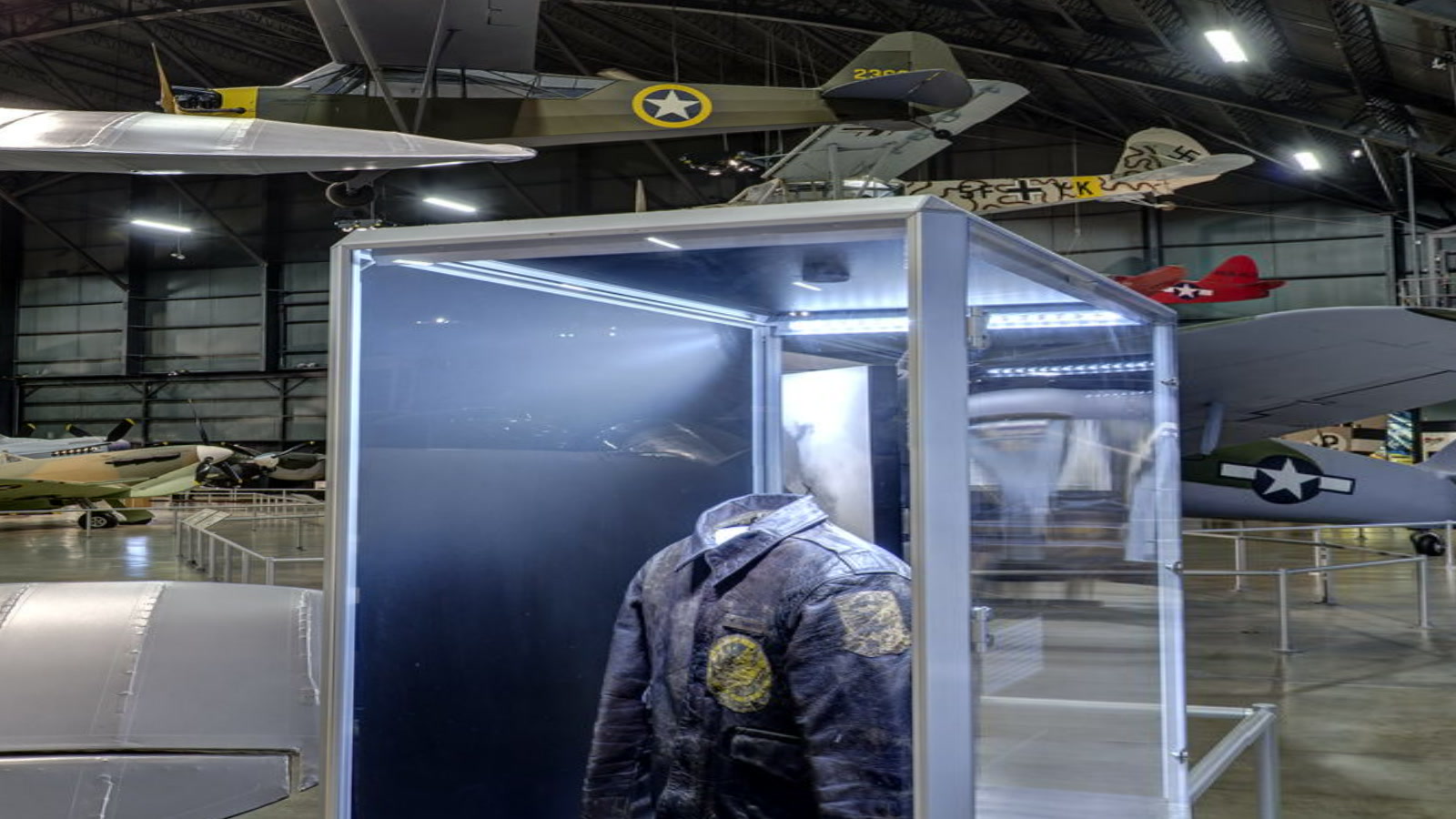
The smaller artifacts deserve attention within that story. A tractor moved aircraft and loads around an airfield. A jacket or oxygen mask helped a crew member function in an exposed environment. A trainer allowed procedures to be practiced without consuming a combat aircraft's life. These objects connect the spectacular mission to repeated daily work. Their history broadens the meaning of service: victory depended on people who built, supplied, repaired, taught, recorded, and cared for others, as well as those whose actions became famous in combat.