Air Force Museum
X-3
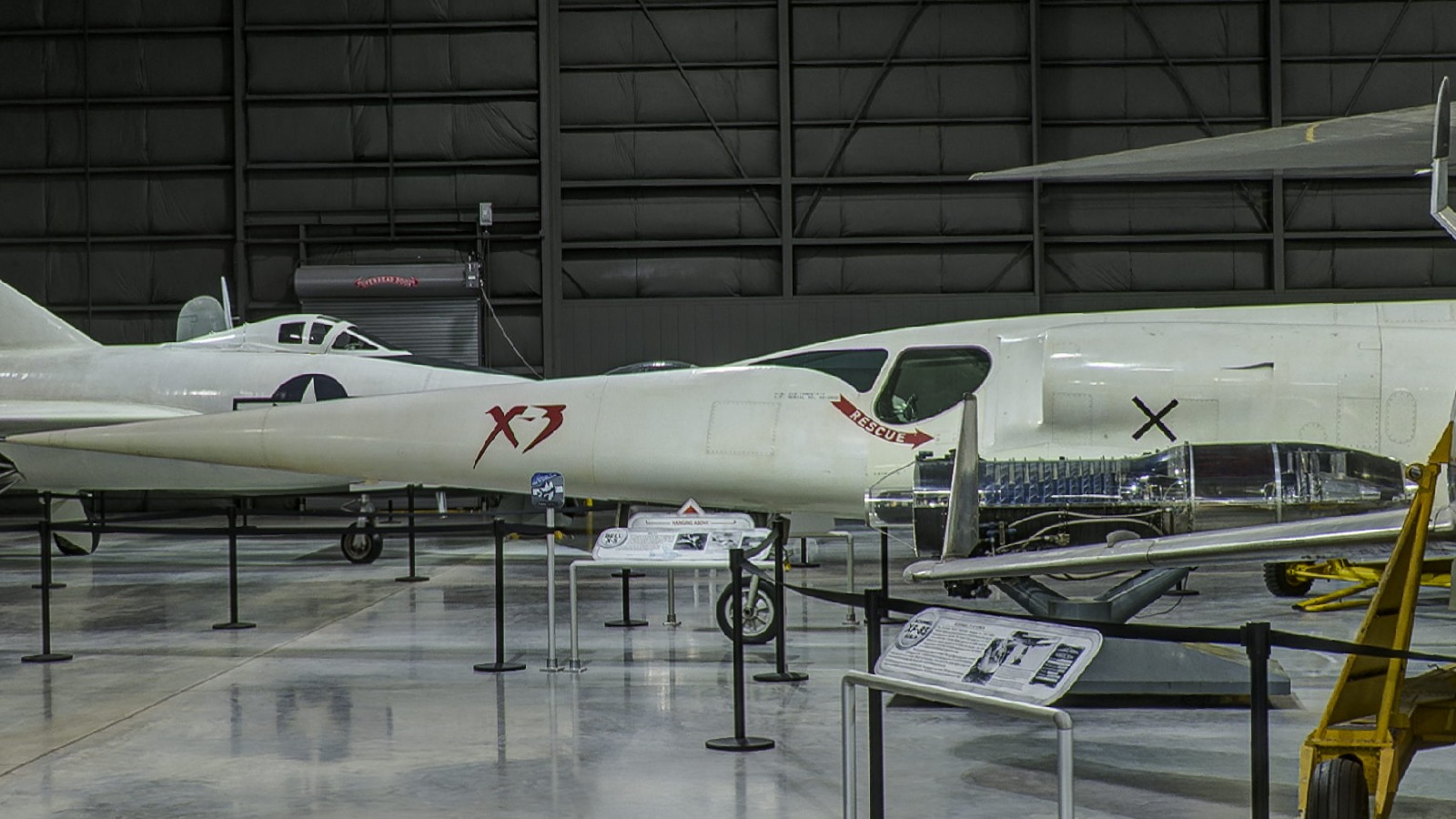
The Douglas X-3 Stiletto never achieved its intended Mach 2 performance in level flight, but its unusual shape and flight behavior produced valuable research. The X-3 was built to investigate sustained supersonic flight with a long pointed fuselage, very small wings, and extensive use of titanium. Its engines did not deliver enough thrust for the original goal, and the aircraft's maximum speed in level flight was about 650 miles per hour.
In depth
The story behind the display
The program nevertheless exposed dangerous roll-coupling behavior: at high speed, a control input around one axis could trigger violent motion around the others. Data from the X-3 influenced later aircraft including the F-104 and contributed to research associated with the X-15 and SR-71.
History & service
The twin-turbojet X-3, the only one built, was designed to test sustained flight at twice the speed of sound. It also explored the use of very short wings and titanium airframe construction.
Engine development difficulties forced the use of lower-powered engines than originally planned, prohibiting the X-3 from achieving its Mach 2 design potential. Even so, data gained from the X-3 program greatly benefited the F-104, X-15, SR-71 and other high performance aircraft.
The X-3 made its first test flight at Edwards Air Force Base, Calif., in October 1952. The X-3 was transferred to the museum in 1956.
Details that tell the story
Only one X-3 was completed · First test flight occurred in October 1952 · Designed to study sustained supersonic flight · Research helped explain high-speed roll-coupling behavior
The aircraft in figures
Engines: Two Westinghouse J34s of 3,370 lbs. thrust each (4,900 lbs. thrust with afterburner) · Maximum speed: 650 mph (level flight), but designed for Mach 2 · Service ceiling: 38,000 feet · Wingspan: 22 feet, 8 inches · Length: 66 feet, 10 inches · Weight: 22,400 lbs. maximum
Keeping people alive beyond the atmosphere
A crewed spacecraft carries a small, controlled environment into a place that cannot support unprotected human life. Pressure, temperature, oxygen, carbon dioxide removal, water, electrical power, and waste management all become engineering responsibilities. The flight suit or capsule displayed in a museum is therefore part of a larger life-support system, not simply clothing or a vehicle body.
Early missions established capabilities in stages. Launch and recovery, orbital flight, longer duration, maneuvering, rendezvous, and work outside a spacecraft each introduced different demands. Ground controllers, tracking stations, medical teams, recovery forces, and manufacturers supported the crew. A successful mission depended on that network as much as on the people visible in the cabin.
Artifacts preserve evidence of those demands at a human scale. A small hatch suggests the difficulty of entering or leaving in bulky equipment. A glove makes clear that pressure protection can restrict dexterity. The shape of a returning capsule reveals the importance of managing atmospheric heating and deceleration. Connections to high-altitude aviation are especially strong: pressure suits, research aircraft, and instrumented test flights helped build knowledge that spacecraft designers could use. The history is a sequence of carefully developed capabilities, with extraordinary journeys resting on many ordinary systems that had to keep working together.