Udvar-Hazy
Langley Aerodrome A
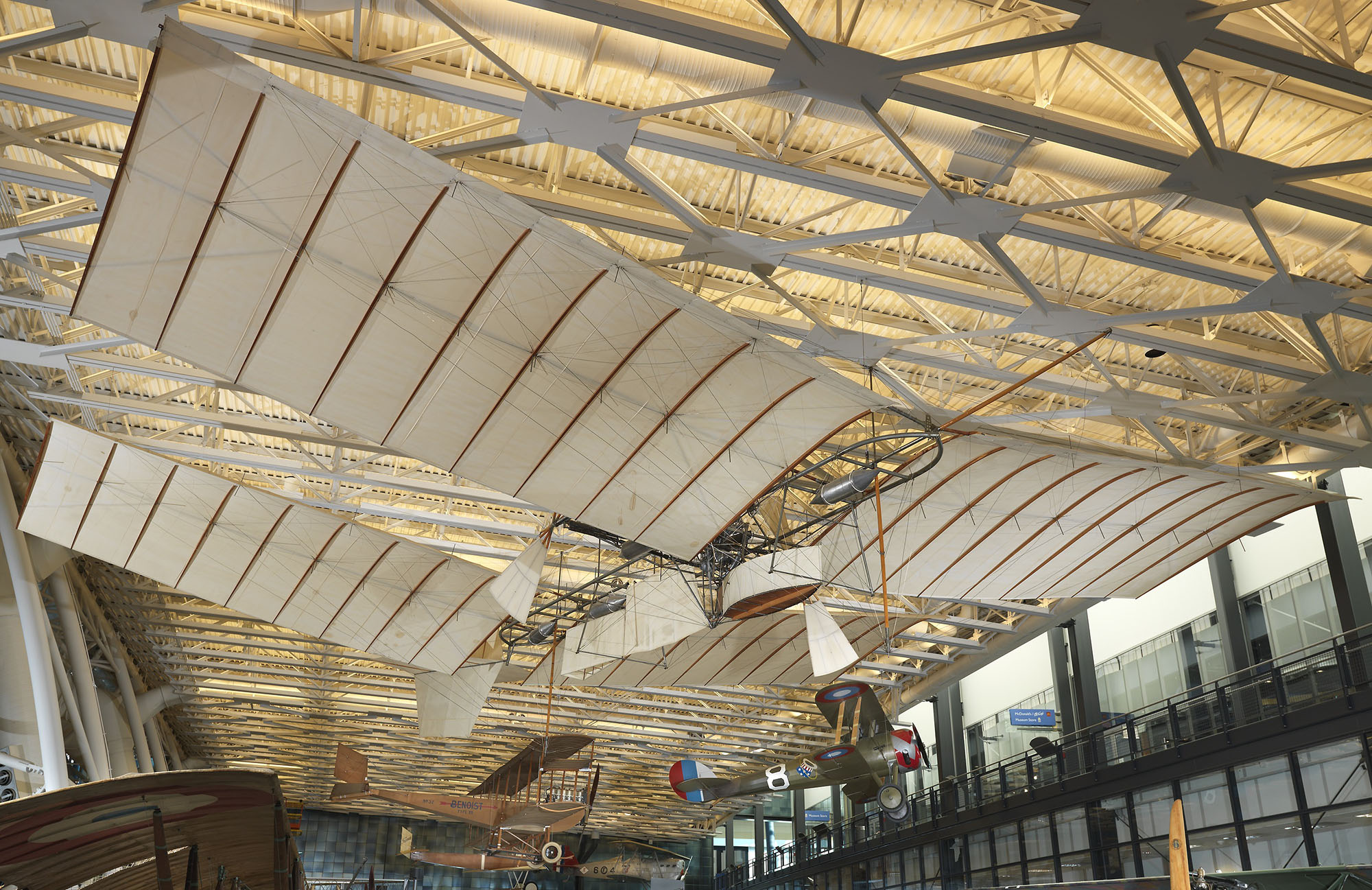
Samuel Langley tried to turn successful model airplanes into a machine large enough to carry a person. His Aerodrome had an impressive engine, but its two launch attempts in 1903 ended in the Potomac River. The Wright brothers flew successfully just days after the second attempt. These events show how difficult powered flight really was: a strong engine was not enough. Structure, balance, control, and the method of getting airborne all had to work together.
In depth
Success at one scale, failure at another
Langley’s unpiloted Aerodrome models flew successfully in 1896, giving him reason to pursue a full-size aircraft. The larger project required more than simply increasing every dimension. Loads, weight, structural stiffness, and control requirements do not scale in identical ways.
The project produced a notable water-cooled, five-cylinder radial engine. That achievement addressed the need for useful power without excessive weight. Yet a successful component does not automatically produce a successful aircraft. The machine still needed to survive launch and sustain controlled flight.
Two launches into the river
On October 7 and December 8, 1903, the Aerodrome failed during launch attempts from a houseboat on the Potomac. The second failure occurred nine days before the Wright brothers’ successful flights at Kitty Hawk. Langley attributed the failures to the launching apparatus, but the aircraft also had serious structural and aerodynamic shortcomings.
The contrast with the Wrights is especially revealing. Their development emphasized a controllable flying system, informed by glider experience and systematic testing. Langley’s powerful engine could not compensate for weaknesses elsewhere in his aircraft.
Failure can preserve useful evidence
The Aerodrome makes a complicated idea visible: engineering success is a property of the whole system. Strength in one component may be overwhelmed by the failure of another. Launching equipment, pilot control, structure, and propulsion all participate in the outcome.
In the panorama, trace the long, lightly built structure and the separation of its lifting surfaces. Then follow the connection to the Wright Flyer. Comparing the two is more illuminating than simply placing a winner beside a loser. They embody different paths through a problem whose solution had not yet become obvious.