Udvar-Hazy
Monocoupe 110 Special Little Butch
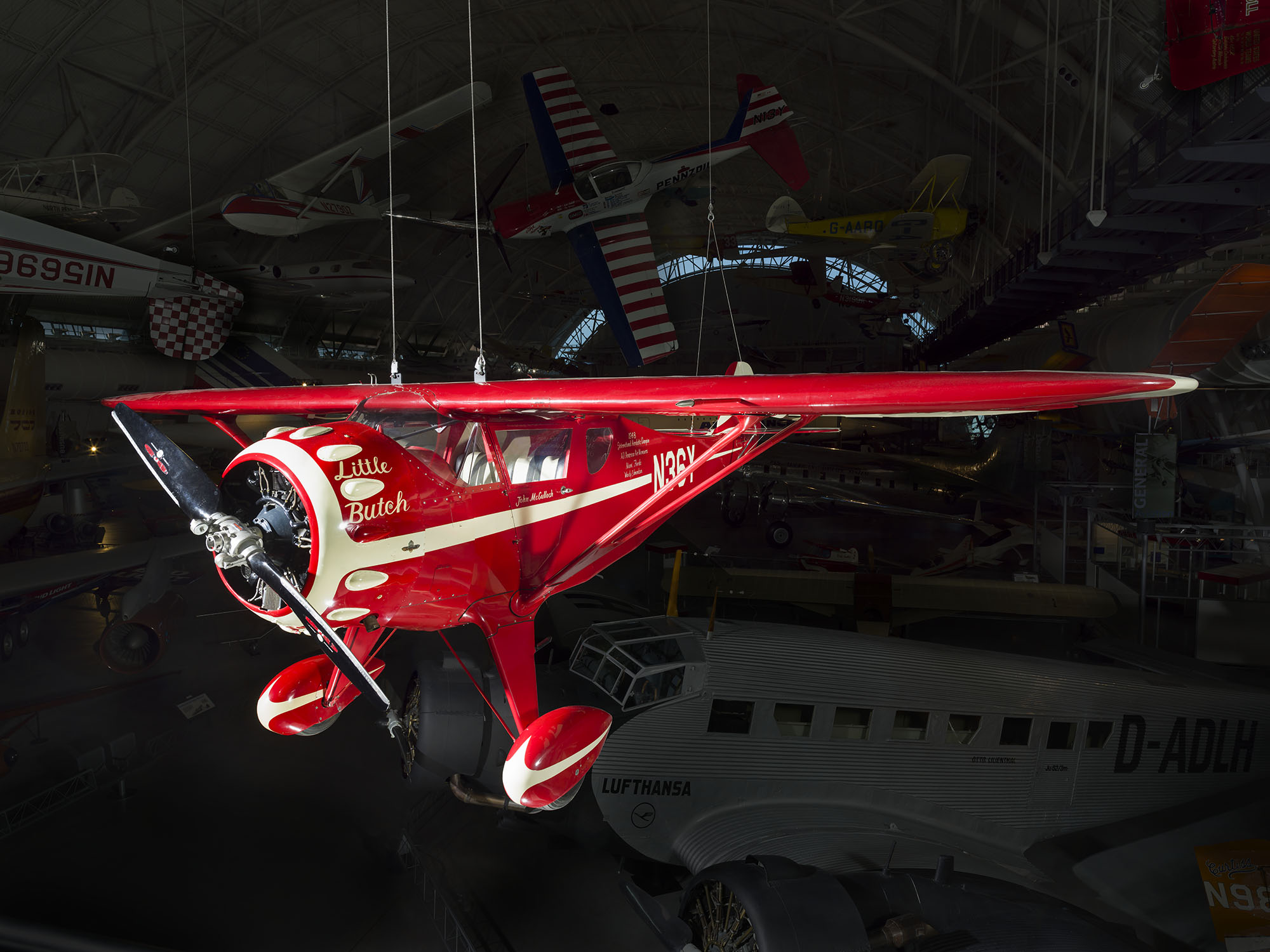
Woody Edmondson called this compact Monocoupe Little Butch because of its bulldog-like appearance. Its shortened wings helped turn a sporting aircraft into an agile aerobatic performer. After finishing behind Bevo Howard in two American championships, Edmondson won the 1948 International Aerobatic Championship. Little Butch belongs to an era when a distinctive airplane and a memorable pilot could become stars together.
In depth
A sport airplane sharpened for competition
The Monocoupe family offered compact, enclosed aircraft with a strong sporting identity. The 110 Special shortened the wings of the basic design, producing a machine suited to rapid maneuvering and air-show work.
Shortening a wing changes more than appearance. It can reduce resistance to rolling, but also changes wing loading and low-speed behavior. A modification attractive to an experienced aerobatic pilot may make an aircraft more demanding in other parts of flight. The result has to be judged as a whole, not by agility alone.
Rivalry gives the airframe a personality
W. W. “Woody” Edmondson placed second to Bevo Howard in the 1946 and 1947 American aerobatic championships before winning the first International Aerobatic Championship in 1948. Howard’s Jungmeister is also represented in this collection, allowing visitors to compare the aircraft behind a genuine competitive relationship.
Little Butch’s nickname made the machine easy to remember. Its short span and compact body give the description some visual force, but the lasting reputation came from what Edmondson did with it before an audience.
A different route to aerobatic performance
Set the Monocoupe beside the Pitts and Jungmeister. Its enclosed cabin and high-wing monoplane arrangement differ from the open-cockpit biplanes, yet all served pilots pursuing precise control through dramatic attitudes.
Ken Hyde restored Little Butch before its donation to the museum. Preservation lets the aircraft retain both its technical identity and its place in the culture of air shows. The story is not only about a design category; it is about competitors learning their machines deeply enough to turn mechanical response into a recognizable style of flying.