Presence opens the door.
Panoramic scale and spatial sound can establish place quickly. That sense of arrival is useful, but it is an introduction rather than an outcome.
Research notebook · museum science · instructional design
Spatial capture can preserve a room, reveal its geometry, and offer a new point of view. The research question is harder: when does that freedom help someone understand what the room contains?
01 / The question
A spatial model can produce an immediate sense of presence. Without evidence, story, comparison, and a reason to look closely, that first impression can quickly become the whole experience.
Three-dimensional reconstruction works best as a stage for inquiry—not as the lesson itself.
02 / Prototype lab
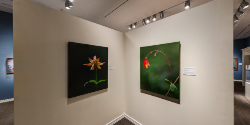
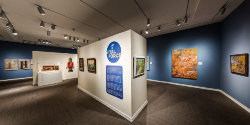
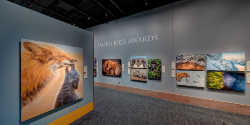
Both experiments place panoramic imagery onto depth or mesh information so the viewer can move beyond a fixed camera point. The rebuilt shell removes the obsolete controls while preserving every recorded viewpoint.
Connected-room study
A linked reconstruction tests movement between camera positions and a detached spatial view of several gallery rooms.
Experimental archival software may require a modern browser with WebGL. The studies are preserved as research artifacts; visual gaps in detached spatial views reveal the limits of the source geometry.
03 / What the tests revealed
Panoramic scale and spatial sound can establish place quickly. That sense of arrival is useful, but it is an introduction rather than an outcome.
Free movement adds cognitive work. Maps, named viewpoints, guided routes, and dependable reset controls help the learner form a mental model.
Objects, labels, photographs, and architectural details require visible prompts. Hidden polygons and unexplained hotspots make important material easy to miss.
Exploration becomes more productive when learners can pursue a question, compare sources, or follow a short interpretive path without losing the freedom to wander.
A complete experience needs keyboard operation, readable text, motion controls, captions, transcripts, and a meaningful non-spatial path through the same content.
The useful measure is not whether a model looks impressive. It is whether people can find, interpret, remember, and apply what the museum wants to share.
04 / An evolving toolkit
Excellent image quality, efficient streaming, and faithful visual documentation. Movement occurs between selected viewpoints.
Useful for:gallery records, remote visits, close looking, linked interpretation
A navigable surface can support measurement, detached views, and object or room-scale inspection. Reflective, transparent, and hidden surfaces remain difficult.
Useful for:objects, architecture, context, conservation reference, spatial relationships
Systems such as Matterport combine cameras or phone capture with automated alignment, spatial data, a dollhouse view, annotations, and guided tours.
Useful for:repeatable production, remote access, facilities, standard documentation workflows
NeRF represents a scene with a neural network optimized from posed images, enabling new viewpoints without requiring a conventional textured mesh.
Useful for:view synthesis research, complex appearance, captured scenes
Optimized 3D Gaussians provide an explicit scene representation and fast, high-quality novel-view rendering. Capture coverage and delivery size still matter.
Useful for:photorealistic objects and places, free-viewpoint presentation, spatial media research
Haptics and other sensory channels can make relationships perceptible in new ways, but they require careful testing, accessible alternatives, and a clear learning purpose.
Useful for:tactile form, embodied procedures, access research, guided simulation
05 / Continuing questions
Acknowledgment
These independent experiments were made possible by access to museum spaces and collections. With thanks to the Museum of the Shenandoah Valley and the Smithsonian Institution. Their inclusion here does not imply sponsorship or endorsement.
Sources