Air Force Museum
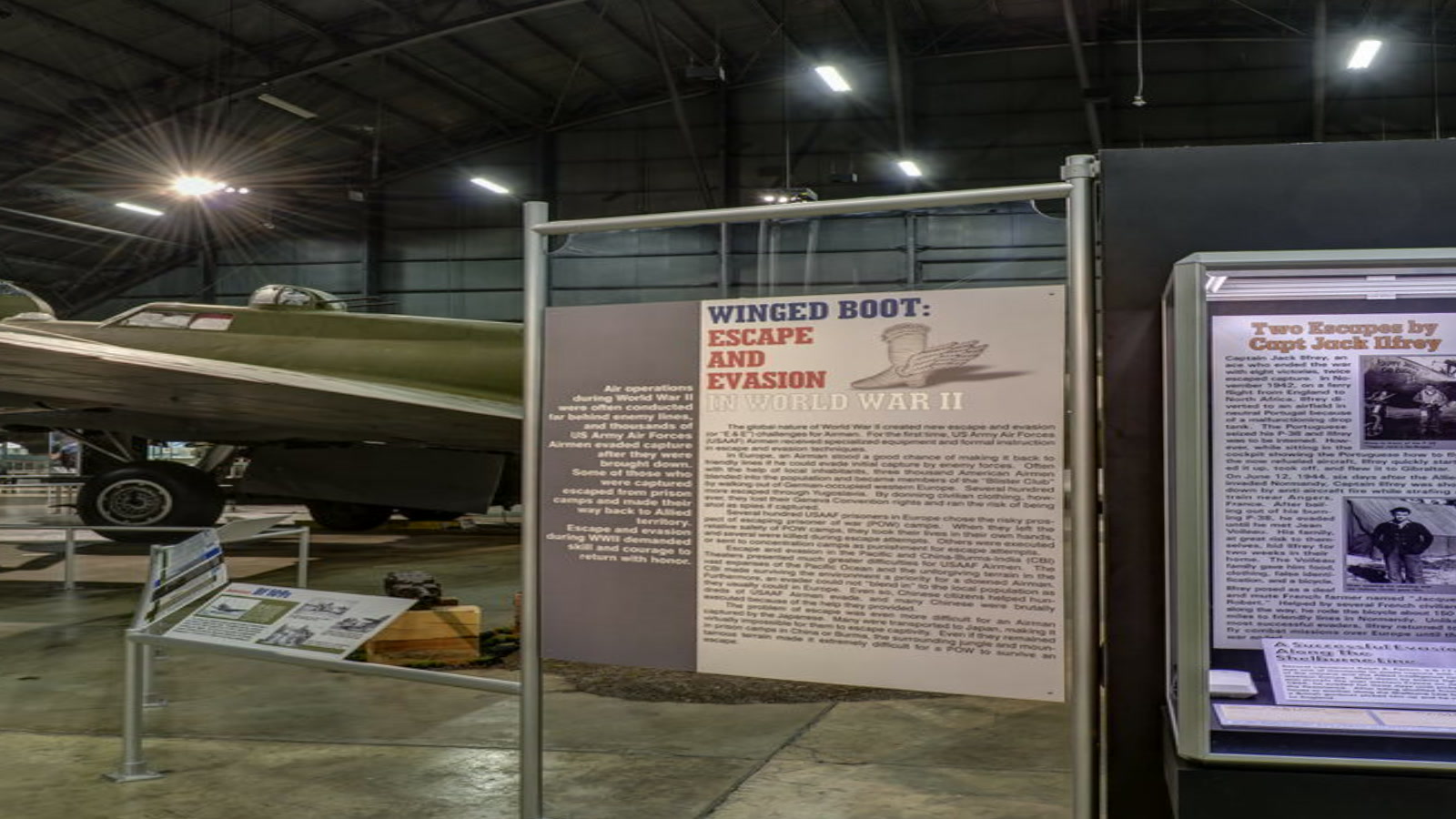
Winged Boot: Escape and Evasion in World War II
The winged boot symbolized a successful return after escaping from enemy territory, often with the help of civilians and resistance networks. Downed aircrew carried maps, compasses, currency, and other escape aids, but equipment alone rarely brought someone home. Evaders depended on local people who offered shelter, clothing, false papers, guides, and routes through occupied territory.
In depth
The story behind the display
A winged boot patch marked an airman's completed escape or evasion. Behind the small emblem stood networks whose civilian participants faced imprisonment, torture, or execution if discovered, making the object a record of shared risk rather than individual adventure alone.
History & service
Air operations during World War II were often conducted far behind enemy lines, and thousands of U.S. Army Air Forces airmen evaded capture after they were brought down. Some of those who were captured escaped from prison camps and made their way back to Allied territory. Escape and evasion during WWII demanded skill and courage to return with honor.
The global nature of World War II created new escape and evasion (or "E & E") challenges for airmen. For the first time, U.S. Army Air Forces (USAAF) airmen received specialized equipment and formal instruction in escape and evasion techniques.
In Europe, an airman stood a good chance of making it back to friendly lines if he could evade initial capture by enemy forces. Often with the help of local inhabitants, three thousand American airmen blended into the population and became members of the "Blister Club" by walking out of German-occupied western Europe. Several hundred more escaped through Yugoslavia. By donning civilian clothing, however, they lost their Geneva Convention rights and ran the risk of being shot as spies if captured.
Several hundred USAAF prisoners in Europe chose the risky prospect of escaping prisoner of war (POW) camps. When they left the relatively safety of POW camps, they took their lives in their own hands, and several were killed during escape attempts. Others were executed or sent to concentration camps as punishment for escape attempts.
Escape and evasion in the Pacific and China-Burma-India (CBI) Theaters presented much greater difficulties for USAAF airmen. The vast expanses of the Pacific Ocean and the unforgiving terrain in the CBI made surviving the environment a priority for a downed airman. Furthermore, an evader could not "blend in" to the local population as they usually could in Europe. Even so, Chinese citizens helped hundreds of USAAF airmen evade, and many Chinese were brutally executed because of the help they provided.
The problem of escape was even more difficult for an airman captured by the Japanese. Many were transported to Japan, making it virtually impossible for them to escape captivity. Even if they remained in prison camps in China or Burma, the surrounding jungle and mountainous terrain made it extremely difficult for a POW to survive an escape.
Details that tell the story
Associated with successful escape or evasion · Aircrew used specialized maps and concealed compasses · Resistance networks organized routes across occupied Europe · Civilian helpers accepted extreme personal danger
The mission was to bring someone home
Rescue and medical evacuation changed the meaning of aviation's reach. Speed could shorten the time between an injury and treatment. Aircraft could cross terrain that made a ground journey slow or impossible. But the ability to reach a person did not guarantee the ability to recover them. Weather, enemy fire, limited landing space, weight, and the patient's condition shaped every decision.
Rescue depended on a chain of people and equipment. Someone had to locate the survivor, communicate the position, assess the danger, provide protection where necessary, and bring a recovery aircraft to the right place. Medical personnel then worked in an environment that could be noisy, cramped, and poorly suited to care. The aircraft's range and payload mattered, but so did preparation, coordination, and judgment.
The personal equipment in these galleries makes that work concrete. A radio could turn a search into a precise approach. Protective clothing could keep a survivor alive long enough to be found. A helicopter could lift someone from a place with no runway. A transport could carry casualties toward a hospital. These connections span civil and military aviation and link the museums through a shared purpose. Heroism here often means accepting risk in order to reduce another person's danger, while relying on a carefully organized team to make the attempt possible.