National Mall
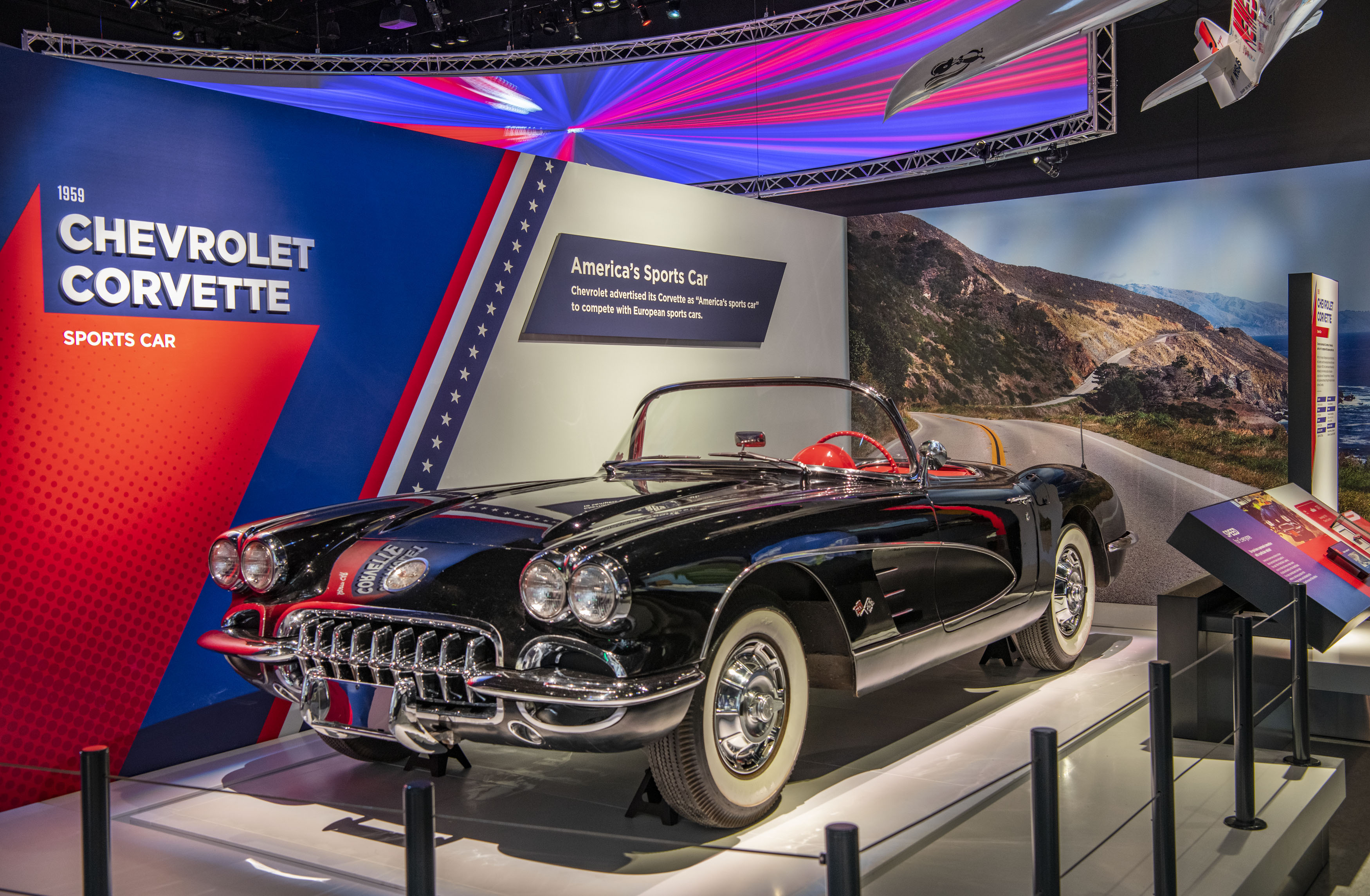
1959 Chevrolet Corvette
Chevrolet promoted the Corvette as an American answer to European sports cars. Its fiberglass body, V-8 engine, and bold shape turned performance into something drivers could recognize on ordinary roads. The Corvette combined engine power, low mass, tires, steering, brakes, structure, and driver position. Top speed mattered, but acceleration, control, durability, and usability determined whether the design worked as a road car.
In depth
Performance is a system, not one number
Introduced in 1953, the Corvette became a durable symbol of American performance culture. Its association with Mercury and Apollo astronauts tied private consumer choice to public images of technical confidence and adventure.
Going beyond the known envelope
Flight testing turns a prediction into evidence. Engineers may calculate how an aircraft should behave, but actual flight brings structures, engines, controls, instruments, weather, and a human operator together. The safest useful test changes conditions deliberately and records enough information to explain what happened. The aim is knowledge, not simply a dramatic number.
Research aircraft often look unusual because they were built to answer a narrow question. A shape that is valuable for studying high-speed flight may be unsuitable for ordinary transport. A rocket engine can reach a demanding test condition but offers only a short powered flight. The carrier aircraft, tracking stations, telemetry, ground crews, and recovery procedures become part of the experiment.
The pilot's contribution is both technical and human. Training makes it possible to recognize a developing problem, follow a planned sequence, and describe behavior that instruments alone may not capture. Courage matters, but so does the discipline to end a test when conditions no longer match the plan. The X-1, X-15, rocket motors, pressure suits, and wind-tunnel equipment connect across museums because they belong to this shared process. Each represents a way of making the unknown smaller so that later aircraft and spacecraft could operate with greater confidence.