National Mall
Sonic Wind Rocket Sled
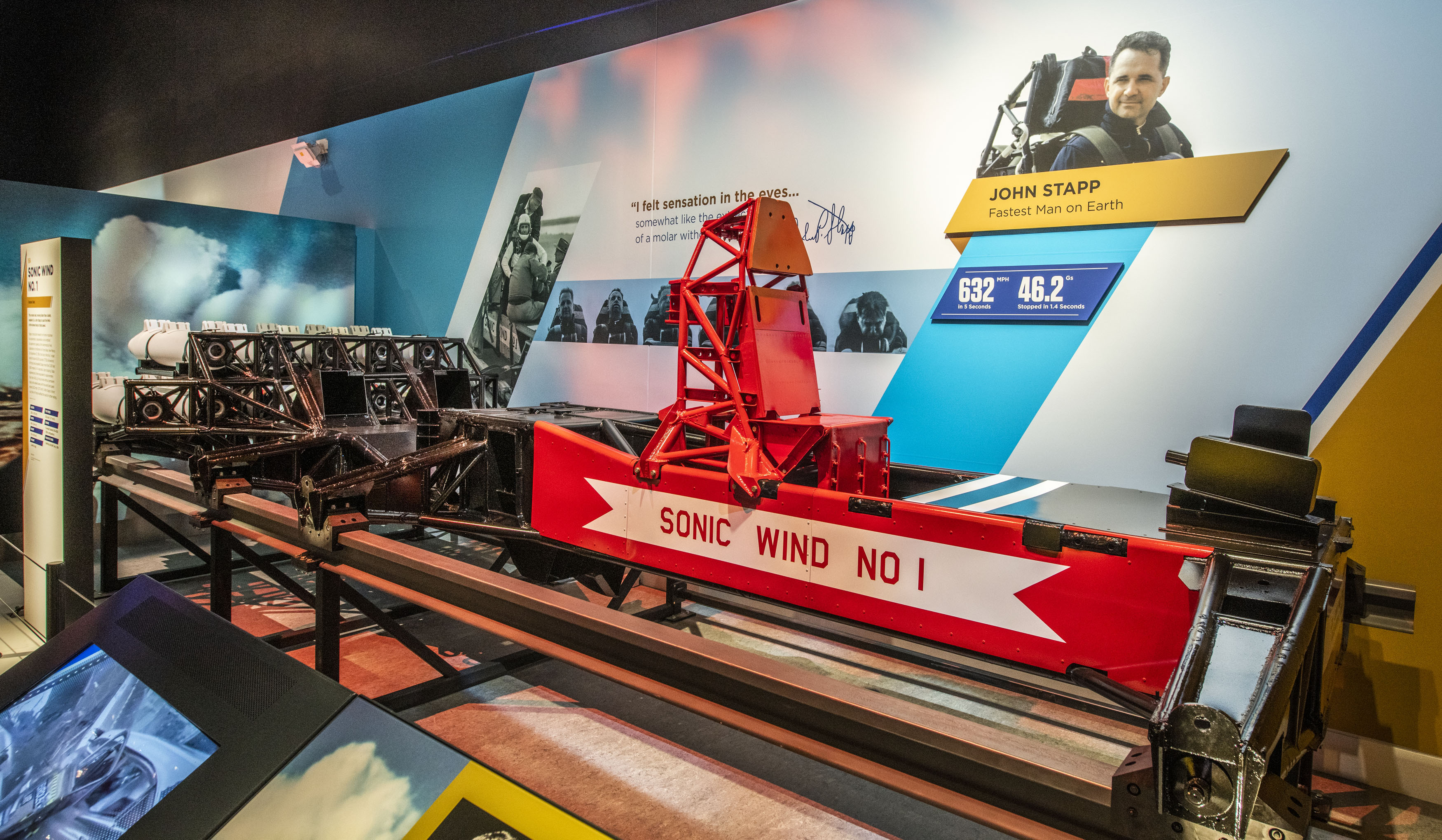
John Stapp rode Sonic Wind No. 1 to study acceleration, deceleration, and windblast. The machine deliberately created extreme forces so researchers could learn how to protect people in aircraft and vehicles. The rockets produced rapid acceleration, but the deceleration system created the largest load on Stapp’s body. Timing, restraint geometry, seat support, instrumentation, and track alignment all had to turn a brief run into reliable evidence.
In depth
The most important event happened during braking
Stapp’s 1954 run joined personal courage to military aeromedical research. Its historical importance lies not only in a speed record but in the attempt to replace assumptions about human tolerance with measured data.
Going beyond the known envelope
Flight testing turns a prediction into evidence. Engineers may calculate how an aircraft should behave, but actual flight brings structures, engines, controls, instruments, weather, and a human operator together. The safest useful test changes conditions deliberately and records enough information to explain what happened. The aim is knowledge, not simply a dramatic number.
Research aircraft often look unusual because they were built to answer a narrow question. A shape that is valuable for studying high-speed flight may be unsuitable for ordinary transport. A rocket engine can reach a demanding test condition but offers only a short powered flight. The carrier aircraft, tracking stations, telemetry, ground crews, and recovery procedures become part of the experiment.
The pilot's contribution is both technical and human. Training makes it possible to recognize a developing problem, follow a planned sequence, and describe behavior that instruments alone may not capture. Courage matters, but so does the discipline to end a test when conditions no longer match the plan. The X-1, X-15, rocket motors, pressure suits, and wind-tunnel equipment connect across museums because they belong to this shared process. Each represents a way of making the unknown smaller so that later aircraft and spacecraft could operate with greater confidence.