Udvar-Hazy
Mother Ship Model "Close Encounters of the Third Kind"
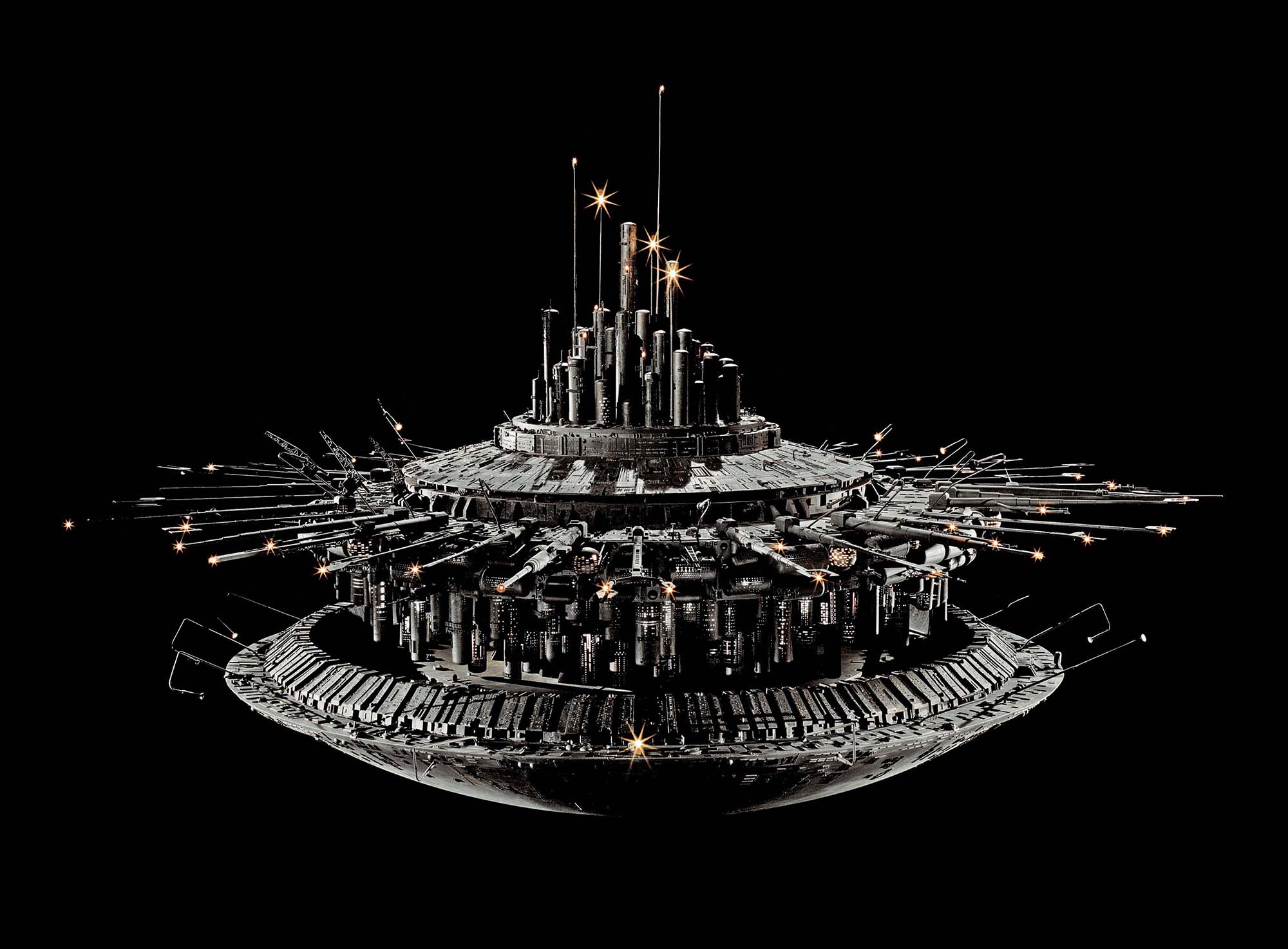
This enormous-looking alien spacecraft began as a physical model for the 1977 film Close Encounters of the Third Kind. Model makers combined lights, miniature structures, and everyday model-kit parts to create the illusion of a vast ship. Tiny jokes are hidden among the details, including a small R2-D2. It never traveled through space, but it helped millions of viewers imagine an encounter beyond Earth—and shows how much skilled craft can go into a moment of movie magic.
In depth
A spacecraft built for the camera
Steven Spielberg’s Mother Ship needed to feel immense, intricate, and mysterious. The team led by Gregory Jein constructed a physical object whose surfaces and lighting could carry that impression when photographed. The engineering problem was visual: make a miniature persuade an audience that it belonged to a much larger world.
Model-train components and pieces from other kits became part of the ship’s densely detailed exterior. Their original purposes disappeared into a new pattern. Repetition and changes of scale helped suggest an elaborate structure extending beyond anything the viewer could immediately understand.
Light supplies another dimension
Rotating colored lights beneath the model contributed to its screen presence. A physical surface reacts to real illumination, producing highlights, shadows, and reflections that the camera records. Carefully controlled photography could then turn an object on a stage into a hovering vessel in the story.
This is a useful contrast with the aircraft around it. A wing’s shape must manage airflow. The Mother Ship’s shape must manage attention and belief. Both demand skilled fabrication, testing, and coordination, but success is judged by different kinds of evidence.
The makers left their signatures
Hidden miniature objects include a Volkswagen bus, a submarine, a mailbox, an aircraft, a small cemetery plot, and R2-D2. These details were private jokes within the construction team rather than essential elements of the film’s plot. They reward close viewing of the actual model.
An air-and-space collection can include imagined machines because imagination is part of aviation’s cultural history. Film spacecraft help shape the language through which people picture exploration, advanced technology, and unfamiliar worlds. The related Enterprise model offers another example of a carefully built object making an invented future feel physically convincing.