Air Force Museum
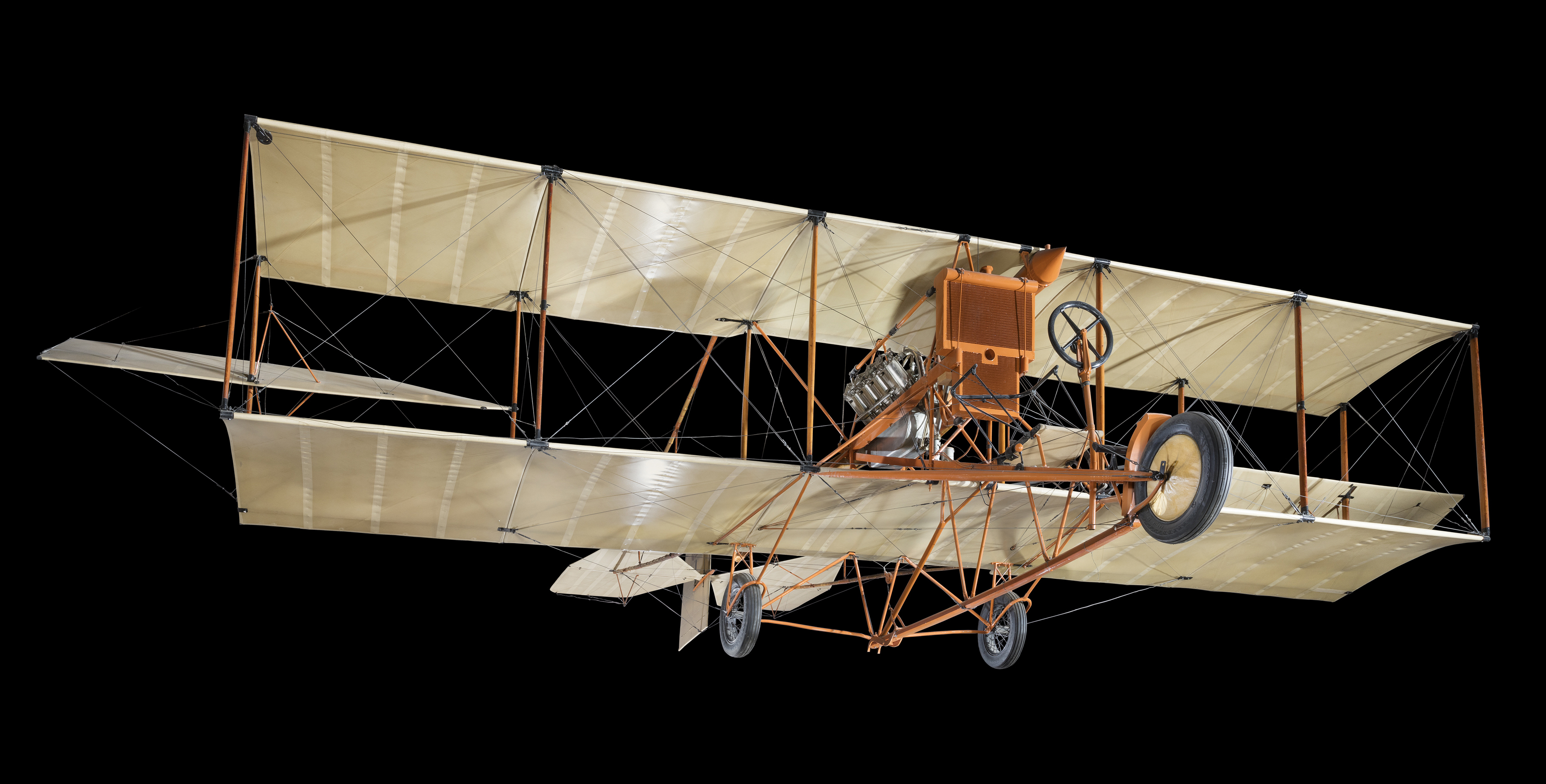
Curtiss 1911 Model D
Curtiss pusher aircraft helped replace wing warping with movable ailerons. The contrast with Wright aircraft makes control—not merely lift or power—a central early-flight story. The shift from wing warping to ailerons involved engineering performance, manufacturing, safety, and patent conflict. The surviving aircraft reveals the physical design but not the full institutional contest.
In depth
History & service
In 1911 the U.S. Army Signal Corps purchased its second airplane, a Curtiss Model D Type IV. The military version of the Curtiss Model D could be easily disassembled and transported on Army wagons. Like other Curtiss aircraft of the time, the Model D was a pusher, meaning the rear-mounted propeller "pushed" the aircraft. Designated Signal Corps Airplane No. 2, it was accepted at Fort Sam Houston, Texas, on April 27, 1911, one of five airplanes ordered by the Army that year.
The control system for the Curtiss Model D operated differently than that used on Signal Corps No. 1, a Wright aircraft. A pilot flying the Curtiss operated the ailerons with his shoulders, and the front elevator and rear rudder with the wheel mounted on a column in front of him. Also, rather than sitting next to the pilot, the observer sat behind the pilot.
The Signal Corps scrapped the original aircraft, so museum personnel constructed the reproduction on display, completing it in 1987. They relied heavily on measurements scaled from early photographs of the original Signal Corps No. 2 because the original drawings and adequate written descriptions were not available. Additional details were gathered from an existing factory-built Curtiss pusher and from recent drawings.
Except for the engine, which is made of wood and plastic, all materials used in the reproduction are essentially the same as those used in the original.
Details that tell the story
Pusher configuration placed the propeller behind the pilot · Movable ailerons controlled roll · Related Curtiss designs served early military aviation · Open structure makes control and bracing systems visible
The aircraft in figures
Engine: Curtiss V-8 of 60 hp · Maximum speed: 50 mph · Endurance: 2 1/2 hours · Span: 38 ft. 3 in. (including ailerons) · Length: 29 ft. 3 in. · Height: 7 ft. 10 in. · Weight: 700 lbs. empty; 1,300 lbs. loaded
A new invention becomes a public world
Before airplanes became routine transport, public demonstrations helped establish what they could do. Exhibition flights, races, and crossings placed fragile machines before crowds, officials, and potential customers. The audience saw courage and spectacle. Behind the spectacle were less visible questions about reliable engines, controllable wings, suitable landing grounds, and how to recover when the weather changed.
Different configurations competed at the same time. Some designers placed the propeller behind the pilot; others put it at the front. Biplanes used bracing to make light structures sufficiently rigid. Monoplanes reduced some of that external framework but posed their own structural and handling problems. Balloons and dirigibles remained part of the same aviation world, offering capabilities that early airplanes could not simply replace.
The famous firsts matter, but so does the period immediately after them. Flight schools, licensed manufacture, military trials, mechanics, and spare parts carried an invention outward. An aircraft could influence aviation through the pilots trained on it or the designs adapted from it, even after its own performance became outdated. The machines in Washington and Dayton preserve different points along that process. Their differences show how quickly an experimental achievement became an international industry, and how many people had to turn a remarkable flight into a repeatable service.