Air Force Museum
Eugene Jacques Bullard
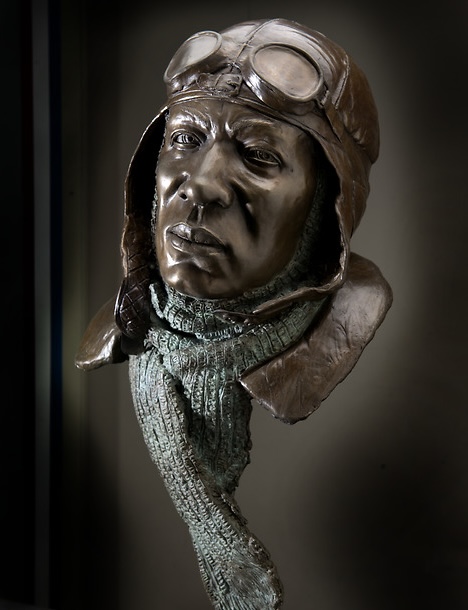
Eugene Bullard flew for France during World War I and became the first Black American military pilot. The United States did not permit him to fly for its air service. Bullard's service reveals how racial exclusion shaped the American aviation profession even as the United States celebrated technological progress.
In depth
History & service
In August of 1917 Eugene Jacques Bullard, an American volunteer in the French army, became the first African American military pilot and one of only a few blacks pilot in World War I. Born in Columbus, Ga., on Oct.
9, 1894, Eugene Bullard left home at the age of 11 to travel the world, and by 1913, he had settled in France as a prizefighter. When WWI started in 1914, he enlisted in the French Foreign Legion and rose to the rank of corporal. For his bravery as an infantryman in combat, Bullard received the Croix de Guerre and other decorations.
During the Battle of Verdun in 1916, Bullard was seriously wounded. While recuperating, he accepted an offer to join the French air force as a gunner/observer, but when he reported to gunnery school, he obtained permission to become a pilot. After completing flight training, Bullard joined the approximately 200 other Americans who flew in the Lafayette Flying Corps, and he flew combat missions from Aug. 27 until Nov.
11, 1917. He distinguished himself in aerial combat, as he had on the ground, and was officially credited with shooting down one German aircraft. Unfortunately, Bullard -- an enlisted pilot -- got into a disagreement with a French officer, which led to his removal from the French air force. He returned to his infantry regiment, and he performed non-combatant duties for the remainder of the war.
After the war, Bullard remained in France as an expatriate. When the Germans invaded France in May 1940, the 46-year-old Bullard rejoined the French army. Again seriously wounded by an exploding shell, he escaped the Germans and made his way to the United States. For the rest of World War II, despite his lingering injuries, he worked as a longshoreman in New York and supported the war effort by participating in war bond drives.
Bullard stayed in New York after the war and lived in relative obscurity, but to the French, he remained a hero. In 1954 he was one of the veterans chosen to light the “Everlasting Flame” at the French Tomb of the Unknown Soldier under the Arc de Triomphe, and in 1959, the French honored him with the Knight of the Legion of Honor.
On Oct. 13, 1961, Eugene Bullard died and was buried with full military honors in his legionnaire’s uniform in the cemetery of the Federation of French War Veterans in Flushing, N.Y. On Sept. 14, 1994, the Secretary of the Air Force posthumously appointed him a second lieutenant in the United States Air Force.
Details that tell the story
Served as a French military pilot in World War I · First Black American military pilot · Racial discrimination barred him from flying for the United States · Later service and recognition extended beyond aviation
A new invention becomes a public world
Before airplanes became routine transport, public demonstrations helped establish what they could do. Exhibition flights, races, and crossings placed fragile machines before crowds, officials, and potential customers. The audience saw courage and spectacle. Behind the spectacle were less visible questions about reliable engines, controllable wings, suitable landing grounds, and how to recover when the weather changed.
Different configurations competed at the same time. Some designers placed the propeller behind the pilot; others put it at the front. Biplanes used bracing to make light structures sufficiently rigid. Monoplanes reduced some of that external framework but posed their own structural and handling problems. Balloons and dirigibles remained part of the same aviation world, offering capabilities that early airplanes could not simply replace.
The famous firsts matter, but so does the period immediately after them. Flight schools, licensed manufacture, military trials, mechanics, and spare parts carried an invention outward. An aircraft could influence aviation through the pilots trained on it or the designs adapted from it, even after its own performance became outdated. The machines in Washington and Dayton preserve different points along that process. Their differences show how quickly an experimental achievement became an international industry, and how many people had to turn a remarkable flight into a repeatable service.