Air Force Museum
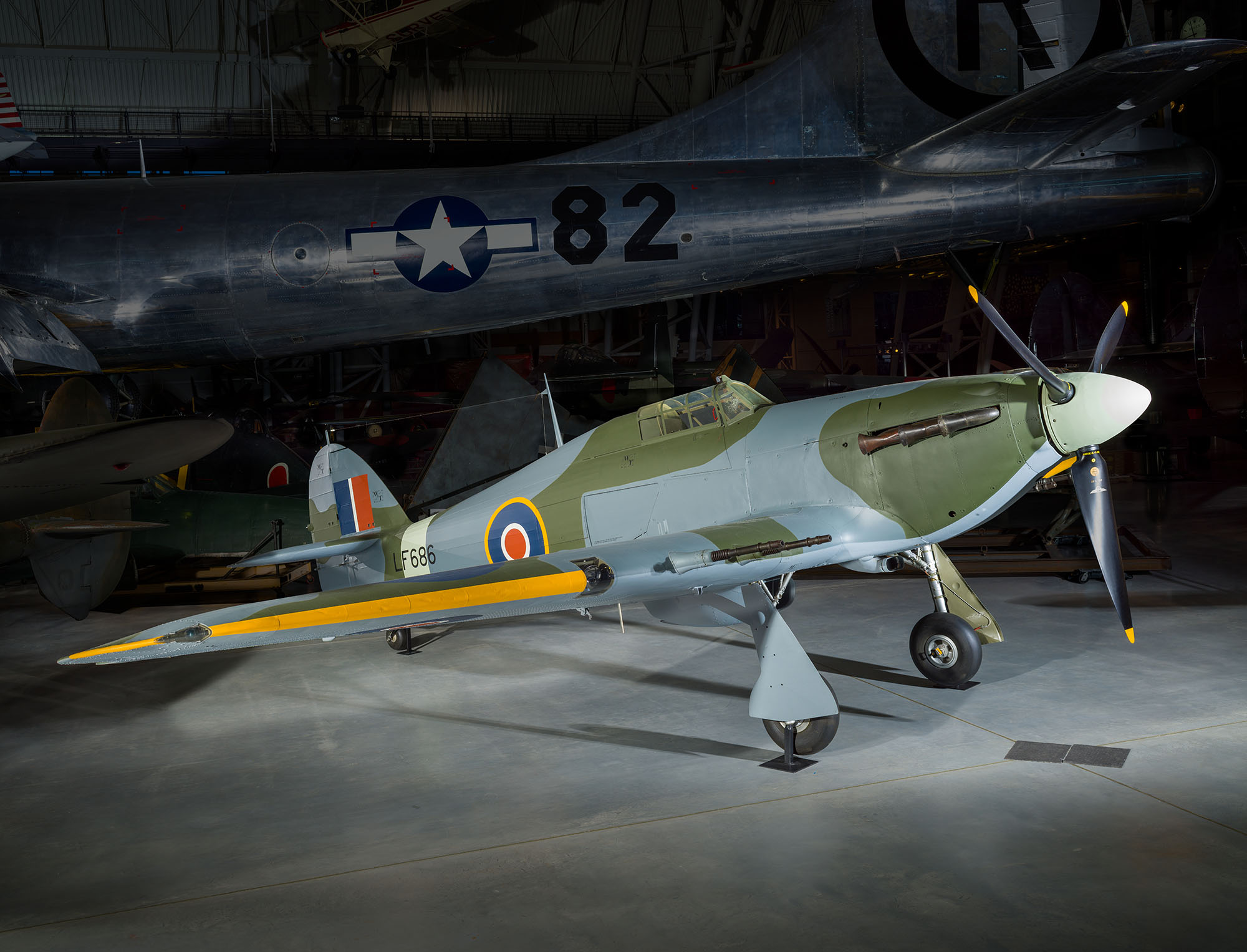
Hawker Hurricane MkIIa
The Hawker Hurricane formed the larger share of RAF fighter strength during the Battle of Britain and combined a modern monoplane layout with construction methods familiar to British industry. It was sturdy, maintainable, and adaptable to several roles.
In depth
Americans fly before U.S. entry into war
This Canadian-built Hurricane is presented in markings associated with No. 71 Squadron, the first of three RAF Eagle Squadrons formed around American volunteers before the United States entered World War II. The aircraft connects individual choice, Allied recruitment, and the later transfer of many Eagle Squadron pilots into the U.S. Army Air Forces.
History & service
The Hawker Hurricane was one of the most famous British fighters of World War II. The plane’s legend was born during the Battle of Britain in the summer of 1940.
When the Nazis attacked Great Britain, Royal Air Force (RAF) Fighter Command had only 527 Hurricanes and 321 Spitfire fighters to counter the enemy's 2,700 aircraft. Yet, the RAF maintained air superiority in the skies of England due in part to the Hurricane’s quality and British industry’s ability to replace lost aircraft.
The Hurricanes absorbed the brunt of the German air attacks until the faster, more maneuverable Spitfire was available in quantity to counter the German Messerschmitt Bf 109.
The prototype Hurricane first flew in November 1935, and the first production aircraft flew in October 1937. Hurricanes were built not only in Great Britain but also in Yugoslavia before the German invasion, and in Canada from 1940 to 1942. The Hurricane Mk IIa on display is a Canadian-built plane painted to represent an aircraft of 71 Squadron, Royal Air Force—the original American Eagle Squadron.
Details that tell the story
Hurricane prototype first flew in 1935 · Entered RAF service before World War II · Built in Britain and Canada · No. 71 Squadron was the first Eagle Squadron
The aircraft in figures
Armament: Eight .303-cal. Browning machine guns · Engine: Rolls-Royce Merlin XX of 1,260 hp · Maximum speed: 340 mph · Cruising speed: 238 mph · Range: 468 miles with internal fuel only; 1,090 miles with two 90-gal. external tanks · Ceiling: 35,000 ft. · Span: 40 ft. · Length: 31 ft. 4 in. · Height: 13 ft. · Weight: 7,200 lbs. loaded
A new invention becomes a public world
Before airplanes became routine transport, public demonstrations helped establish what they could do. Exhibition flights, races, and crossings placed fragile machines before crowds, officials, and potential customers. The audience saw courage and spectacle. Behind the spectacle were less visible questions about reliable engines, controllable wings, suitable landing grounds, and how to recover when the weather changed.
Different configurations competed at the same time. Some designers placed the propeller behind the pilot; others put it at the front. Biplanes used bracing to make light structures sufficiently rigid. Monoplanes reduced some of that external framework but posed their own structural and handling problems. Balloons and dirigibles remained part of the same aviation world, offering capabilities that early airplanes could not simply replace.
The famous firsts matter, but so does the period immediately after them. Flight schools, licensed manufacture, military trials, mechanics, and spare parts carried an invention outward. An aircraft could influence aviation through the pilots trained on it or the designs adapted from it, even after its own performance became outdated. The machines in Washington and Dayton preserve different points along that process. Their differences show how quickly an experimental achievement became an international industry, and how many people had to turn a remarkable flight into a repeatable service.