Air Force Museum
North American B-25B Mitchell
The B-25 Mitchell became one of the war's most adaptable medium bombers and the aircraft chosen for the first American air attack on the Japanese home islands. Sixteen B-25Bs launched from USS Hornet on April 18, 1942. A medium land-based bomber had never been intended to operate from a carrier, so crews practiced extremely short takeoffs and the aircraft were modified for the one-way mission.
In depth
The story behind the display
The physical damage caused by the Doolittle Raid was limited, but the mission raised American morale and compelled Japan to reconsider the defense of its home islands. It also exposed the enormous distances and risks that defined the Pacific air war.
History & service
The B-25 medium bomber was one of America's most famous airplanes of World War II. It was the type used by Gen. Jimmy Doolittle for the Tokyo Raid on April 18, 1942.
Subsequently, B-25s saw duty in every combat area being flown by the Dutch, British, Chinese, Russians and Australians in addition to U.S. forces. Although the airplane was originally intended for level bombing from medium altitudes, it was used extensively in the Pacific Theater for bombing Japanese airfields and beach emplacements from treetop level, and for strafing and skip bombing enemy shipping.
Built by North American Aviation, the B-25 first flew on Aug. 19, 1940, and the U.S. Army Air Corps accepted the first five B-25s in February 1941. By the end of the war, North American Aviation had built a total of 9,816 B-25s at its California and Kansas plants.
During its long career, the B-25 experienced a number of modifications. The first major change occurred with the G model that included a 75mm cannon and two fixed .50-cal. guns in the nose. The H model was the first to add additional forward firing .50-cal. guns in cheek blisters. In the J version, the most numerous variant, the aircraft returned to its initial arrangement as a level bomber, reverting to a transparent nose that included one flexible and two fixed .50-cal. guns.
Driven by requirements in the Pacific, however, field-modified Js and finally production versions once again featured a solid nose that housed eight fixed .50-cal. guns for low-level attack. In this configuration, the J model could devastate vehicles and shipping with up to 14 forward firing heavy machine guns.
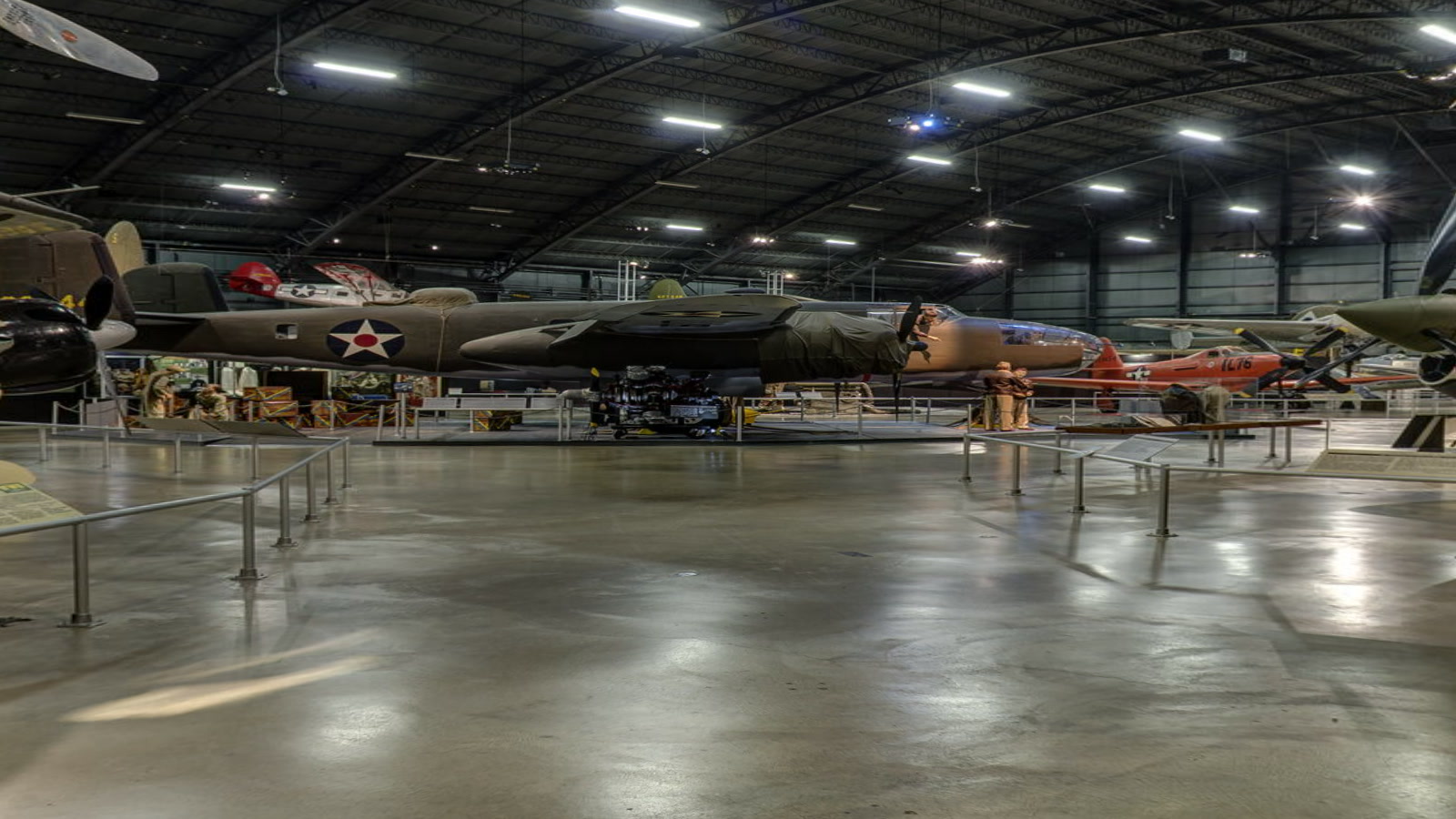
The airplane on display, actually a RB-25D (S/N 43-3374), was removed from storage at Tucson, Ariz., and rebuilt by North American Aviation at Inglewood, Calif., to the configuration of the lead B-25B flown by Lt. Col. Doolittle on the Tokyo Raid. It was then flown to the museum, arriving in April 1958.
Details that tell the story
First flew in 1940 · Sixteen B-25Bs launched during the Doolittle Raid · Selected for its range, bomb load, and short takeoff capability · B-25 variants served in every combat theater
The aircraft in figures
Armament: Six .50-cal. machine guns; 3,000 lbs. of bombs · Engine: Two Wright R-2600s of 1,700 hp each · Maximum speed: 328 mph · Cruising speed: 233 mph · Range: 2,500 miles (with auxiliary tanks) · Ceiling: 21,200 ft. · Span: 67 ft. 6 in. · Length: 53 ft. · Height: 16 ft. 9 in. · Weight: 29,300 lbs. maximum
A bomber was a workplace under pressure
A multi-engine bomber carried a crew whose members performed different jobs in a confined, noisy, and often very cold environment. Pilots, navigators, bombardiers, radio operators, engineers, and gunners depended on one another. Oxygen, communications, heating, and the movement of equipment mattered to survival as well as to the mission. Damage could turn an ordinary procedure into a difficult act of improvisation.
Formation flying added another layer of dependence. Bombers attempted to combine navigation, concentrated bombing, and defensive fire while holding position through changing weather and enemy attacks. Long-range fighter escort altered the balance, but it did not remove antiaircraft fire, mechanical failure, or the consequences of fatigue. Mission reports and surviving equipment reveal both the power of the force and the vulnerability of the people inside it.
Named aircraft and famous crews offer an entry into this history without representing every experience. Nose art and personal possessions made an industrial machine feel like a shared home, yet many crews and aircraft left little material trace. The museums preserve fragments of that wider world: a turret, a flight jacket, an engine, a decorated aircraft, a story of escape. Linking them across galleries allows the technical history of bombing to be read alongside courage, loss, civilian consequences, and the work required to bring a damaged aircraft and its crew back.