Air Force Museum
Link Trainer
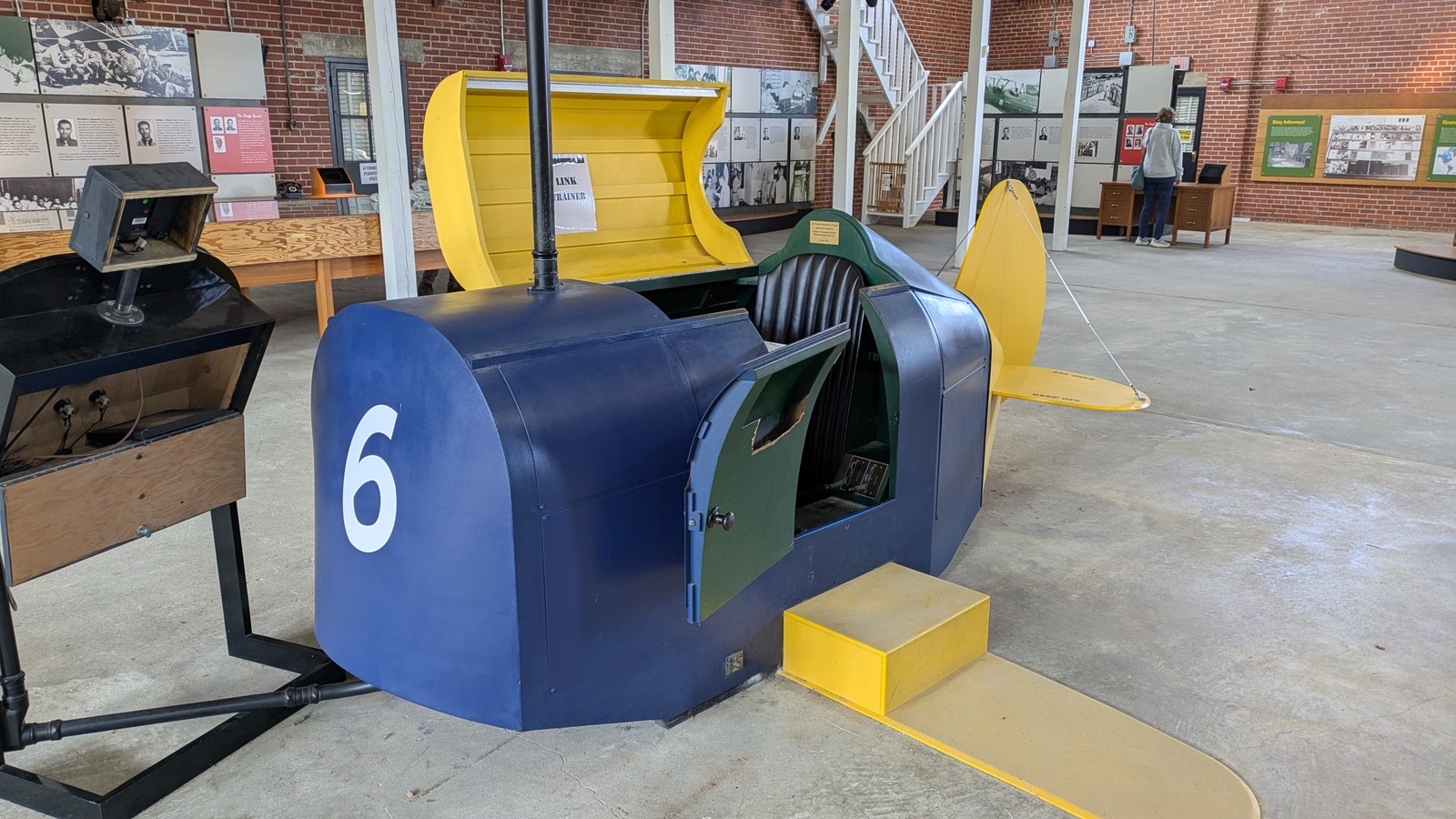
The Link Trainer taught instrument flying safely on the ground and helped turn mass recruitment into an effective wartime air force. Built around pneumatic controls, bellows, instruments, and a small enclosed cockpit, the Link Trainer reproduced the movements and instrument indications of an airplane. An instructor could give a student a route and introduce weather or navigation problems without risking an aircraft or crew.

In depth
The story behind the display
Thousands of trainers supported the enormous wartime flying-school system. Their importance was not glamorous, but they allowed students to practice procedures repeatedly, conserve fuel and aircraft time, and learn to trust instruments when clouds or darkness removed the outside horizon.
History & service
Crude pilot training aids had been designed even before World War I, but none had any significant training value. Edwin A. Link provided a giant step forward when in 1931 he received a patent on his "pilot maker" training device. He had perfected his design in the basement of his father's piano and organ factory in Binghamton, N.Y. Organ bellows and a motor provided the means for the trainer, mounted on a pedestal, to pitch, roll, dive and climb as the student "flew" it.
Ironically, most of his first sales were to amusement parks. In 1934, after a series of tragic accidents while flying the air mail, the Army Air Corps bought six Link trainers to assist in training pilots to fly at night and in bad weather relying only on instruments.
The World War II era brought orders for thousands of Link trainers from the United States and many foreign countries. Although Army Air Forces aviation cadets flew various trainer aircraft, virtually all took blind-flying instruction in a Link. Movement of the trainer is accomplished by vacuum operated bellows, controlled by valves connected to the control wheel (or stick) and rudder pedals.
An instructor sat at the desk and transmitted radio messages which the student in the Link heard through his earphones.
Inside the "cockpit," the student relied on his instruments to "fly" the Link through various maneuvers while his navigational "course" was traced on a map on the desk by the three-wheeled "crab." Slip stream simulators gave the controls the feeling of air passing over control surfaces and a rough air generator added additional realism during the "flight." The trainers were realistic enough that a humorous but unlikely story circulated that one student, told by his instructor that he had run out of fuel on a night flight, broke his ankle when he leaped from the trainer as though parachuting to safety.
The complexity of flight simulators has grown with that of military and civilian aircraft. No one knows how many lives, aircraft and training dollars have been saved by flight simulators, but those savings can be traced back to Link's "Blue Box," which pointed the way to today's highly sophisticated and complex trainers.
Details that tell the story
Developed by Edwin Link · Used pneumatic systems to simulate movement · Supported instrument and navigation instruction · Reduced the cost and danger of basic procedural training
Aviation close to everyday life
Most flying does not take place in a large scheduled airliner. General aviation includes personal travel, instruction, business transport, surveying, agricultural work, medical missions, and many other uses. These activities share airspace, but their aircraft can be very different. A short rough landing strip, a modest operating budget, or a specialized payload may be more important than high speed.
Small aircraft make the relationship between pilot and machine especially visible. Weight, balance, weather, and fuel planning have immediate consequences. Straightforward designs can be useful precisely because they are manageable to maintain and operate. More elaborate equipment can expand capability, but it also adds cost, training requirements, and new systems to understand.
The personal artifacts in this gallery widen the story beyond aircraft specifications. Clothing, equipment, and accounts of individual flights reveal ambition, work, ingenuity, and the barriers people encountered. The same airplane might be a livelihood for one person, an instrument of public service for another, and a route into a lifelong enthusiasm for a third. Connections to military liaison aircraft, air-rescue machines, and commercial transports show how ideas move across categories. Aviation's importance lies as much in useful daily service as in the famous firsts that attract headlines.