Air Force Museum
Radioplane OQ-2A
In the mid-1930s, radio-controlled model airplanes became the basis for the U.S. Army Air Corps' development of the aerial targets for antiaircraft gunnery training. Starting in 1935, the Radioplane Co. in California developed several variations of an original design by former movie star and modeler Reginald Denny. The successful OQ-2A generated contracts for almost 1,000 targets in 1943.
In depth
History & service
The OQ-2A launched from a catapult, and a controller flew it with a control box on the ground. To recover, the OQ-2A deployed a 24-foot diameter parachute, and it floated down to the ground.
The aircraft in figures
Engine: One O-15-1 2-cylinder, air-cooled, two-cycle of 6 hp · Maximum speed: 90 mph · Endurance: 60 minutes · Ceiling: 8,000 ft. · Span: 13 ft. 3 in. · Length: 8 ft. 8 in. · Height: 2 ft. 8 in. · Weight: 108 lbs.
Finding the way, then trusting it
The view from the cockpit can be wonderfully clear, or it can disappear into cloud, darkness, smoke, or unfamiliar terrain. Aviation navigation developed to bridge those conditions. Maps and visual landmarks worked alongside compasses, clocks, radio signals, instruments, and increasingly sophisticated calculations. Each new method changed what routes and weather conditions could be attempted, but it also required training and a clear understanding of its limitations.
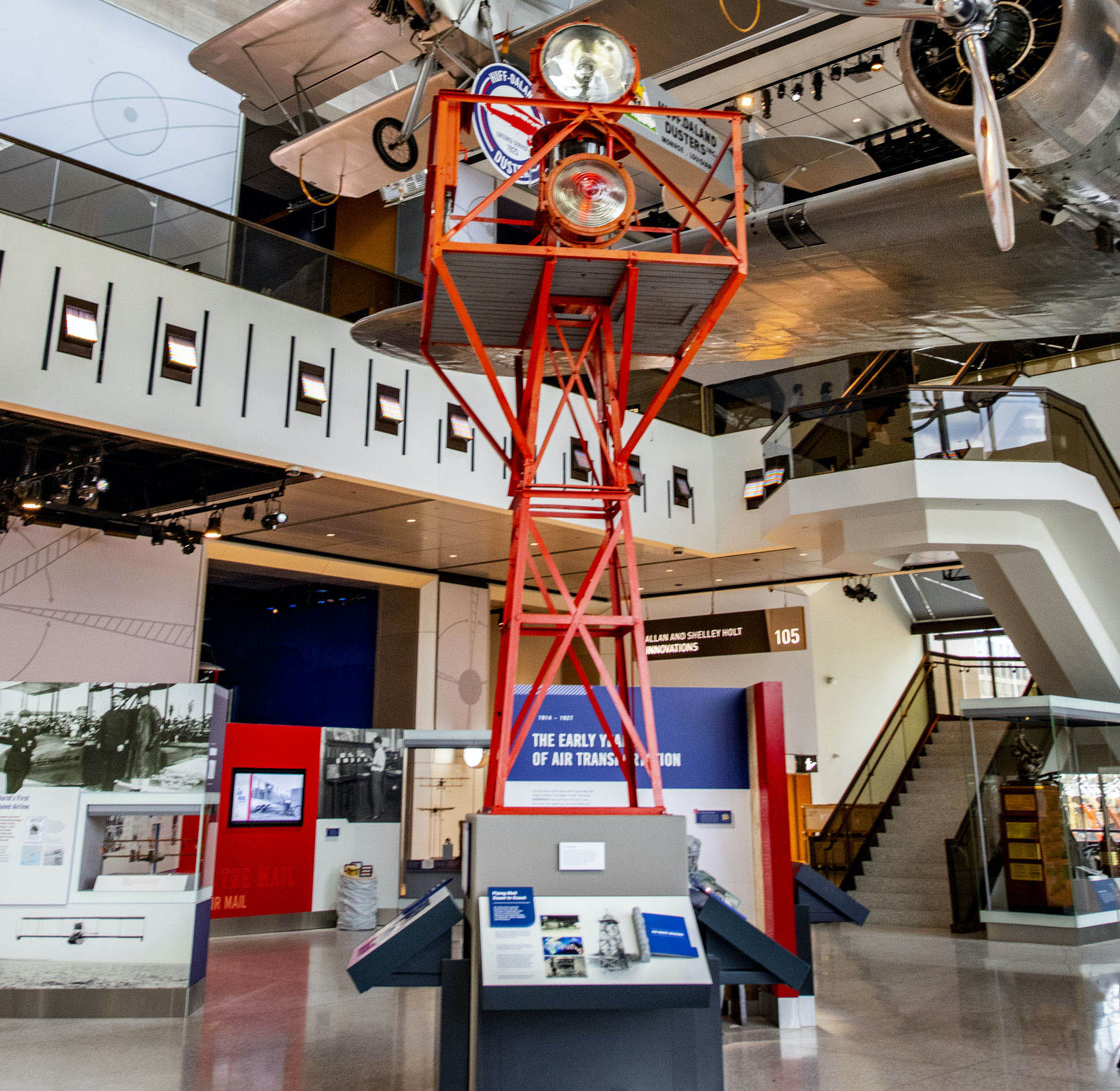
The challenge was larger than keeping one airplane on course. Busy air routes needed shared procedures, reliable communications, and ways to separate aircraft that could not see one another. A beacon on the ground, a radio in the cockpit, and an instrument trainer belonged to the same expanding system. The result was an ability to operate more regularly instead of waiting for ideal visibility.
Navigation also connects aircraft with spacecraft. Both depend on measurements, reference frames, timing, and the interpretation of signals. Their environments differ greatly, yet both require people to decide whether the instruments are describing reality correctly. Comparing a route beacon with a satellite or a cockpit instrument makes that continuity visible. The extraordinary flight is often supported by something deceptively modest: an accurate clock, a dependable signal, or a practiced procedure followed at the right moment.