Air Force Museum
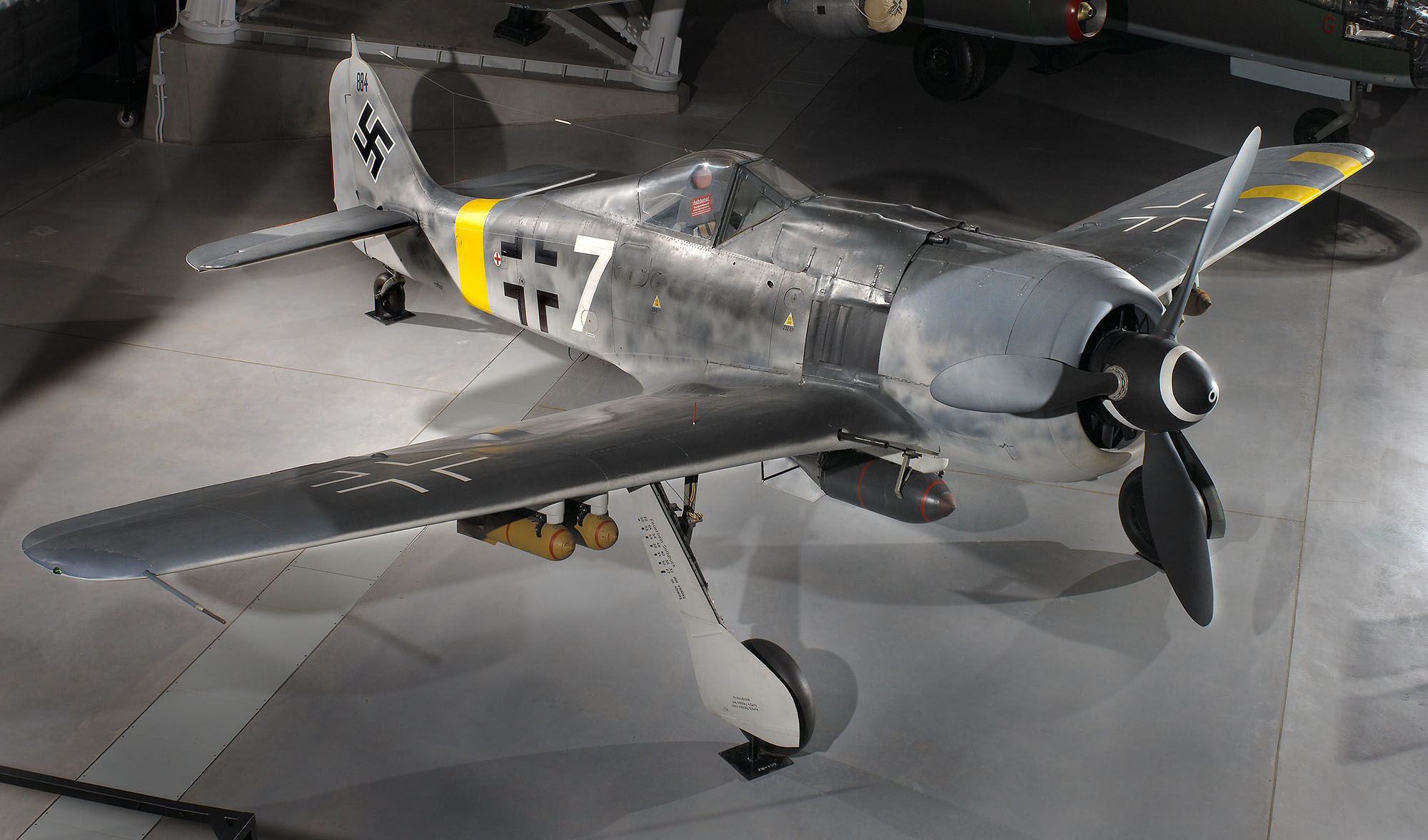
Focke-Wulf Fw 190D-9
The Fw 190, one of Germany's best fighter airplanes of World War II, made its first flight on June 1, 1939. It appeared in action over northwestern France in September 1941 and rapidly proved its superiority over the Mark V Spitfire, Britain's best fighter of that time.
In depth
History & service
Most Fw 190s were the "A" series, powered by a BMW radial engine. Late in 1943, however, the more capable "D" series appeared in action against U.S. bombers, powered by the more powerful Jumo 213 inline, liquid-cooled engine. Because the larger engine lengthened its nose, a 20-inch section had to be added to the Fw 190D-9's fuselage just forward of the tail. During its lifetime, more than 20,000 Fw 190s of all types were built.
The Fw 190D-9 on display was assigned to the JG3 "Udet" Geschwader. One of the Luftwaffe's most famous fighter units, JG3 was named for Ernst Udet, Germany's leading ace to survive World War I. The airplane, captured and brought to the United States for testing at the end of WWII, is on loan from the Smithsonian Institution's National Air and Space Museum.
The aircraft in figures
Armament: Two 20mm MG 151 cannons in wings and two 13mm MG 131 machine guns in nose · Engine: Junkers Jumo 213 of 2,240 hp with methanol-water injection · Maximum speed: 426 mph · Cruising speed: 280 mph · Range: 520 miles · Ceiling: 40,000 ft. · Span: 34 ft. 5 1/3 in. · Length: 33 ft. 5 1/4 in. · Height: 11 ft. 1/4 in. · Weight: 10,670 lbs. combat-loaded
Performance was only part of the contest
A fighter's speed, climb, range, visibility, and armament shaped what it could do, but those qualities did not act alone. Training, tactics, warning systems, maintenance, fuel, and the condition of the airfield influenced every encounter. The aircraft that looks best in a table might be at a disadvantage at the wrong altitude, carrying the wrong load, or arriving with too little fuel to remain in the fight.
Escort missions demonstrate the importance of purpose. A fighter defending bombers had responsibilities beyond pursuing an opponent. It needed sufficient range, a useful position, and the discipline to remain with the force it protected. Ground attack imposed different demands, including visibility, endurance near the target, and the ability to survive damage from below.
Comparing aircraft across museums is most rewarding when the mission remains in view. An early pursuit biplane, a wartime piston fighter, and a Cold War jet represent different technologies, but all were part of a larger operational system. Personal accounts reveal how pilots worked within those limits. They also show why claims of individual success need context: weather, surprise, teamwork, and opportunities created by others shaped the outcome. The aircraft provides the physical evidence; the surrounding stories explain how people used it and what that use cost.