Air Force Museum
MiG-15bis
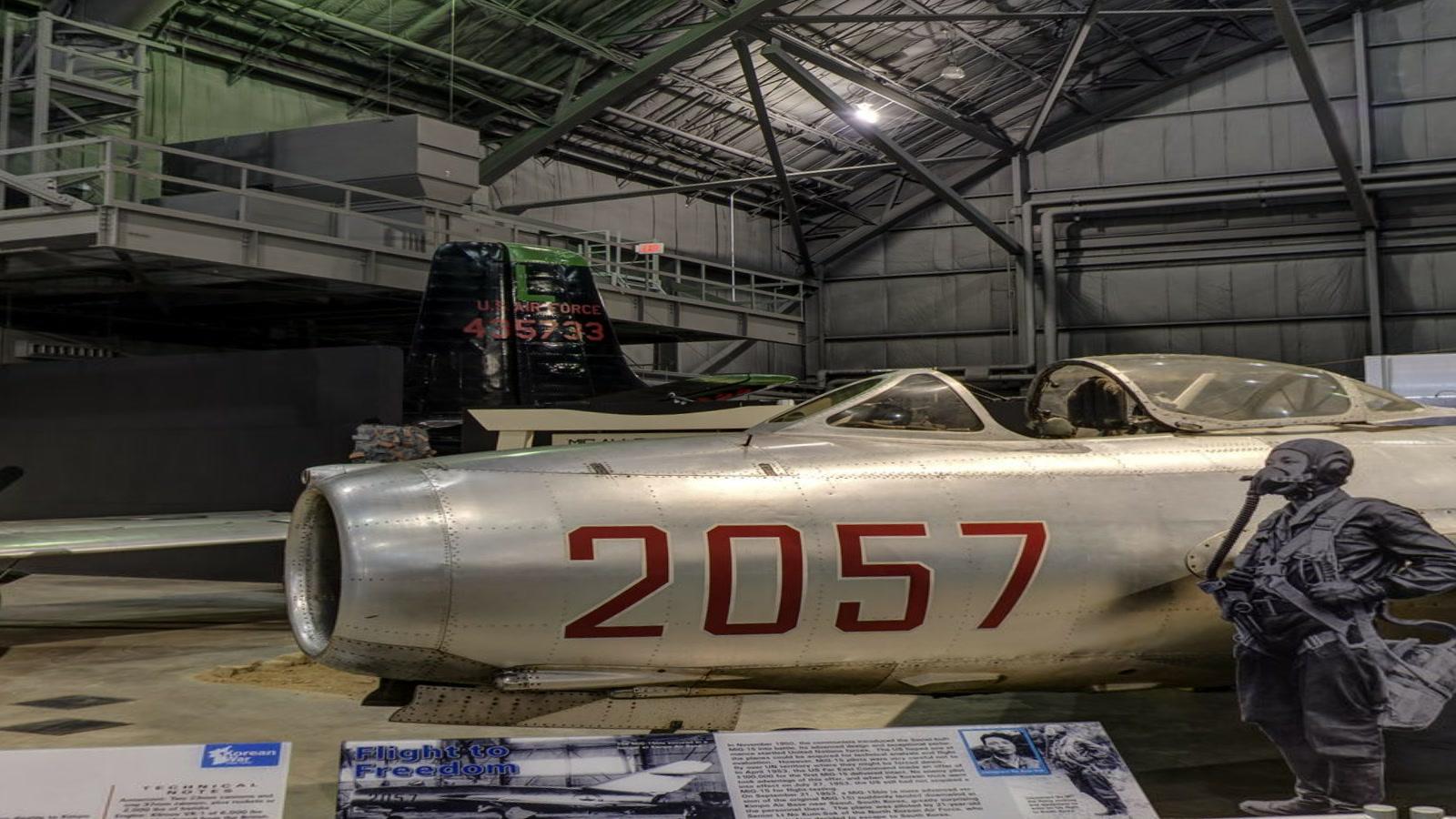
The MiG-15 forced the United States and its allies to confront a fast, heavily armed swept-wing jet over Korea. Designed in the Soviet Union and flown by several communist air forces, the MiG-15 could climb rapidly and operated effectively at high altitude. Its cannon armament posed a serious threat to heavy bombers.
In depth
The story behind the display
Its appearance ended any assumption that American forces would automatically control the air. The result was a technically demanding contest shaped by training, tactics, secrecy, and the political limits of a war fought near China and the Soviet Union.
History & service
The Soviet Union developed the MiG-15 following World War II and the fighter entered service in 1949. By 1952 the Soviets provided the MiG-15 (NATO code name "Fagot") to a number of communist satellite nations, including North Korea. In 1950 the Soviets began production of a more capable version, the MiG-15bis. The MiG-15bis used a more powerful engine and hydraulically boosted ailerons. During the Korean War, both versions of the MiG-15 operated extensively against United Nations forces.
A defecting North Korean pilot flew the airplane on display to Kimpo Air Base in South Korea on Sept. 21, 1953. The airplane provided important intelligence data, especially since it was the advanced version of the MiG-15. After considerable flight-testing, the U.S. offered to return the airplane to its "rightful owners." The offer was ignored, and in November 1957 it was transferred to the museum for public exhibition.
Details that tell the story
Swept-wing jet fighter · Armed with one 37 mm and two 23 mm cannon · Powered by a Soviet development of the Rolls-Royce Nene engine · Major opponent of the F-86 Sabre
The aircraft in figures
Armament: Two 23mm cannons and one 37mm cannon plus rockets or 2,000 lbs. of bombs · Engine: Klimov VK-1 of 6,000 lbs. thrust (developed from the British Rolls-Royce "Nene" engine) · Maximum speed: 670 mph · Range: 500 miles · Ceiling: 51,000 ft. · Span: 33 ft. 1 1/2 in. · Length: 33 ft. 3 5/8 in. · Height: 11 ft. 2 in. · Weight: 11,270 lbs. maximum · Serial number: 2015357
Performance was only part of the contest
A fighter's speed, climb, range, visibility, and armament shaped what it could do, but those qualities did not act alone. Training, tactics, warning systems, maintenance, fuel, and the condition of the airfield influenced every encounter. The aircraft that looks best in a table might be at a disadvantage at the wrong altitude, carrying the wrong load, or arriving with too little fuel to remain in the fight.
Escort missions demonstrate the importance of purpose. A fighter defending bombers had responsibilities beyond pursuing an opponent. It needed sufficient range, a useful position, and the discipline to remain with the force it protected. Ground attack imposed different demands, including visibility, endurance near the target, and the ability to survive damage from below.
Comparing aircraft across museums is most rewarding when the mission remains in view. An early pursuit biplane, a wartime piston fighter, and a Cold War jet represent different technologies, but all were part of a larger operational system. Personal accounts reveal how pilots worked within those limits. They also show why claims of individual success need context: weather, surprise, teamwork, and opportunities created by others shaped the outcome. The aircraft provides the physical evidence; the surrounding stories explain how people used it and what that use cost.