Air Force Museum
SM-62 Snark
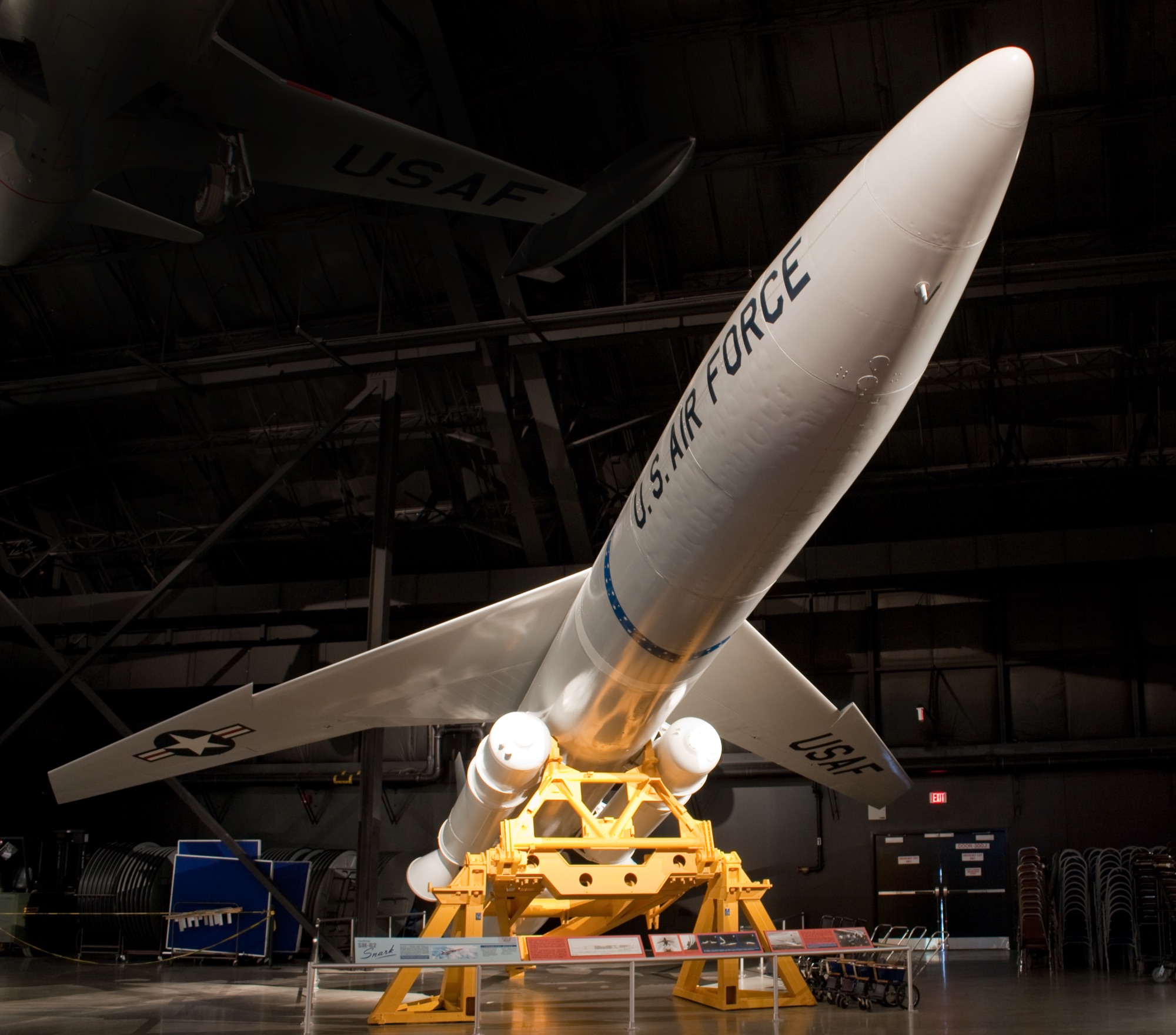
The Snark was an ambitious intercontinental cruise missile developed before ballistic missiles became practical. A jet engine carried it toward its target while inertial and celestial navigation attempted to solve the difficult problem of long-range guidance. It briefly stood alert in Maine, but rapid progress in intercontinental ballistic missiles made it obsolete almost as soon as it became operational.
In depth
History & service
The Snark, a pilotless nuclear missile, represented an important step in weapons technology during the Cold War. The SM-62 (Strategic Missile) program lasted from 1945-1961, and it gave the U.S. Air Force valuable experience in developing long-range strategic nuclear missile systems. The SM-62 was a significant forerunner of cruise missiles developed many years later.
To solve the problem, the near-supersonic Snark used an innovative guidance system that relied on inertial navigation updated and corrected by star tracking.
Development of intercontinental ballistic missiles (ICBMs) and newer, faster manned jet bombers complicated the SM-62's prospects. However, the Snark concept remained attractive because it was cheaper than ICBMs, and unlike bombers, did not risk aircrews, needed no tanker fleet for air refueling, and was easier to maintain. Guidance and aerodynamic issues, though, slowed the SM-62's progress, even as design variations made the Snark bigger, faster and able to deliver more powerful nuclear warheads.
While several test Snarks were launched from fixed platforms, operational missiles were to be launched from mobile platforms. At launch, solid rocket motors helped the Snark quickly gain speed, then dropped away as its jet engine took over. When the Snark approached its target, the nose separated, and the nuclear warhead inside continued on a ballistic path to the target.
The USAF placed its first Snark on alert in March 1960 with the 702nd Strategic Missile Wing (SMW), Presque Isle Air Force Base, Maine. Soon after, however, the USAF withdrew the missile from service. In June 1961 the 702nd SMW was inactivated after President John F. Kennedy declared Snark obsolete compared to the newest nuclear ballistic missiles and manned bombers.
Details that tell the story
Program ran from 1945 to 1961 · Used inertial navigation corrected by star tracking · First operational Snark went on alert in 1960
The aircraft in figures
Armament: Nuclear warhead · Engines: Pratt & Whitney J57-P-1 jet engine of 10,500 lbs. thrust and two Aerojet-General solid-propellant booster rockets of 130,000 lbs. thrust each · Guidance: Doppler radar (at launch), celestial and back-up Doppler (midcourse), ballistic (terminal phase) · Range: 6,325 miles · Ceiling: 50,000 ft. · Speed: 650 mph · (Video)Museum Restoration Moves Snark within Gallery
Readiness became a permanent condition
During the Cold War, aviation was organized around the possibility of a conflict that governments hoped to prevent. Bombers, missiles, interceptors, reconnaissance aircraft, warning networks, and tankers became parts of interdependent systems. Their value was judged not only by what they could do in flight, but by how reliably they could be maintained, alerted, launched, supported, and controlled.
This emphasis produced striking aircraft and difficult tradeoffs. Long range demanded fuel and support. High speed increased heat and mechanical stress. Sophisticated electronics offered new capabilities but created new maintenance requirements. A reconnaissance aircraft needed an effective camera and a workable route as well as altitude or speed. An interceptor depended on warning and guidance before its pilot could make an engagement.
The human experience included long periods of training and routine punctuated by crises. Crews and ground personnel practiced procedures whose purpose was to remain credible without being used in war. At the same time, military aviation carried out reconnaissance, transport, rescue, humanitarian missions, and conventional operations around the world. Linking these aircraft with civil airliners, research machines, and spacecraft reveals a history of shared technologies and different purposes. The machines embody technical accomplishment, but also the enormous resources and sustained human effort required to keep a global force ready.