Air Force Museum
HU-16B Albatross
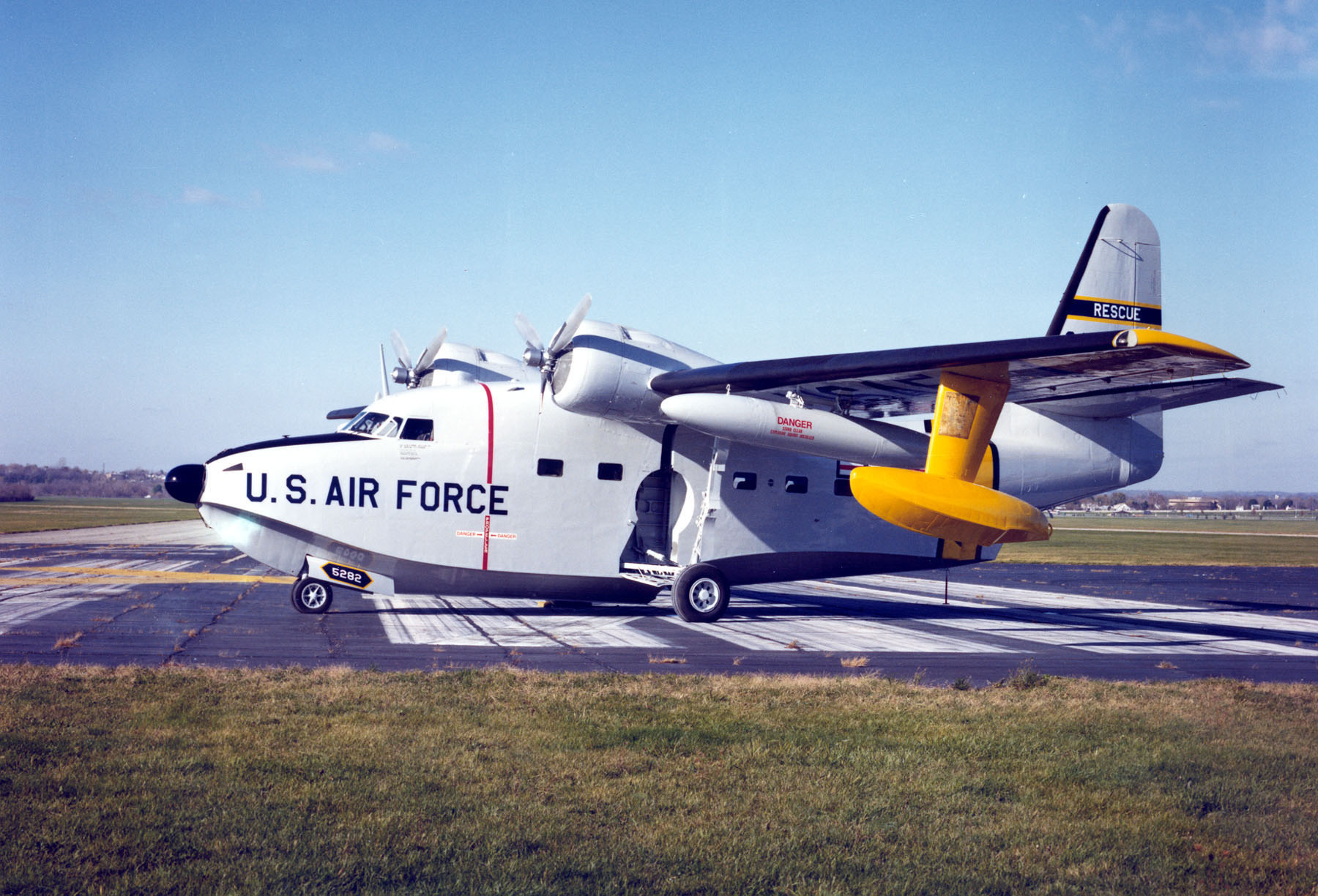
The amphibious Albatross gave rescue crews access to airmen and sailors far from a runway. Its boat-shaped hull allowed open-water landings, while conventional landing gear supported ordinary airfield operations. During the Cold War and conflicts in Korea and Southeast Asia, Albatross crews turned range, seamanship, and persistence into a lifeline.
In depth
History & service
Grumman designed the versatile Albatross to meet a U.S. Navy requirement for an amphibious utility aircraft which could also operate from snow and ice with skis. During the Korean War, Albatrosses rescued almost 1,000 United Nations personnel from coastal waters and rivers, often behind enemy lines. They also made numerous dramatic and hazardous rescues in Southeast Asia, on occasion taxiing many miles over rough, open water when unable to take off.
The prototype first flew on Oct. 24, 1947, and soon after the U.S. Air Force ordered a quantity for air-sea rescue duties as SA-16As. Grumman delivered 297 A models to the Air Force, mostly for the Air Rescue Service. In 1962 the USAF changed the designation to HU-16.
In 1955 Grumman developed an improved version with a 16 1/2 foot increase in wingspan and larger aileron and tail surfaces. Beginning in 1957, many A models were converted to the B configuration with these improvements.
The HU-16 on display was one of the last operational USAF Albatrosses. The aircraft established a world altitude record for twin-engine amphibians when it reached 32,883 feet on July 4, 1973. The crew for this record setting flight included Lt. Col. Chuck Manning, pilot; Maj. Paul Schaefer, co-pilot; and Tech. Sgt. Ed Schindler, flight mechanic. Two weeks later, the aircraft was retired and flown to the museum.
Details that tell the story
Amphibious search-and-rescue aircraft · Operated from both water and land · Served in Korea, Southeast Asia, and peacetime rescue
Readiness became a permanent condition
During the Cold War, aviation was organized around the possibility of a conflict that governments hoped to prevent. Bombers, missiles, interceptors, reconnaissance aircraft, warning networks, and tankers became parts of interdependent systems. Their value was judged not only by what they could do in flight, but by how reliably they could be maintained, alerted, launched, supported, and controlled.
This emphasis produced striking aircraft and difficult tradeoffs. Long range demanded fuel and support. High speed increased heat and mechanical stress. Sophisticated electronics offered new capabilities but created new maintenance requirements. A reconnaissance aircraft needed an effective camera and a workable route as well as altitude or speed. An interceptor depended on warning and guidance before its pilot could make an engagement.
The human experience included long periods of training and routine punctuated by crises. Crews and ground personnel practiced procedures whose purpose was to remain credible without being used in war. At the same time, military aviation carried out reconnaissance, transport, rescue, humanitarian missions, and conventional operations around the world. Linking these aircraft with civil airliners, research machines, and spacecraft reveals a history of shared technologies and different purposes. The machines embody technical accomplishment, but also the enormous resources and sustained human effort required to keep a global force ready.