Air Force Museum
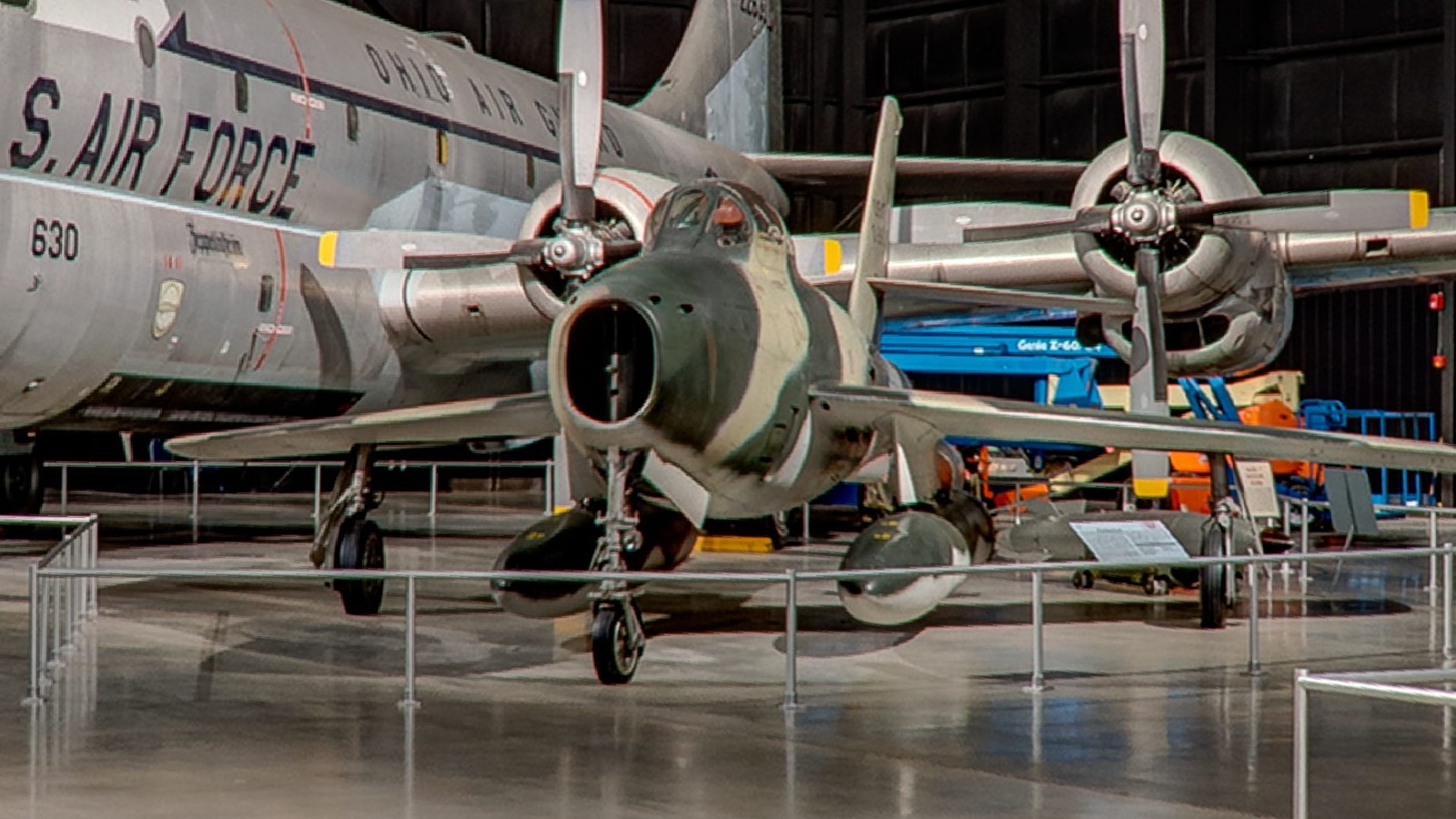
F-84F Thunderstreak
The swept-wing F-84F was a principal Tactical Air Command fighter-bomber during the 1950s. It could deliver conventional or nuclear weapons and served widely with NATO allies. Its deployment embodied a Cold War strategy that combined American aircraft production, forward bases, and allied forces to defend Europe.
In depth
History & service
Evolved from the straight-wing F-84, the F-84F prototype first flew in June 1950. Deliveries began in 1954, with most of the aircraft going to the Tactical Air Command as a ground support fighter bomber. Republic built 2,112 F-84Fs while General Motors fabricated 599 more. Of these, 1,301 were delivered to NATO air forces. Production of a reconnaissance version, the RF-84F, totaled 715 aircraft, including 386 for allied countries.
To accommodate cameras in the nose, Republic moved the RF-84F's air intakes to the wing roots.
Through the late 1950s, the U.S. Air Force replaced its F-84Fs with supersonic F-100s, and the Thunderstreaks went to Air National Guard units. However, some F-84Fs temporarily returned to USAF service in the early 1960s due to the Berlin crisis.
The aircraft on display was flown to the museum in 1970 following its assignment to the Ohio Air National Guard. During its career, it served in England, Greece, Alaska and the continental United States. In 1961 it participated in the mass deployment of 200 fighters across the Atlantic Ocean to Europe in response to the Berlin situation.
Details that tell the story
Swept-wing fighter-bomber · Capable of conventional or nuclear strike · Widely supplied to NATO air forces
The aircraft in figures
Armament: Six .50-cal. machine guns and 24 5-in. rockets; 6,000 lbs. of bombs externally · Engine: Wright J65-W-3 of 7,220 lbs. thrust · Maximum speed: 685 mph · Range: 1,900 miles · Span: 33 ft. 7 in. · Length: 43 ft. 5 in. · Height: 15 ft. · Weight: 27,000 lbs. maximum · Serial number: 52-6526
Performance was only part of the contest
A fighter's speed, climb, range, visibility, and armament shaped what it could do, but those qualities did not act alone. Training, tactics, warning systems, maintenance, fuel, and the condition of the airfield influenced every encounter. The aircraft that looks best in a table might be at a disadvantage at the wrong altitude, carrying the wrong load, or arriving with too little fuel to remain in the fight.
Escort missions demonstrate the importance of purpose. A fighter defending bombers had responsibilities beyond pursuing an opponent. It needed sufficient range, a useful position, and the discipline to remain with the force it protected. Ground attack imposed different demands, including visibility, endurance near the target, and the ability to survive damage from below.
Comparing aircraft across museums is most rewarding when the mission remains in view. An early pursuit biplane, a wartime piston fighter, and a Cold War jet represent different technologies, but all were part of a larger operational system. Personal accounts reveal how pilots worked within those limits. They also show why claims of individual success need context: weather, surprise, teamwork, and opportunities created by others shaped the outcome. The aircraft provides the physical evidence; the surrounding stories explain how people used it and what that use cost.