Air Force Museum
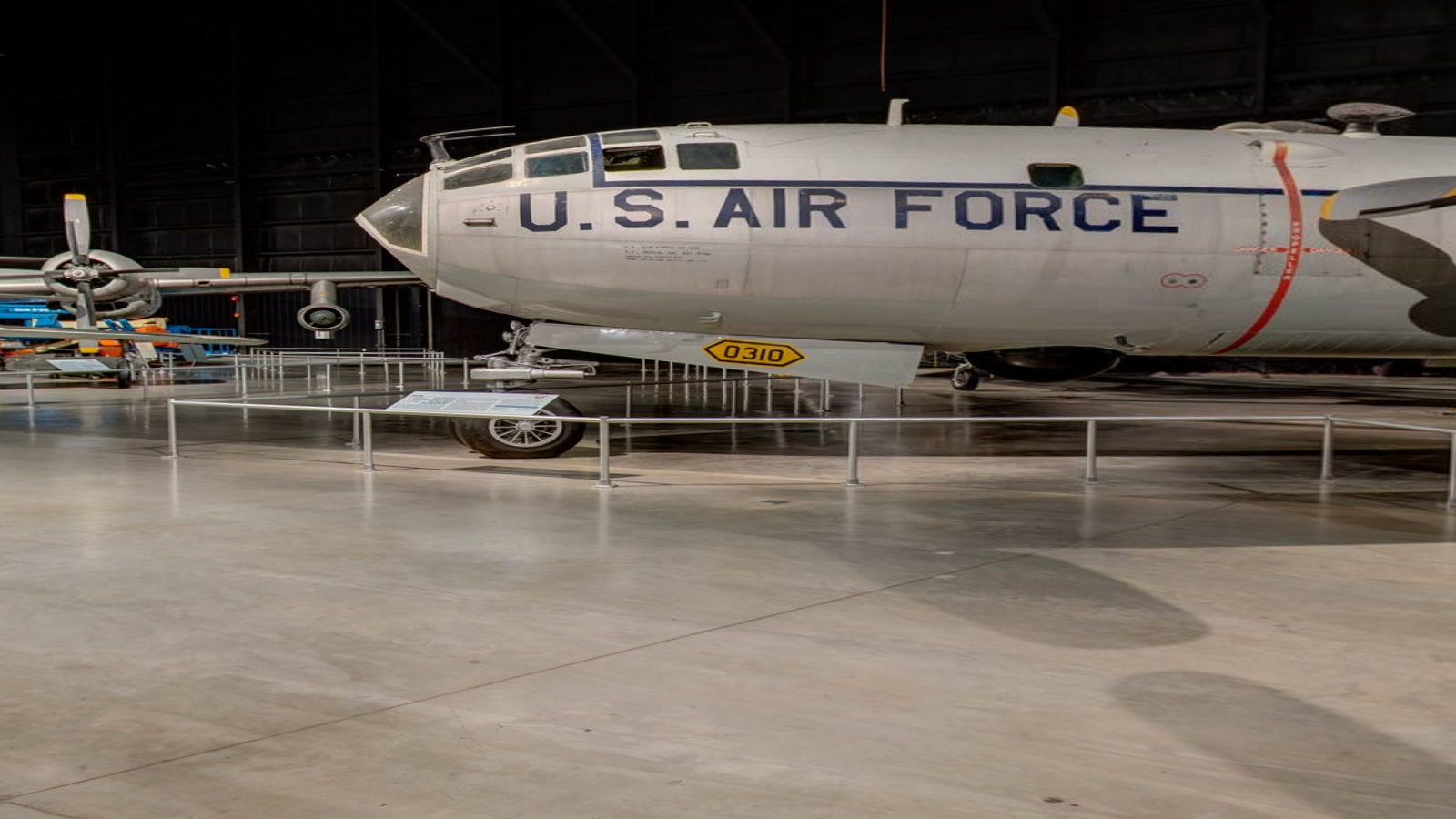
WB-50D Superfortress
The WB-50D turned a bomber airframe into a long-range weather reconnaissance platform. Crews penetrated storms, sampled the atmosphere, and gathered the data needed for flight planning and forecasting. During an era of global bomber routes and missile testing, accurate weather information was part of operational readiness.
In depth
History & service
The B-50, the last propeller-driven bomber delivered to the U.S. Air Force, made its initial flight on June 25, 1947. Basically an improved version of the B-29, this aircraft's large number of modifications caused its redesignation as the B-50. Between 1948 and 1954, B-50s served with the Strategic Air Command as medium bombers, and they were replaced by jet-propelled B-47s. Many were modified for support roles such as weather reconnaissance, crew training, photo-mapping and aerial refueling.
In 1953 the USAF decided to replace its aging WB-29 weather reconnaissance aircraft with modified B-50Ds. Stripped of their defensive armament, 36 B-50Ds were equipped for long-range weather reconnaissance missions with high-altitude atmospheric samplers, Doppler radar, weather radar and a bomb-bay fuel tank for extended range. Some WB-50 aircraft also flew missions to sample the air for radioactive particles indicating that the Soviet Union had detonated a nuclear weapon.
The WB-50D aircraft accomplished special weather reconnaissance missions with SAC's 97th Bomb Wing until April 1955, when all WB-50s went to the Air Weather Service.
In 1963 the USAF started phasing out the WB-50Ds, and in 1965 the aircraft on display became the last WB-50D to be retired. It was delivered to the museum in 1968.
Details that tell the story
Weather-reconnaissance development of the B-50 · Carried specialized meteorological equipment · Supported global forecasting and atmospheric research
The aircraft in figures
Engines: Four Pratt & Whitney R-4360s of 3,500 hp each · Maximum speed: 395 mph · Range: 4,900 statute miles (without aerial refueling) · Ceiling: 36,700 ft. · Span: 141 ft. 2 in. · Length: 99 ft. · Height: 32 ft. 8 in. · Weight: 173,000 lbs. maximum · Serial number: 49-0310
Readiness became a permanent condition
During the Cold War, aviation was organized around the possibility of a conflict that governments hoped to prevent. Bombers, missiles, interceptors, reconnaissance aircraft, warning networks, and tankers became parts of interdependent systems. Their value was judged not only by what they could do in flight, but by how reliably they could be maintained, alerted, launched, supported, and controlled.
This emphasis produced striking aircraft and difficult tradeoffs. Long range demanded fuel and support. High speed increased heat and mechanical stress. Sophisticated electronics offered new capabilities but created new maintenance requirements. A reconnaissance aircraft needed an effective camera and a workable route as well as altitude or speed. An interceptor depended on warning and guidance before its pilot could make an engagement.
The human experience included long periods of training and routine punctuated by crises. Crews and ground personnel practiced procedures whose purpose was to remain credible without being used in war. At the same time, military aviation carried out reconnaissance, transport, rescue, humanitarian missions, and conventional operations around the world. Linking these aircraft with civil airliners, research machines, and spacecraft reveals a history of shared technologies and different purposes. The machines embody technical accomplishment, but also the enormous resources and sustained human effort required to keep a global force ready.