Air Force Museum
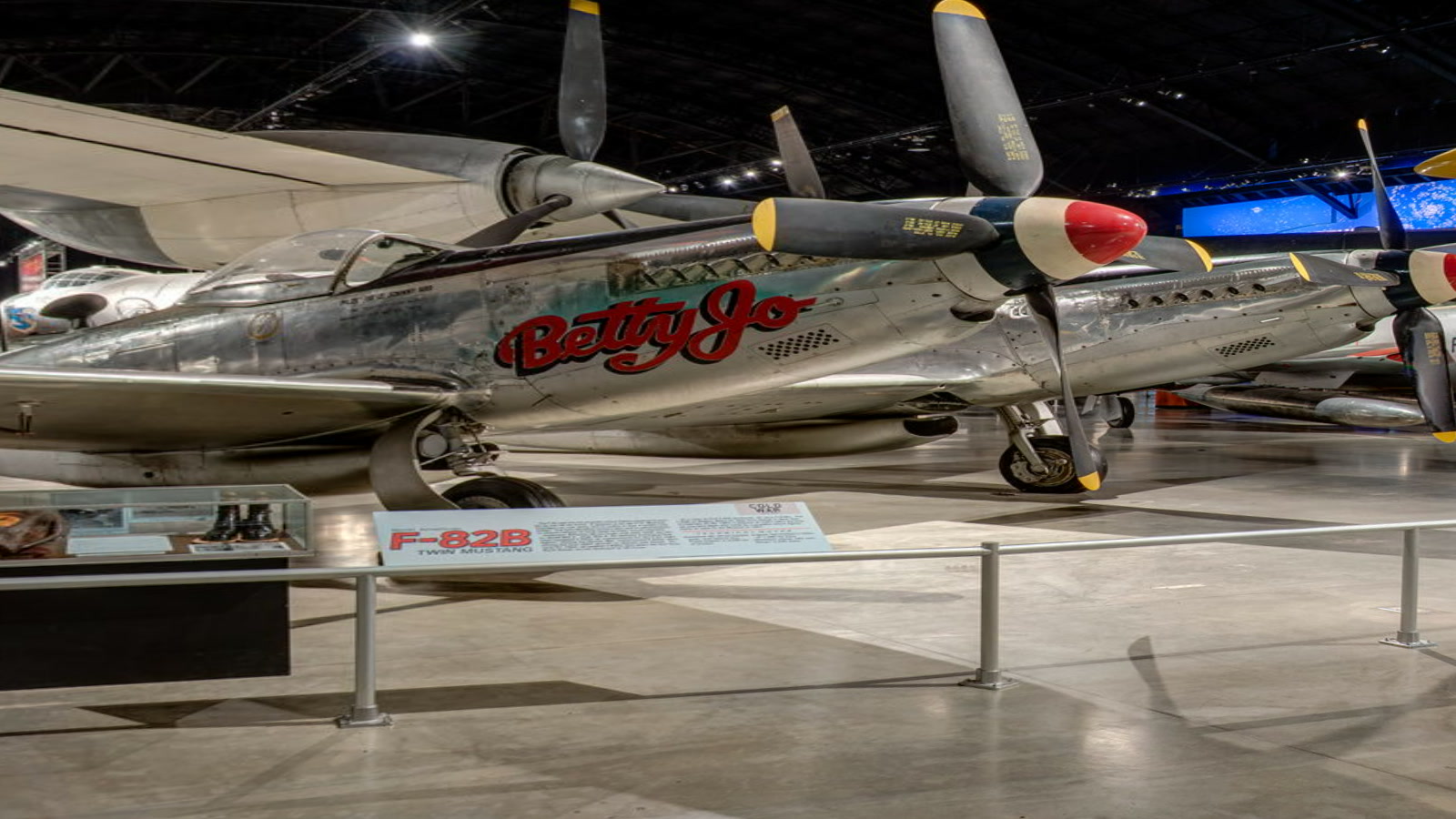
F-82B Twin Mustang
The Twin Mustang joined two Mustang-derived fuselages to produce a long-range fighter for escort and air-defense missions. Its range answered a late-World War II requirement, but the aircraft found an immediate postwar role in all-weather interception. Related F-82 models later scored some of the first U.S. aerial victories of the Korean War.
In depth
History & service
The F-82 was the last propeller-driven fighter acquired in quantity by the U.S. Air Force. It appears to be two P-51 Mustang fuselages on one wing, but in reality it was a totally new design. The Twin Mustang carried a pilot and co-pilot/navigator to reduce fatigue on long-range bomber escort missions. Production deliveries did not begin until early 1946, too late for World War II. After WWII, Air Defense Command flew radar-equipped F-82Gs as replacements for the P-61 night fighter.
During the Korean War, Japan-based F-82Gs were among the first USAF aircraft to operate over Korea. On June 27, 1950, all-weather F-82Gs shot down the first three North Korean airplanes destroyed by U.S. forces.
Of a total of 273 F-82s produced, 20 were F-82Bs. The F-82B on display, Betty-Jo, flew from Hawaii to New York on Feb. 27-28, 1947, a distance of 5,051 miles, the longest non-stop flight ever made by a propeller-driven fighter. Betty-Jo came to the museum in 1957.
Details that tell the story
Long-range, twin-fuselage fighter · Adapted for radar-equipped interception · F-82 variants served at the opening of the Korean War
The aircraft in figures
Armament: Six .50-cal. machine guns, 25 5-inch rockets and 4,000 lbs. of · bombs · Engines: Two Packard V-1650s of 1,380 hp each · Maximum speed: 482 mph · Cruising speed: 280 mph · Range: 2,200 miles · Ceiling: 39,000 ft. · Span: 51 ft. 3 in. · Length: 38 ft. 1 in. · Height: 13 ft. 8 in.
Performance was only part of the contest
A fighter's speed, climb, range, visibility, and armament shaped what it could do, but those qualities did not act alone. Training, tactics, warning systems, maintenance, fuel, and the condition of the airfield influenced every encounter. The aircraft that looks best in a table might be at a disadvantage at the wrong altitude, carrying the wrong load, or arriving with too little fuel to remain in the fight.
Escort missions demonstrate the importance of purpose. A fighter defending bombers had responsibilities beyond pursuing an opponent. It needed sufficient range, a useful position, and the discipline to remain with the force it protected. Ground attack imposed different demands, including visibility, endurance near the target, and the ability to survive damage from below.
Comparing aircraft across museums is most rewarding when the mission remains in view. An early pursuit biplane, a wartime piston fighter, and a Cold War jet represent different technologies, but all were part of a larger operational system. Personal accounts reveal how pilots worked within those limits. They also show why claims of individual success need context: weather, surprise, teamwork, and opportunities created by others shaped the outcome. The aircraft provides the physical evidence; the surrounding stories explain how people used it and what that use cost.