Air Force Museum
Tactical Air Command
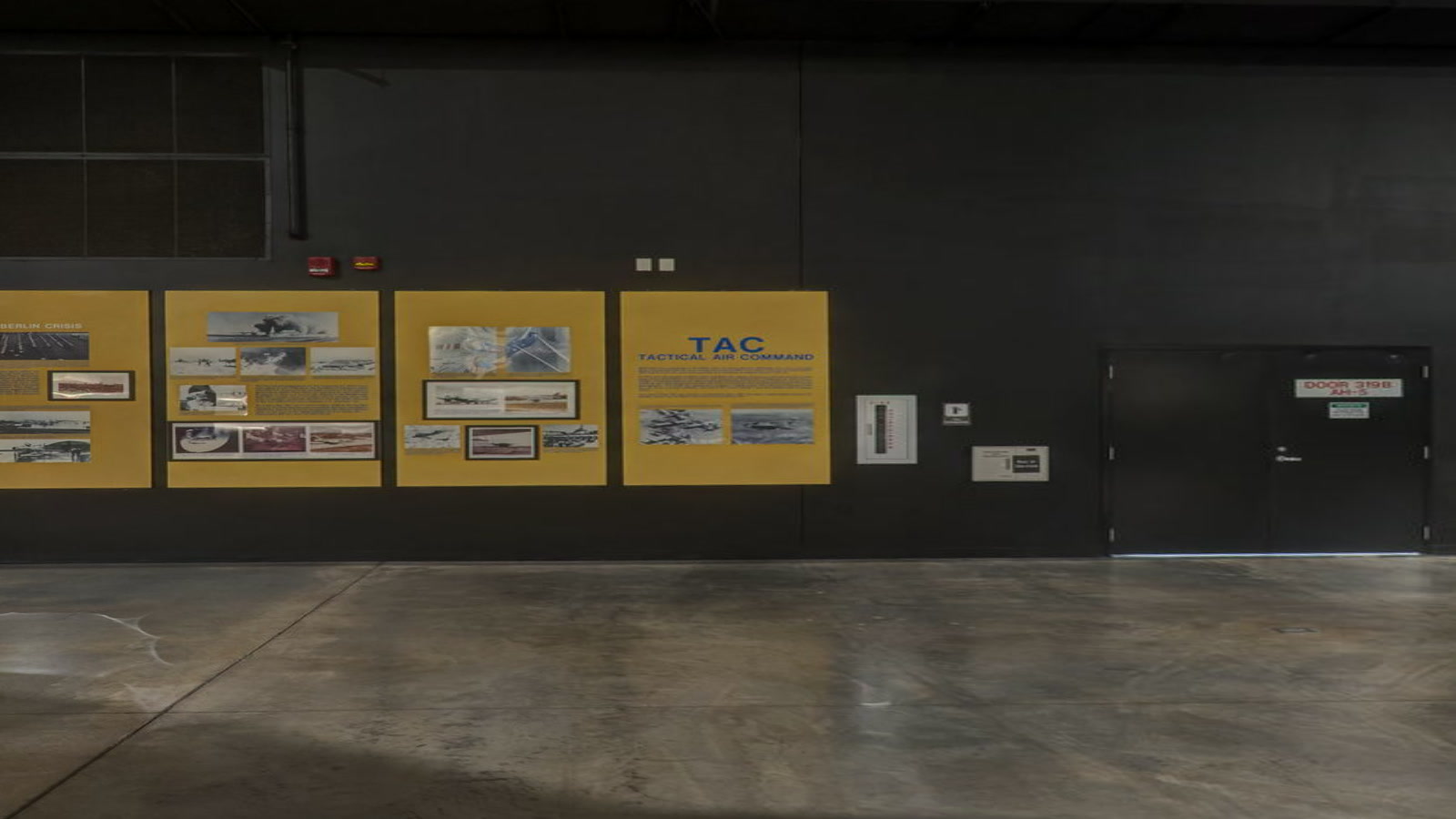
Tactical Air Command organized the fighters, reconnaissance aircraft, troop carriers, and support systems intended to influence a battle directly. Its Cold War mission ranged from reinforcing NATO to responding to regional crises. TAC’s history shows why combat aircraft depended on tankers, transports, maintenance, communications, and deployable bases.
In depth
History & service
While Strategic Air Command (SAC) was expanding in the 1950s, Tactical Air Command (TAC) was doing likewise. Although many of its units had been transferred to the Far East during the Korean Conflict and others to Europe to bolster NATO, TAC had formed new units and acquired new airplanes to replace those it had lost.
In 1955 TAC developed a mobile strike capability for rapidly moving its units from the United States to any area of the world where a "brush-fire" was threatened. Named the "Composite Air Strike Force" (CASF), it included fighters for delivering both conventional and nuclear weapons, transports for airlifting men and equipment, tankers for mid-air refueling and reconnaissance planes for aerial photography. The CASF was designed to augment combat-ready units already assigned to the U.S. Air Force in Europe, the Pacific Air Force and the Alaskan Air Command.
Two years later, TAC was further strengthened when SAC no longer needed fighter planes for bomber escort and its fighter units were transferred to TAC.
The first actual employment of the CASF took place in July 1958 when the president of Lebanon called upon the United States to prevent the possible overthrow of his nation's government. Within three hours of receiving an alert, TAC had its planes on their way across the Atlantic to the Middle East. With TAC's nuclear forces in Turkey only 15 minutes away, the crisis in Lebanon gradually dissolved and the CASF returned to the United States without having to engage in a "shooting" war.
Six weeks later TAC had to send another CASF to the Far East because of a Red Chinese announcement that they intended to attack the island of Quemoy occupied by the Chinese Nationalists. In the face of the rapid reaction by U.S. forces, the Communists did not carry out their threat.
Details that tell the story
Established in 1946 · Responsible for major tactical combat capabilities · Deployed forces rapidly during Cold War crises
Readiness became a permanent condition
During the Cold War, aviation was organized around the possibility of a conflict that governments hoped to prevent. Bombers, missiles, interceptors, reconnaissance aircraft, warning networks, and tankers became parts of interdependent systems. Their value was judged not only by what they could do in flight, but by how reliably they could be maintained, alerted, launched, supported, and controlled.
This emphasis produced striking aircraft and difficult tradeoffs. Long range demanded fuel and support. High speed increased heat and mechanical stress. Sophisticated electronics offered new capabilities but created new maintenance requirements. A reconnaissance aircraft needed an effective camera and a workable route as well as altitude or speed. An interceptor depended on warning and guidance before its pilot could make an engagement.
The human experience included long periods of training and routine punctuated by crises. Crews and ground personnel practiced procedures whose purpose was to remain credible without being used in war. At the same time, military aviation carried out reconnaissance, transport, rescue, humanitarian missions, and conventional operations around the world. Linking these aircraft with civil airliners, research machines, and spacecraft reveals a history of shared technologies and different purposes. The machines embody technical accomplishment, but also the enormous resources and sustained human effort required to keep a global force ready.