Air Force Museum
1962 Bendix Trophy
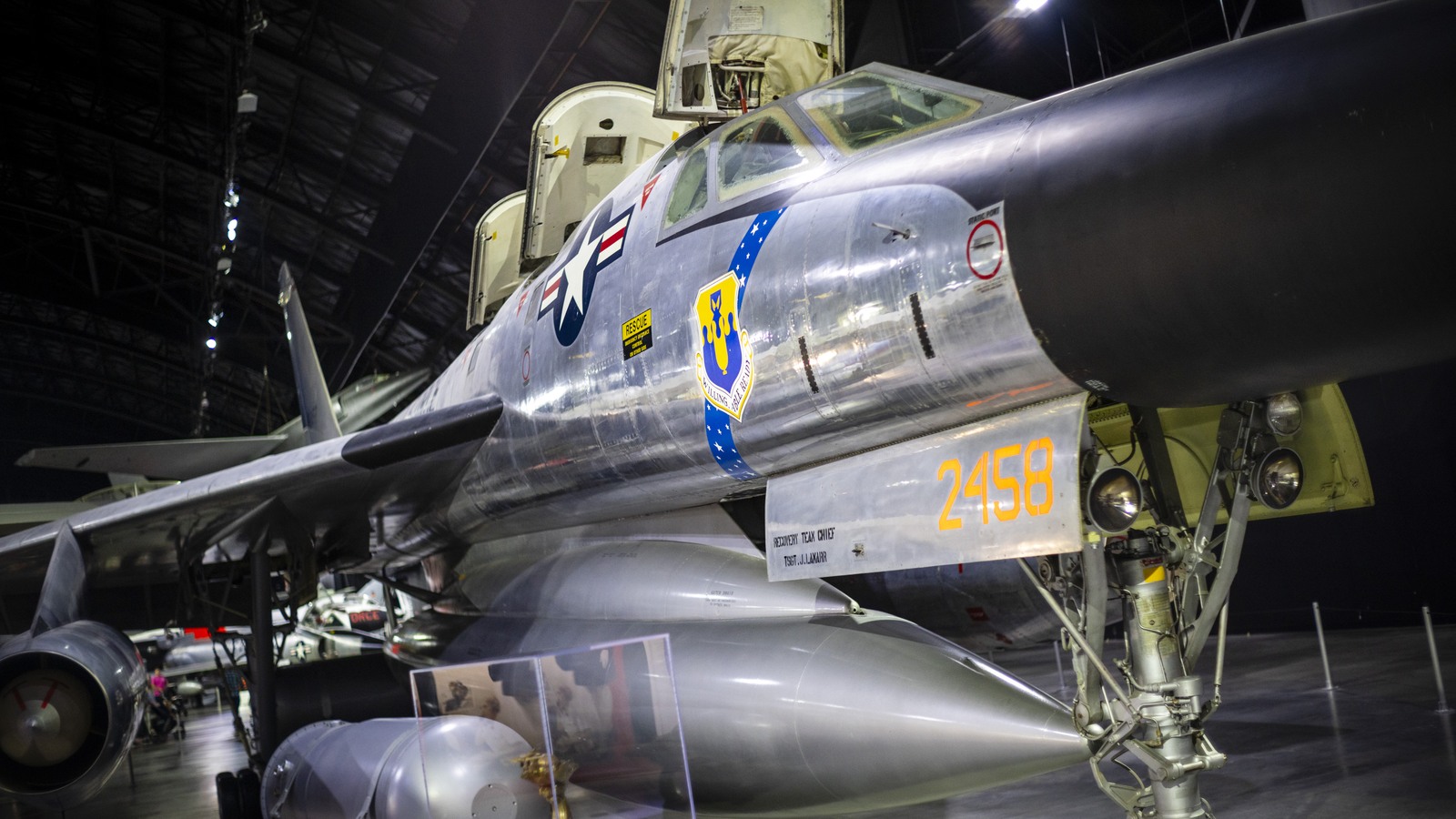
This trophy marks the B-58’s 1962 transcontinental speed run from Los Angeles to New York and back. The record flight publicized the bomber’s performance while demonstrating the navigation, tanker coordination, maintenance, and crew discipline required to sustain supersonic operations. The achievement was both a competition and a strategic message.

In depth
History & service
On March 5, 1962, Capts. Robert G. Sowers (pilot), Robert MacDonald (navigator) and John T. Walton (defensive systems operator) flew from Los Angeles to New York City in the B-58A on display at the museum in only 2 hours 56.8 seconds, an average speed of 1,214.17 miles per hour. For this, they were awarded the Bendix Trophy for 1962 and each received the Distinguished Flying Cross. They broke two other speed records on the return flight -- New York to Los Angeles and for the roundtrip.
Twenty-eight years later on March 6, 1990, an Air Force crew flew an SR-71 Blackbird from Los Angeles to the east coast (Washington, D.C.) in just under 68 minutes, at an average speed of 2,124.5 mph.
The Bendix Trophy cross-country races, sponsored by the Bendix Corp., began in 1931. The award was established to encourage aviation progress. The winner of the first such race was Maj. James H. Doolittle, who flew from Los Angeles to Cleveland, Ohio, at an average speed of 223 miles per hour. The actual Bendix Trophy is nearly three feet tall and weighs approximately 100 pounds. Winners receive a smaller replica such as the one pictured at left and displayed near the B-58 in the museum.
Details that tell the story
Awarded for a 1962 B-58 record flight · Flight crossed the United States in both directions · Crew also received the Mackay Trophy
Readiness became a permanent condition
During the Cold War, aviation was organized around the possibility of a conflict that governments hoped to prevent. Bombers, missiles, interceptors, reconnaissance aircraft, warning networks, and tankers became parts of interdependent systems. Their value was judged not only by what they could do in flight, but by how reliably they could be maintained, alerted, launched, supported, and controlled.
This emphasis produced striking aircraft and difficult tradeoffs. Long range demanded fuel and support. High speed increased heat and mechanical stress. Sophisticated electronics offered new capabilities but created new maintenance requirements. A reconnaissance aircraft needed an effective camera and a workable route as well as altitude or speed. An interceptor depended on warning and guidance before its pilot could make an engagement.
The human experience included long periods of training and routine punctuated by crises. Crews and ground personnel practiced procedures whose purpose was to remain credible without being used in war. At the same time, military aviation carried out reconnaissance, transport, rescue, humanitarian missions, and conventional operations around the world. Linking these aircraft with civil airliners, research machines, and spacecraft reveals a history of shared technologies and different purposes. The machines embody technical accomplishment, but also the enormous resources and sustained human effort required to keep a global force ready.