Air Force Museum
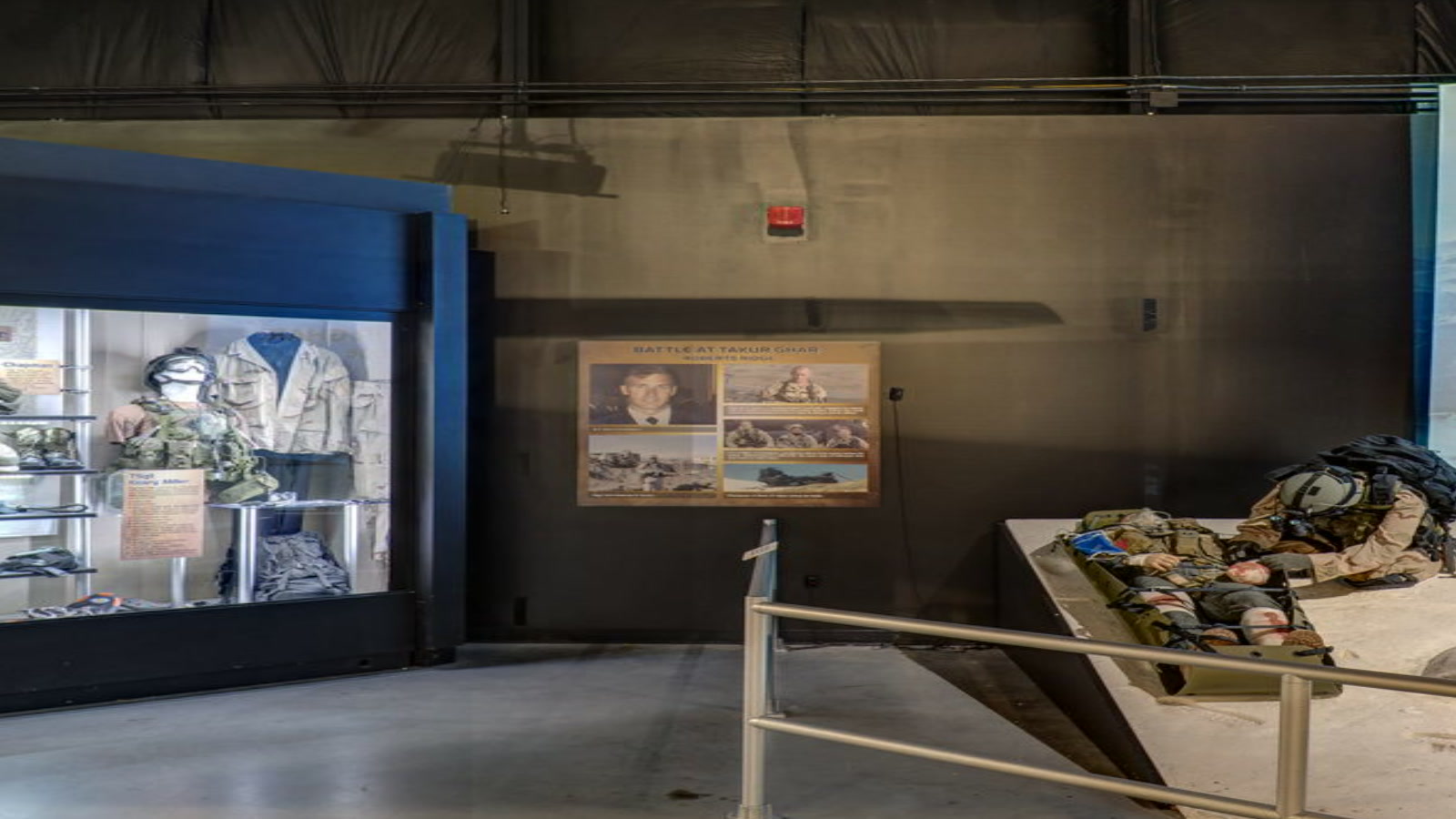
Battle at Takur Ghar
The battle on Takur Ghar in March 2002 showed the extraordinary demands placed on joint special-operations teams in Afghanistan. At high altitude and under intense fire, airmen coordinated air support, treated casualties, fought alongside ground forces, and attempted rescue. The episode made clear that modern air power reaches the battlefield through trained people as well as aircraft.
In depth
History & service
In March 2002, in conjunction with Operation Anaconda, small reconnaissance teams established observation posts in strategic locations in Afghanistan and directed U.S. air power against enemy targets. During this campaign, a small US force fought a 17-hour intense battle against enemy forces on the mountaintop of Takur Ghar, which came to be known as Roberts Ridge.
At about 1:00 am on March 4, Razor 03, a U.S. Army MH-47E helicopter tried to insert a reconnaissance team on top of Takur Ghar, unaware it was an enemy stronghold. While landing, it was hit by a rocket propelled grenade (RPG) and gunfire, causing US Navy SEAL Neil Roberts to fall from the helicopter. With the MH-47E heavily damaged, the aircrew made an emergency landing about three miles away. U.S. Air Force Combat Controller Tech. Sgt. John A.
Chapman, a member of the team, began coordinating close air support and a rescue effort to retrieve Roberts. Another helicopter, Razor 04, picked up the team and took them back to rescue Roberts on the 10,000-foot mountaintop.
Once on the ground, Chapman left the helicopter and charged uphill through the snow toward enemy positions while under heavy fire from three directions. Receiving fire from two enemy personnel in a fortified position, Chapman returned fire, killing both. Almost immediately, the team began taking machine gun fire from another fortified enemy position only 12 meters away. Chapman deliberately moved into the open to engage the new enemy position.
As he engaged the enemy, he was struck by a burst of gunfire and became critically injured. Regaining his faculties, Chapman continued to fight relentlessly despite his severe wounds. For over an hour he sustained a violent engagement with multiple enemy fighters through the arrival of the quick reaction force, before being fatally wounded. Credited with saving the lives of his teammates, Chapman was posthumously awarded the Medal of Honor and promoted to Master Sgt.
The quick reaction force helicopter, Razor 01, arrived carrying a Ranger team and four Air Force personnel—Staff Sgt. Kevin Vance, Staff Sgt. Gabe Brown, Senior Airman Jason Cunningham, and Tech. Sgt. Keary Miller. As it landed, Razor 01 was hit with multiple RPGs and riddled with machine gun fire that immediately killed and wounded several of those onboard. Vance and Brown coordinated close air support throughout the entire battle, both receiving the Silver Star for heroism.
Cunningham, a pararescuman (PJ), began administering trauma care and moving the wounded out of the burning helicopter. For several hours, and without regard for his safety, Cunningham returned fire and repeatedly moved casualties out of the line of fire. His actions to save others made himself vulnerable and he was mortally wounded. Senior Airman Cunningham was posthumously awarded the Air Force Cross for his selfless acts.
When Cunningham was killed, Miller, another PJ, assumed his role – providing medical aid under fire to the wounded – and braved enemy fire to move the wounded to better cover and concealment. For his actions, Tech. Sgt. Miller was awarded the Air Force Cross.
Though hit with mortar rounds, RPGs, and small-arms fire, the team on the ground sporadically battled the enemy for hours. With the essential support of air power, they slowly silenced the enemy. At 8:15 pm, helicopters arrived, and all US personnel, including the seven dead, were taken off the mountaintop.
Details that tell the story
Fought during Operation Anaconda in March 2002 · Occurred on a high mountain in eastern Afghanistan · Involved special operations forces and battlefield airmen
Readiness became a permanent condition
During the Cold War, aviation was organized around the possibility of a conflict that governments hoped to prevent. Bombers, missiles, interceptors, reconnaissance aircraft, warning networks, and tankers became parts of interdependent systems. Their value was judged not only by what they could do in flight, but by how reliably they could be maintained, alerted, launched, supported, and controlled.
This emphasis produced striking aircraft and difficult tradeoffs. Long range demanded fuel and support. High speed increased heat and mechanical stress. Sophisticated electronics offered new capabilities but created new maintenance requirements. A reconnaissance aircraft needed an effective camera and a workable route as well as altitude or speed. An interceptor depended on warning and guidance before its pilot could make an engagement.
The human experience included long periods of training and routine punctuated by crises. Crews and ground personnel practiced procedures whose purpose was to remain credible without being used in war. At the same time, military aviation carried out reconnaissance, transport, rescue, humanitarian missions, and conventional operations around the world. Linking these aircraft with civil airliners, research machines, and spacecraft reveals a history of shared technologies and different purposes. The machines embody technical accomplishment, but also the enormous resources and sustained human effort required to keep a global force ready.