Air Force Museum
Hunting the Terrorists Down
After September 11, 2001, American air power combined persistent surveillance, special operations, precision strike, and local partnerships against dispersed networks. The campaign required aircraft and ground teams to exchange information quickly across difficult terrain. It also produced continuing debates over intelligence, civilian protection, detention, and the duration of global counterterrorism operations.
In depth
History & service
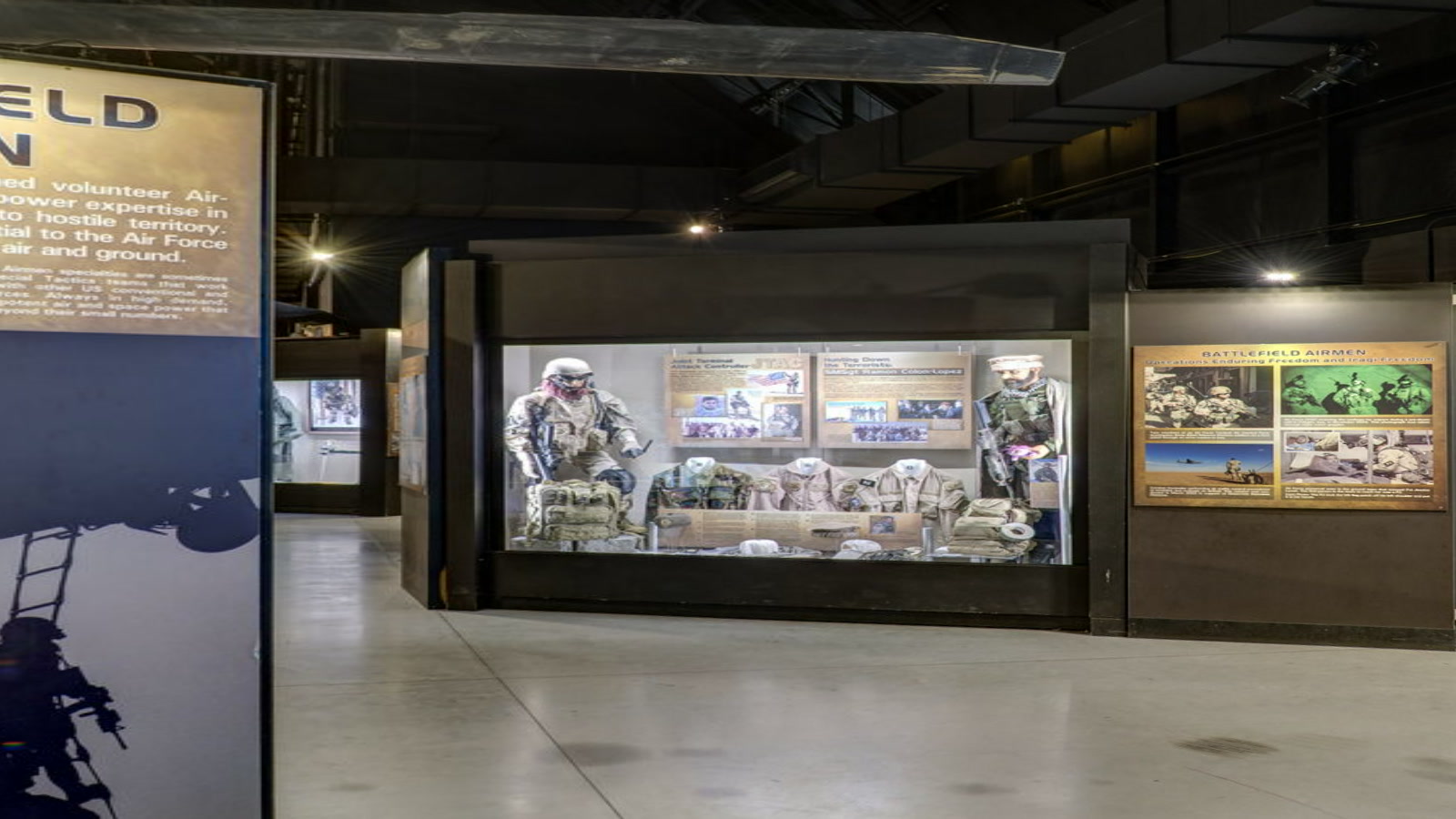
Pararescueman Senior Master Sgt. Ramon Colon-Lopez deployed to Afghanistan shortly after 9/11, and he participated in direct action and combat search and rescue (CSAR) missions to capture or kill high value targets directly related to the recent terrorist attacks on U.S. soil and abroad. He also provided security for Hamid Kharzai, who was elected president of Afghanistan in 2004.
On March 11, 2004, Colon-Lopez was on an operation in Afghanistan to capture a high-value target -- a drug king-pin who was funding terrorism -- and to prevent the proliferation of chemical weapons. Colon-Lopez was on the first of four helicopters, which took sustained small-arms fire and was seriously damaged as it landed. Though he did not know the size of the enemy force, Colon-Lopez moved forward under fire, overrunning the enemy positions. His action suppressed enemy fire against the other three helicopters.
Colon-Lopez and the team drove the enemy away. They killed two of the enemy, captured 10, and destroyed a stash of rocket propelled grenade (RPG) rounds and small caliber weapons. Because of their quick reaction and suppression of the danger facing them, no Americans were killed.
Details that tell the story
Operations began in Afghanistan in 2001 · Combined conventional and special-operations forces · Relied heavily on surveillance and precision strike
Readiness became a permanent condition
During the Cold War, aviation was organized around the possibility of a conflict that governments hoped to prevent. Bombers, missiles, interceptors, reconnaissance aircraft, warning networks, and tankers became parts of interdependent systems. Their value was judged not only by what they could do in flight, but by how reliably they could be maintained, alerted, launched, supported, and controlled.
This emphasis produced striking aircraft and difficult tradeoffs. Long range demanded fuel and support. High speed increased heat and mechanical stress. Sophisticated electronics offered new capabilities but created new maintenance requirements. A reconnaissance aircraft needed an effective camera and a workable route as well as altitude or speed. An interceptor depended on warning and guidance before its pilot could make an engagement.
The human experience included long periods of training and routine punctuated by crises. Crews and ground personnel practiced procedures whose purpose was to remain credible without being used in war. At the same time, military aviation carried out reconnaissance, transport, rescue, humanitarian missions, and conventional operations around the world. Linking these aircraft with civil airliners, research machines, and spacecraft reveals a history of shared technologies and different purposes. The machines embody technical accomplishment, but also the enormous resources and sustained human effort required to keep a global force ready.