Air Force Museum
MiG-29A
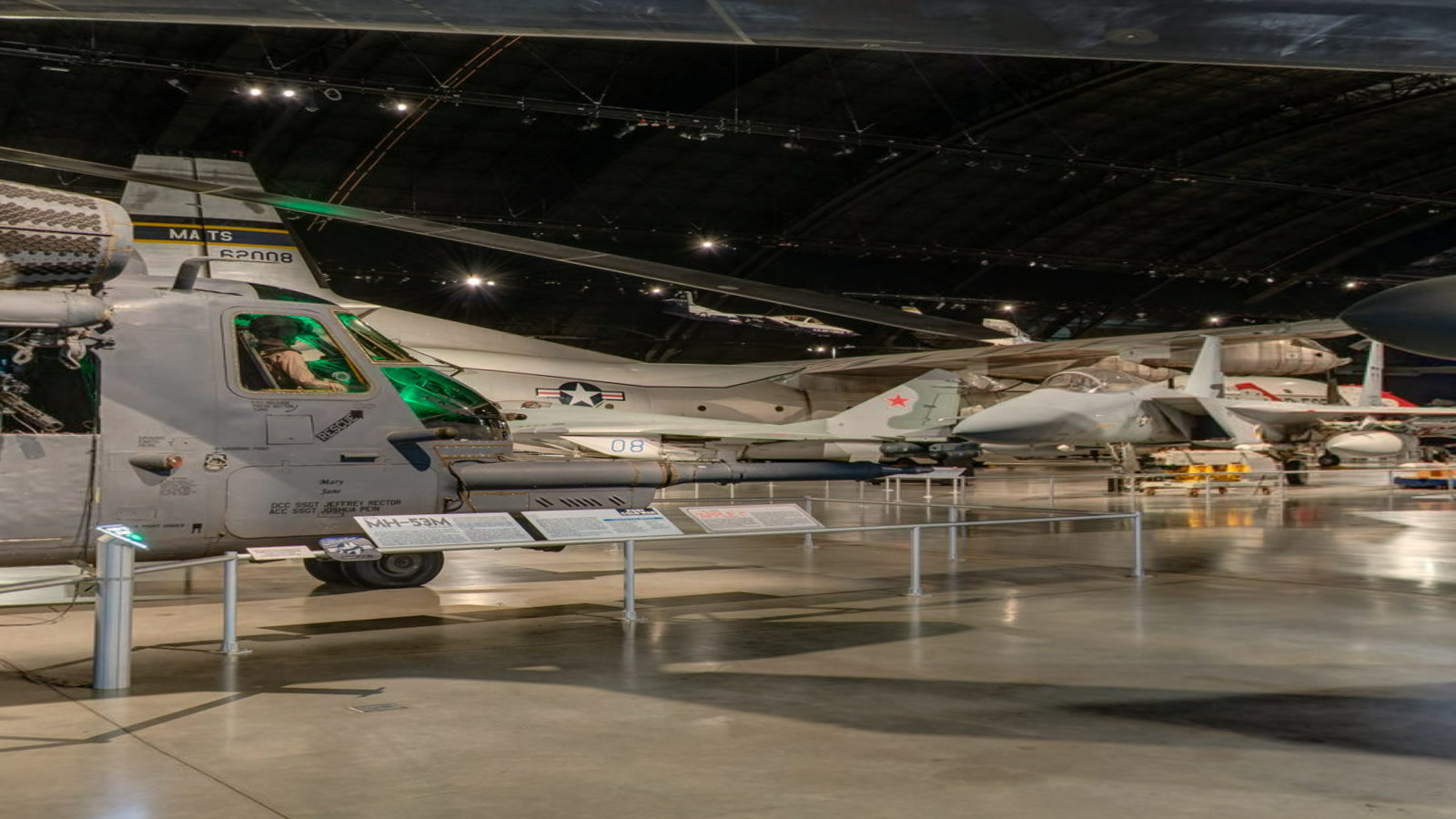
The Soviet-designed MiG-29 was built as an agile frontline fighter able to operate from dispersed bases. Its appearance in this gallery allows direct comparison between rival Cold War design philosophies. After the Soviet bloc fractured, the United States acquired examples for evaluation, training, and preservation.
In depth
History & service
The MiG-29 was designed in response to a new generation of American fighters, which included the F-15 and F-16. Designed as an air defense fighter, this dual-purpose aircraft also possessed a ground attack capability. The task of producing a "frontal" or tactical fighter for the Frontal Aviation Regiments of the Soviet Air Force went to the Mikoyan-Gurevich Design Bureau (MiG OKB).
Production started in 1982, and deliveries to Frontal Aviation units started in 1983. By comparison, the USAF's first operational F-15As arrived seven years earlier in 1976, and its F-16As entered operational service four years earlier in 1979.
Although newer, the MiG-29 still lagged behind the most modern Western fighters in several important areas.
For instance, the aircraft designers had little experience in either fly-by-wire controls or lightweight composite materials for airframe construction, and the first MiG-29 versions used a conventional hydraulic flight control system and an aluminum alloy fuselage. Over time, MiG designers addressed these deficiencies, and later variants of the MiG-29 incorporated some fly-by-wire controls and composite materials.
Nevertheless, the MiG-29 presented a formidable threat to Western pilots. The radars used on earlier Soviet fighters had been unable to distinguish aircraft flying below them from ground clutter, and low-flying aircraft could avoid detection. With the Phazotron NIIR N019 Doppler radar (NATO designation "Slot Back") capable of detecting a target more than 60 miles away, infrared tracking sensors, and a laser rangefinder carried on the MiG-29, a pilot could track and shoot at aircraft flying below him.
Also, the pilot's Shchel-3UM-1 helmet-mounted aiming device turned the MiG-29 into a very dangerous threat once opponents came within visual range. No longer did a pilot have to turn his aircraft toward a target and wait for his missiles' sensors to "lock-on" before firing. Now, the pilot simply turned his head toward a target, and the helmet aimed the missile's sensors toward the target. This "off boresight" procedure gave the MiG-29 pilot a great advantage at close range.
The aircraft on display was an early model Soviet Air Force MiG-29A (S/N 2960516761) assigned to the 234th Gvardeiskii Istrebitelnii Aviatsionnii Polk (234th Guards Fighter Aviation Regiment) stationed at Kubinka Air Base near Moscow. It was one of the six MiG-29s that made a good will visit to Kuopio-Rissala, Finland, in July 1986. This event marked the first public display of the MiG-29.
Details that tell the story
First flew in 1977 · Twin-engine tactical fighter · Exported widely to Soviet allies and partner states
The aircraft in figures
Armament: One 30mm GSh-301 cannon; six air-to-air missiles (mixture of medium-range, radar-guided AA-10 "Alamo-A;" or close-range, infrared-guided AA-11 "Archer;" and/or close-range, infrared-guided AA-8 "Aphid" missiles); able to carry bombs and 57mm, 80mm and 240mm rockets in attack role. · Engines: Two Isotov RD-33 turbofans of approx. 18,300 lbs. thrust each with afterburner · Maximum speed: Approx. Mach 2.3
Performance was only part of the contest
A fighter's speed, climb, range, visibility, and armament shaped what it could do, but those qualities did not act alone. Training, tactics, warning systems, maintenance, fuel, and the condition of the airfield influenced every encounter. The aircraft that looks best in a table might be at a disadvantage at the wrong altitude, carrying the wrong load, or arriving with too little fuel to remain in the fight.
Escort missions demonstrate the importance of purpose. A fighter defending bombers had responsibilities beyond pursuing an opponent. It needed sufficient range, a useful position, and the discipline to remain with the force it protected. Ground attack imposed different demands, including visibility, endurance near the target, and the ability to survive damage from below.
Comparing aircraft across museums is most rewarding when the mission remains in view. An early pursuit biplane, a wartime piston fighter, and a Cold War jet represent different technologies, but all were part of a larger operational system. Personal accounts reveal how pilots worked within those limits. They also show why claims of individual success need context: weather, surprise, teamwork, and opportunities created by others shaped the outcome. The aircraft provides the physical evidence; the surrounding stories explain how people used it and what that use cost.