Air Force Museum
Explosive Ordnance Disposal
Explosive Ordnance Disposal teams identify and neutralize weapons that threaten aircraft, bases, troops, and civilians. The work ranges from conventional bombs to improvised explosive devices and requires patient analysis under severe time pressure. EOD personnel also preserve evidence and advise commanders on how an explosive threat was constructed.
In depth
History & service
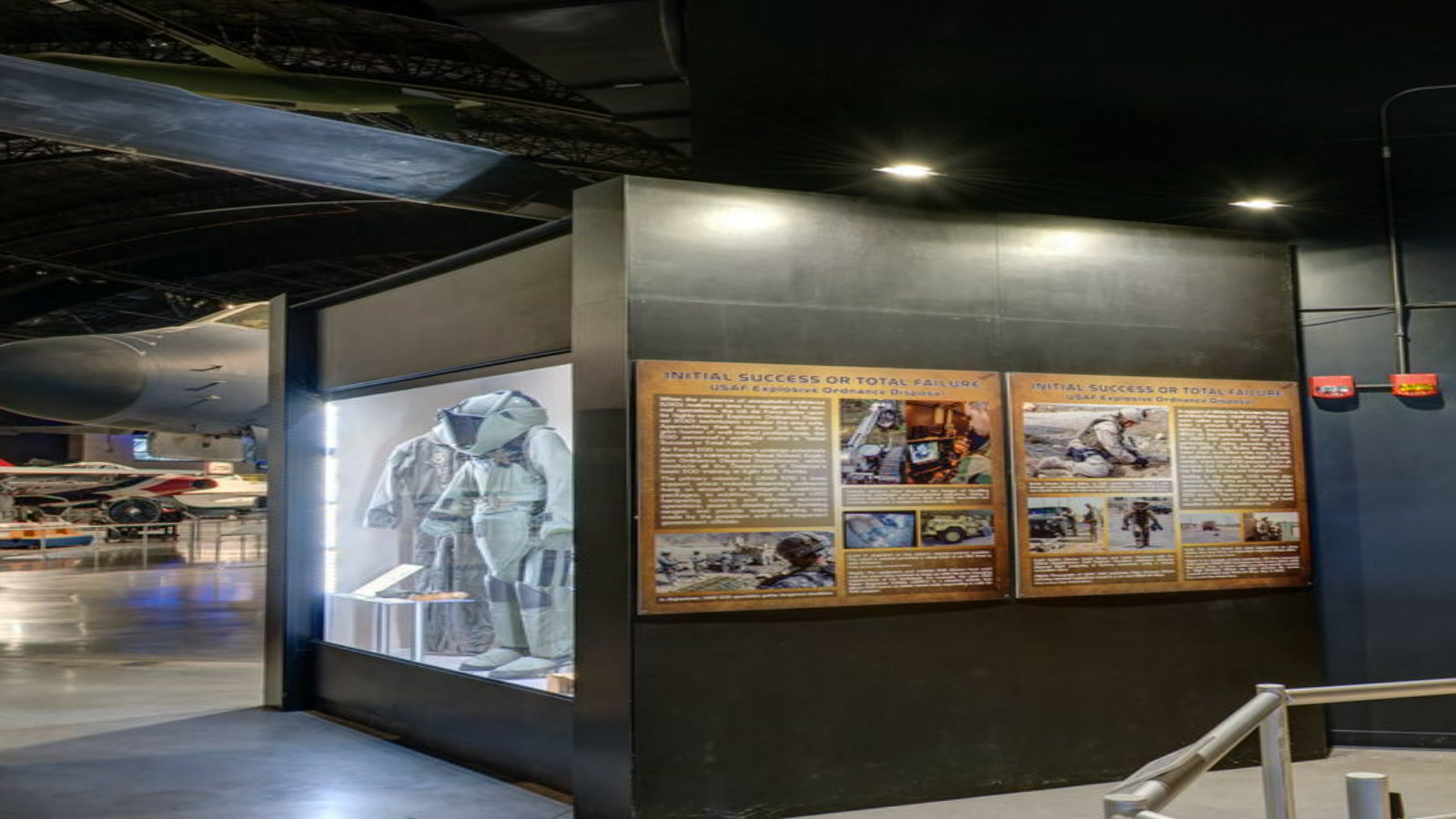
When the presence of unexploded ordnance (UXO) makes an area too dangerous for normal operations, the U.S. Air Force relies upon its highly-trained Explosive Ordnance Disposal (EOD) technicians to make the area safe. Approaching their dangerous job with the grim humor of well-trained professionals, the EOD personnel's unofficial motto is "Initial Success or Total Failure."
Air Force EOD technicians undergo extremely demanding training at the Naval School, Explosive Ordnance Disposal Detachment, which conducts all the Department of Defense's basic EOD training at Eglin Air Force Base, Fla.
The primary mission of USAF EOD is base support, which includes disarming ordnance hung on aircraft or investigating suspicious packages. In addition, they remove UXO hampering runway and airbase recovery operations, assist in clearing active bombing ranges, and provide support during trips made by the president and other important government officials.
In support of Operations Enduring Freedom and Iraqi Freedom, USAF EOD technicians were called upon to assist in what had been a primarily U.S. Army mission -- defusing Improvised Explosive Devices (IEDs) on the battlefield. Since Vietnam, no USAF EOD personnel had died while performing a safing procedure, but in March 2006, Tech. Sgt. Walter Moss, an EOD team chief, was killed while trying to safe an explosive device near Baghdad.
Unfortunately, many more EOD personnel from all services lost life and limb while performing their duty in Iraq and Afghanistan.
Details that tell the story
Respond to conventional and improvised explosive hazards · Support both flight-line safety and deployed operations · Combine technical analysis with protective equipment and robotics
Readiness became a permanent condition
During the Cold War, aviation was organized around the possibility of a conflict that governments hoped to prevent. Bombers, missiles, interceptors, reconnaissance aircraft, warning networks, and tankers became parts of interdependent systems. Their value was judged not only by what they could do in flight, but by how reliably they could be maintained, alerted, launched, supported, and controlled.
This emphasis produced striking aircraft and difficult tradeoffs. Long range demanded fuel and support. High speed increased heat and mechanical stress. Sophisticated electronics offered new capabilities but created new maintenance requirements. A reconnaissance aircraft needed an effective camera and a workable route as well as altitude or speed. An interceptor depended on warning and guidance before its pilot could make an engagement.
The human experience included long periods of training and routine punctuated by crises. Crews and ground personnel practiced procedures whose purpose was to remain credible without being used in war. At the same time, military aviation carried out reconnaissance, transport, rescue, humanitarian missions, and conventional operations around the world. Linking these aircraft with civil airliners, research machines, and spacecraft reveals a history of shared technologies and different purposes. The machines embody technical accomplishment, but also the enormous resources and sustained human effort required to keep a global force ready.