Air Force Museum
B-2 Spirit
The B-2 combined low-observable shaping, materials, sensors, and long range to penetrate heavily defended airspace. Developed during the Cold War and revealed publicly in 1988, the flying-wing bomber entered service in a changed strategic world. It later delivered both conventional precision weapons and maintained a role in nuclear deterrence.
In depth
History & service
The global spread of sophisticated air defense systems in the 1980s threatened the USAF's ability to destroy an enemy's most valued targets. To overcome this threat, the USAF incorporated the revolutionary low-observable, or "stealth," technology into a long-range bomber capable of delivering large payloads of conventional or nuclear weapons.
The Northrop Grumman B-2 Spirit merged the high aerodynamic efficiency of the "flying wing" design with composite materials, special coatings and classified stealth technologies. As a result, the B-2 became virtually invisible to even the most sophisticated air defense radar systems.
The public first saw the highly classified B-2 on Nov. 22, 1988, when it rolled out of its hangar at Air Force Plant 42 in Palmdale, Calif. The B-2 first flew on July 17, 1989, at Palmdale, Calif., and Northrop Grumman delivered the first operational B-2 on Dec. 17, 1993. Based at Whiteman Air Force Base, Mo., the B-2 soon demonstrated its combat capabilities in Operation Allied Force over Serbia in 1999, Operation Enduring Freedom over Afghanistan in 2001, and Operation Iraqi Freedom over Iraq in 2003.
With a crew of only two -- the pilot in the left seat and the mission commander in the right -- a typical combat mission consisted of a non-stop flight from Whiteman Air Force Base to the target and back. During these missions, normally lasting more than 30 hours and requiring numerous aerial refuelings, each B-2 delivered up to 40,000 pounds of precision weapons.
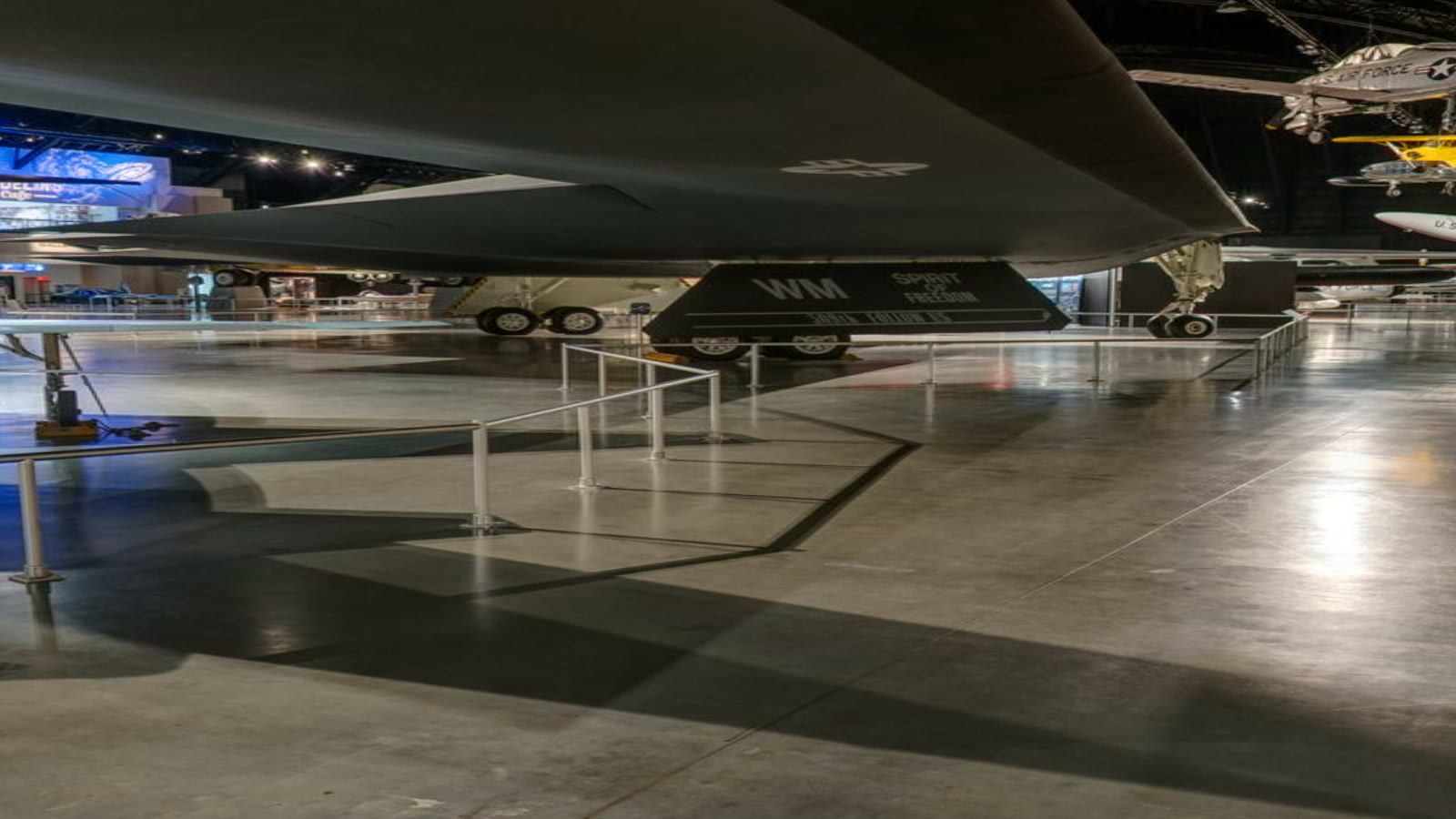
Northrop Grumman constructed two additional aircraft without engines or instruments for fatigue testing. On the second of those test aircraft (the B-2 on display at the museum), engineers attached computer-controlled, hydraulically driven plates along the airframe to simulate all flying conditions. They calculated that the structure would reach 150 percent of the design specifications, but the wing withstood stresses over 161 percent before it finally cracked.
Early production B-2s also underwent extensive environmental testing. In 1993 the Spirit of Ohio (S/N 82-1070) endured more than 1,000 hours of extensive temperature testing at the McKinley Climatic Laboratory at Eglin Air Force Base, Fla. It withstood temperatures ranging from -65 to 120 degrees Fahrenheit, rain and high humidity. To verify the test results outside the laboratory, the Spirit of Ohio deployed to Eielson Air Force Base, Alaska, in March 1996 for further cold climate testing.
To signify these tests, the technicians painted the "Fire and Ice" artwork on the nose landing gear panel and signed it. Presented to the museum in 1999, that nose panel was installed on the museum's B-2 during restoration.
Details that tell the story
Low-observable flying-wing bomber · First public rollout occurred in 1988 · Capable of conventional and nuclear missions
The aircraft in figures
Engines: Four General Electric F118-GE-100 turbofans of 17,300 lbs. thrust each · Wingspan: 172 ft. · Length: 69 ft. · Height: 17 ft. · Speed: High subsonic · Takeoff weight: 336,500 lbs.
Readiness became a permanent condition
During the Cold War, aviation was organized around the possibility of a conflict that governments hoped to prevent. Bombers, missiles, interceptors, reconnaissance aircraft, warning networks, and tankers became parts of interdependent systems. Their value was judged not only by what they could do in flight, but by how reliably they could be maintained, alerted, launched, supported, and controlled.
This emphasis produced striking aircraft and difficult tradeoffs. Long range demanded fuel and support. High speed increased heat and mechanical stress. Sophisticated electronics offered new capabilities but created new maintenance requirements. A reconnaissance aircraft needed an effective camera and a workable route as well as altitude or speed. An interceptor depended on warning and guidance before its pilot could make an engagement.
The human experience included long periods of training and routine punctuated by crises. Crews and ground personnel practiced procedures whose purpose was to remain credible without being used in war. At the same time, military aviation carried out reconnaissance, transport, rescue, humanitarian missions, and conventional operations around the world. Linking these aircraft with civil airliners, research machines, and spacecraft reveals a history of shared technologies and different purposes. The machines embody technical accomplishment, but also the enormous resources and sustained human effort required to keep a global force ready.