Air Force Museum
B-1B Lancer
The B-1B adapted a Cold War penetrating-bomber design into a flexible conventional strike aircraft. Variable-sweep wings, long range, a large internal payload, and sophisticated navigation enabled high-speed low-altitude flight. After the nuclear mission was removed, B-1 crews delivered large numbers of conventional and precision weapons in several conflicts.
In depth
History & service
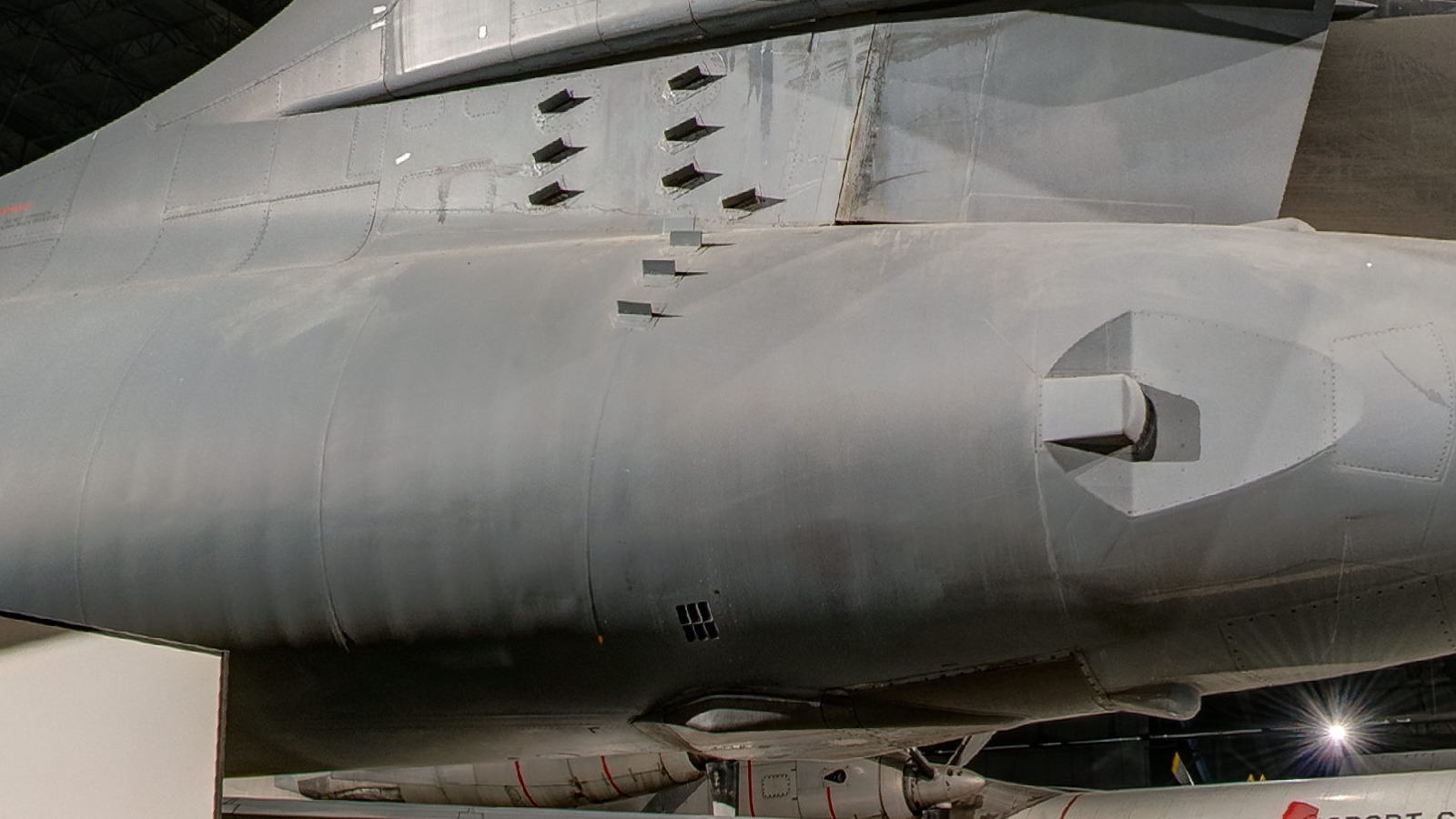
The Boeing (formerly Rockwell International) B-1B Lancer is the improved variant of the B-1A, which was cancelled in 1977. Initiated in 1981, the first production model of this long-range, multi-role, heavy bomber flew in October 1984. The first operational B-1B was delivered to Dyess Air Force Base, Texas, in June 1985, and the final B-1B was delivered in 1988.
The B-1B's blended wing/body configuration, variable-geometry design and turbofan engines combined to provide greater range and high speed -- more than 900 mph (Mach 1.2) at sea level. Forward wing settings were used for takeoff, landing and high-altitude maximum cruise. Aft wing settings were used in high subsonic and supersonic flight, which also enhanced the aircraft's maneuverability.
The B-1B employed forward-looking radar and terrain-following radar. It also had an indicator for moving ground targets. Its extremely accurate Global Positioning System/Inertial Navigation System, Doppler radar and a radar altimeter enabled aircrews to navigate accurately around the world without ground-based navigation aids.
Its three internal weapons bays could accommodate up to 84 Mk-82 general purpose bombs or Mk-62 naval mines, 30 CBU-87/89 cluster munitions or CBU-97 Sensor Fused Weapons, and up to 24 GBU-31 JDAM GPS guided bombs or Mk-84 general purpose bombs. Able to update target information in flight, the B-1B could deliver weapons precisely in a changing combat environment.
First used in combat against Iraq during Operation Desert Fox in 1998, the B-1B has also been employed in Kosovo and Afghanistan. Starting in 2002, the U.S. Air Force began reducing the number of B-1Bs as a cost-saving measure.
The aircraft on display arrived at the museum from the 7th Bomb Wing at Dyess Air Force Base, Texas, on Sept. 10, 2002.
Details that tell the story
Entered operational service in 1986 · Variable-sweep wings balance takeoff and high-speed performance · Used in combat from 1998 onward
The aircraft in figures
Crew: Four (aircraft commander, copilot, offensive systems officer, defensive systems officer) · Engines: Four General Electric F-101-GE-102 turbofan engines of 30,000+ lbs. thrust each, with afterburner · Wingspan: 137 ft. extended forward, 79 ft. swept aft · Length: 146 ft. · Height: 34 ft.
Readiness became a permanent condition
During the Cold War, aviation was organized around the possibility of a conflict that governments hoped to prevent. Bombers, missiles, interceptors, reconnaissance aircraft, warning networks, and tankers became parts of interdependent systems. Their value was judged not only by what they could do in flight, but by how reliably they could be maintained, alerted, launched, supported, and controlled.
This emphasis produced striking aircraft and difficult tradeoffs. Long range demanded fuel and support. High speed increased heat and mechanical stress. Sophisticated electronics offered new capabilities but created new maintenance requirements. A reconnaissance aircraft needed an effective camera and a workable route as well as altitude or speed. An interceptor depended on warning and guidance before its pilot could make an engagement.
The human experience included long periods of training and routine punctuated by crises. Crews and ground personnel practiced procedures whose purpose was to remain credible without being used in war. At the same time, military aviation carried out reconnaissance, transport, rescue, humanitarian missions, and conventional operations around the world. Linking these aircraft with civil airliners, research machines, and spacecraft reveals a history of shared technologies and different purposes. The machines embody technical accomplishment, but also the enormous resources and sustained human effort required to keep a global force ready.