Air Force Museum
C-133A Cargo Master
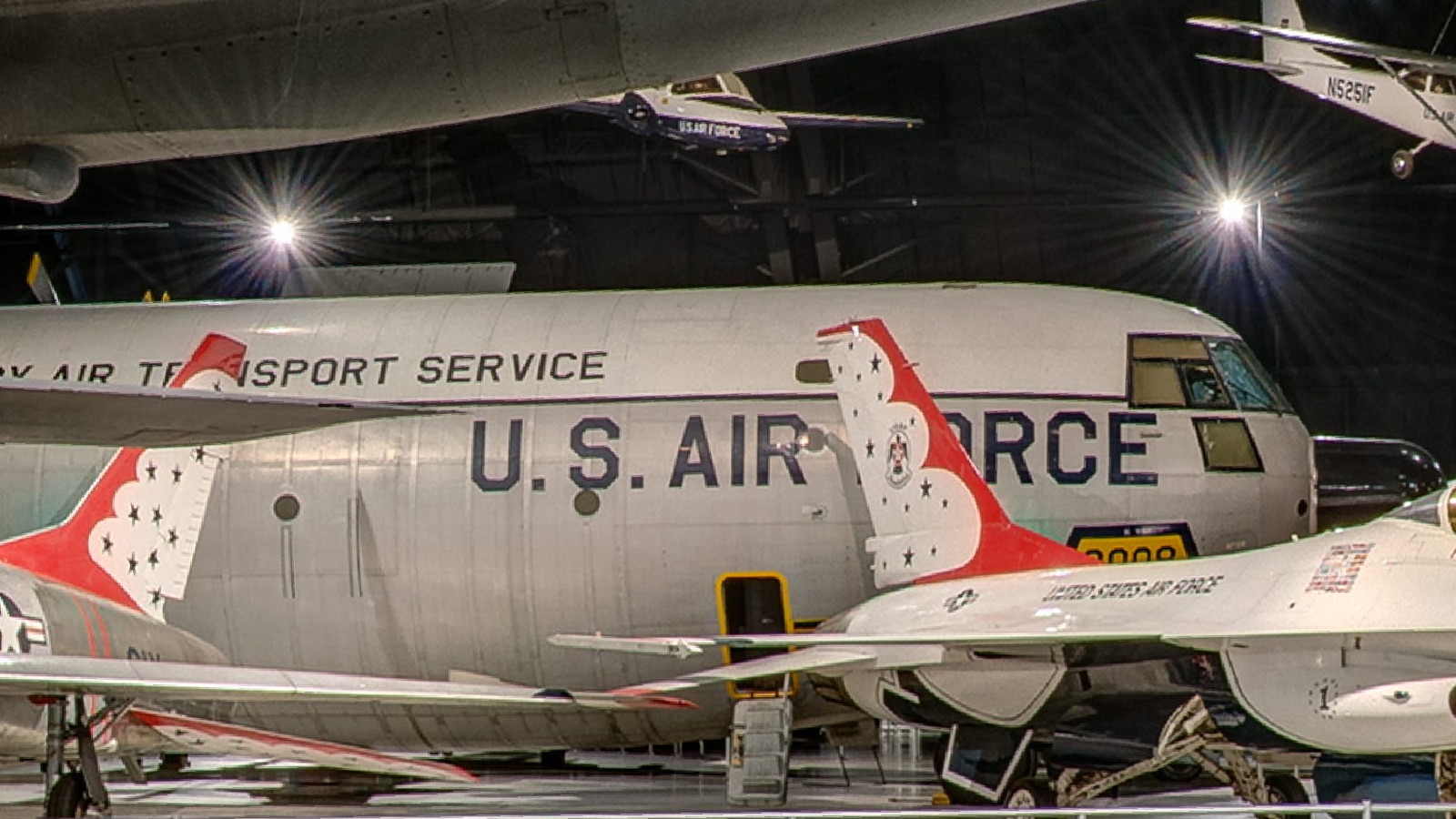
The C-133 carried outsized cargo and missiles at intercontinental range before modern wide-body airlifters entered service. Its high wing, large doors, and spacious cargo hold supported the movement of engines, vehicles, and ballistic-missile components. The aircraft helped make global logistics a routine Air Force capability.
In depth
History & service
The turboprop C-133 was developed to fulfill USAF requirements for a large-capacity strategic cargo aircraft. The Cargo Master went directly into production as the C-133A; no prototypes were built. The first C-133A made its initial flight on April 23, 1956, and when production ended in 1961, Douglas had built 35 C-133As and 15 C-133Bs. C-133s began flying Military Air Transport Service (redesignated Military Airlift Command on Jan.
1, 1966) air routes throughout the world in 1958, and two C-133s established trans-Atlantic speed records for transport aircraft on their first flights to Europe. With its rear-loading and side-loading doors, the C-133 was capable of handling a wide variety of military cargo. Most significant was its ability to transport ballistic missiles, such as the Atlas, cheaper and more quickly than by trailer over highways.
With the development of the larger Lockheed C-5A, the C-133 was released from the active inventory in 1971.
The C-133A on display established a world record for propeller-driven aircraft when, on Dec. 16, 1958, it carried a cargo payload of 117,900 pounds to an altitude of 10,000 feet. It was flown to the museum on March 17, 1971.
Details that tell the story
Strategic turboprop transport · Designed for large and outsized loads · Supported ballistic-missile deployment
The aircraft in figures
Armament: None · Engines: Four Pratt & Whitney T34s of 7,000 hp each · Crew: Four · Maximum speed: 398 mph · Cruising speed: 311 mph · Range: 4,027 statute miles · Ceiling: 23,300 ft. · Span: 179 ft. 8 in. · Length: 157 ft. 6 in. · Height: 48 ft. 8 in.
Readiness became a permanent condition
During the Cold War, aviation was organized around the possibility of a conflict that governments hoped to prevent. Bombers, missiles, interceptors, reconnaissance aircraft, warning networks, and tankers became parts of interdependent systems. Their value was judged not only by what they could do in flight, but by how reliably they could be maintained, alerted, launched, supported, and controlled.
This emphasis produced striking aircraft and difficult tradeoffs. Long range demanded fuel and support. High speed increased heat and mechanical stress. Sophisticated electronics offered new capabilities but created new maintenance requirements. A reconnaissance aircraft needed an effective camera and a workable route as well as altitude or speed. An interceptor depended on warning and guidance before its pilot could make an engagement.
The human experience included long periods of training and routine punctuated by crises. Crews and ground personnel practiced procedures whose purpose was to remain credible without being used in war. At the same time, military aviation carried out reconnaissance, transport, rescue, humanitarian missions, and conventional operations around the world. Linking these aircraft with civil airliners, research machines, and spacecraft reveals a history of shared technologies and different purposes. The machines embody technical accomplishment, but also the enormous resources and sustained human effort required to keep a global force ready.