Air Force Museum
Pancho Villa Attacks New Mexico
After Pancho Villa's forces raided Columbus, New Mexico, on March 9, 1916, the 1st Aero Squadron joined Brigadier General John J. Pershing's Punitive Expedition into Mexico. It was the first time a U.S. military aviation unit deployed on a field operation.
In depth
The first U.S. aviation field deployment
The squadron's fragile Curtiss JN-3 aircraft struggled with mountains, desert distances, dust, poor maps, limited payload, and inadequate engines. Even when airplanes could not meet every expectation, the expedition demonstrated the need for airfields, spare parts, trucks, communications, weather knowledge, and aircraft designed for the environment.
History & service
On March 9, 1916, the Mexican revolutionary, Pancho Villa, crossed the international border with more than 500 men and raided Columbus, N.M., killing 17 Americans. The next day, Brig. Gen. John J. Pershing was directed to organize a force to protect the border and the 1st Aero Squadron, commanded by Capt. B.D. Foulois, was ordered to join Pershing's "Punitive Expedition" at Columbus.
The squadron departed on March 13 from Fort Sam Houston at San Antonio, Texas, where it had been stationed since November 1915, and arrived at Columbus two days later. This was the first time the United States had ever placed a "tactical air unit" in the field.
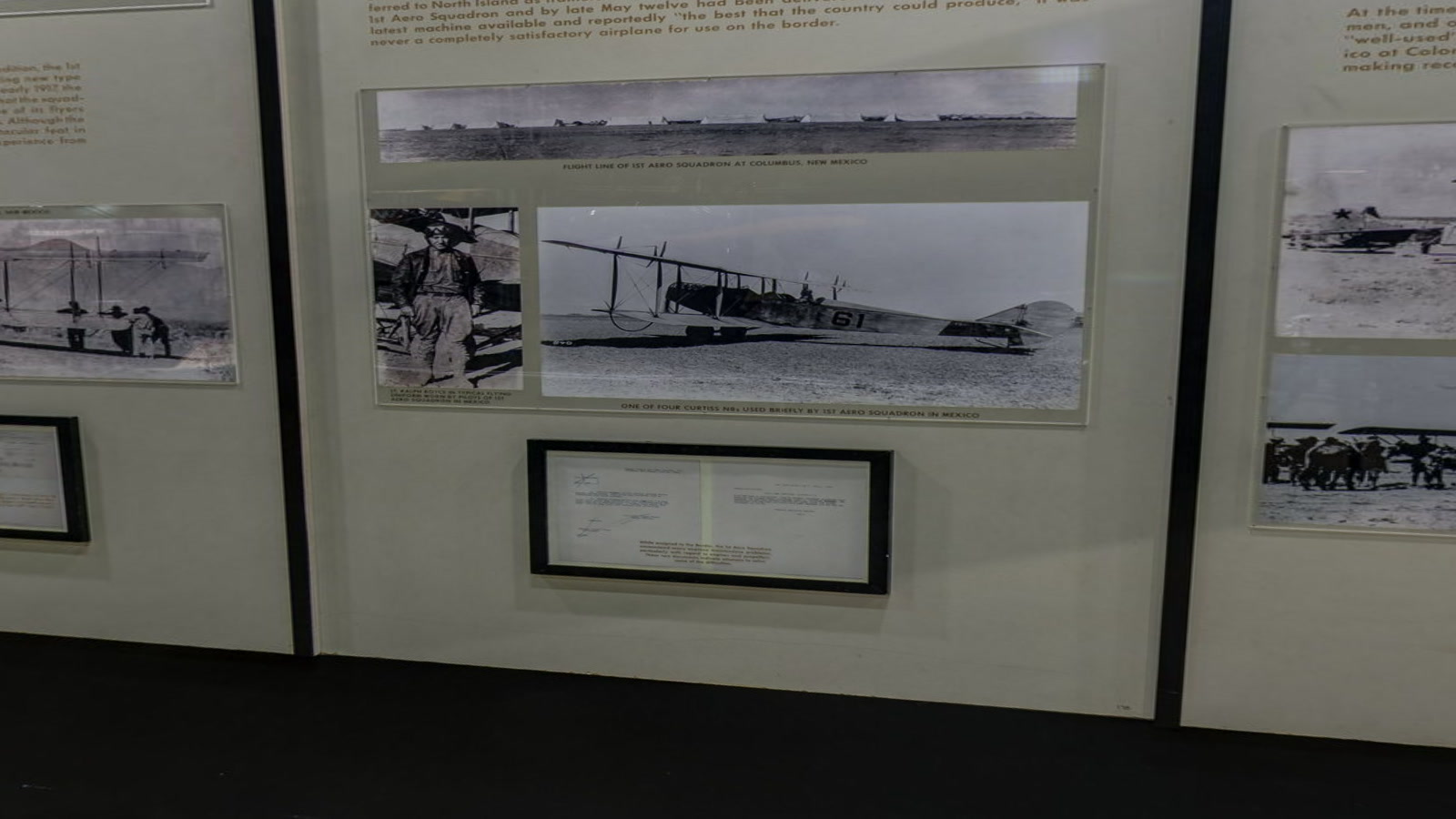
At the time the 1st Aero Squadron joined General Pershing's forces, it consisted of 11 officers, 84 enlisted men and one civilian mechanic. Also, it had a total of eight Curtiss JN3 airplanes, already "well-used" before arriving on the border. A forward base was established in northern Mexico at Colonia Dublan, and during the last part of March 1916, the 1st Aero Squadron began making reconnaissance flights to locate Pancho Villa and his forces.
The rugged terrain and unfavorable operating conditions of northern Mexico, coupled with the limited performance of the JN3s, rapidly took their toll, and by April 20, only two airplanes remained in service. Four new Curtiss NB airplanes were delivered on April 22, but since they were little better than the JN3s, which they closely resembled, they were soon transferred to North Island as trainers.
Another type airplane, the Curtiss R2, was sent to the 1st Aero Squadron, and by late May 12 had been delivered. Although the R2 was the latest machine available and reportedly "the best that the country could produce," it was never a completely satisfactory airplane for use on the border.
During its remaining months with General Pershing's Expedition, the 1st Aero Squadron spent much of its time field-testing new type airplanes purchased for the Aviation Section. By early 1917, the tense border situation had eased to the degree that the squadron was no longer needed in Mexico, and some of its flyers were transferred to newly-opened flying schools.
Although the 1st Aero Squadron never performed any spectacular feat in pursuit of Pancho Villa, it gained valuable field experience from operating under "combat" conditions.
Details that tell the story
Villa's raid occurred March 9, 1916 · The 1st Aero Squadron deployed from Fort Sam Houston · Eight Curtiss JN-3s began the expedition · The deployment exposed severe limits in range, power, and logistics
A new invention becomes a public world
Before airplanes became routine transport, public demonstrations helped establish what they could do. Exhibition flights, races, and crossings placed fragile machines before crowds, officials, and potential customers. The audience saw courage and spectacle. Behind the spectacle were less visible questions about reliable engines, controllable wings, suitable landing grounds, and how to recover when the weather changed.
Different configurations competed at the same time. Some designers placed the propeller behind the pilot; others put it at the front. Biplanes used bracing to make light structures sufficiently rigid. Monoplanes reduced some of that external framework but posed their own structural and handling problems. Balloons and dirigibles remained part of the same aviation world, offering capabilities that early airplanes could not simply replace.
The famous firsts matter, but so does the period immediately after them. Flight schools, licensed manufacture, military trials, mechanics, and spare parts carried an invention outward. An aircraft could influence aviation through the pilots trained on it or the designs adapted from it, even after its own performance became outdated. The machines in Washington and Dayton preserve different points along that process. Their differences show how quickly an experimental achievement became an international industry, and how many people had to turn a remarkable flight into a repeatable service.