Air Force Museum
Lt. Quentin Roosevelt
Quentin Roosevelt, the youngest son of former president Theodore Roosevelt, served as a pursuit pilot with the 95th Aero Squadron. He was killed in aerial combat over France on July 14, 1918, at age twenty.
In depth
A life behind a familiar name
His death received extraordinary public attention because of his family, but it also represents thousands of young airmen whose careers lasted only weeks or months. Letters, squadron records, photographs, and burial history allow a biography to be read without turning sacrifice into spectacle.
History & service
Lt. Quentin Roosevelt, the youngest son of former President Theodore Roosevelt, was a pilot in the 95th Aero Squadron. On July 14, 1918, he was shot down behind German lines by Sgt. Thom, a German ace with 24 victories. Roosevelt's Nieuport 28 crashed at Chamery near Coulonges-en-Tardenois and his body was buried by the Germans at the crash site. Since the plane had crashed so near the front lines, the Germans had to use two pieces of basswood saplings, bound together with wire from the Nieuport, to fashion a cross for the grave.
When the Germans retreated from the area, U.S. troops found the grave and made a wooden cross for it. Still later, Frenchmen constructed an elaborate marker and fence. On July 12, 1944, Quentin's brother, Brig. Gen. Theodore Roosevelt Jr., died of a heart attack in Normandy following the World War II D-Day invasion of France. When the American memorial was established at St. Laurent-sur-Mer after the war at Omaha Beach, Theodore's remains were buried in the cemetery. Quentin's remains were then exhumed and buried at St. Laurent beside those of Theodore.
Details that tell the story
Served with the 95th Aero Squadron · Flew Nieuport 28 fighters · Killed July 14, 1918 · Was twenty years old
A new invention becomes a public world
Before airplanes became routine transport, public demonstrations helped establish what they could do. Exhibition flights, races, and crossings placed fragile machines before crowds, officials, and potential customers. The audience saw courage and spectacle. Behind the spectacle were less visible questions about reliable engines, controllable wings, suitable landing grounds, and how to recover when the weather changed.
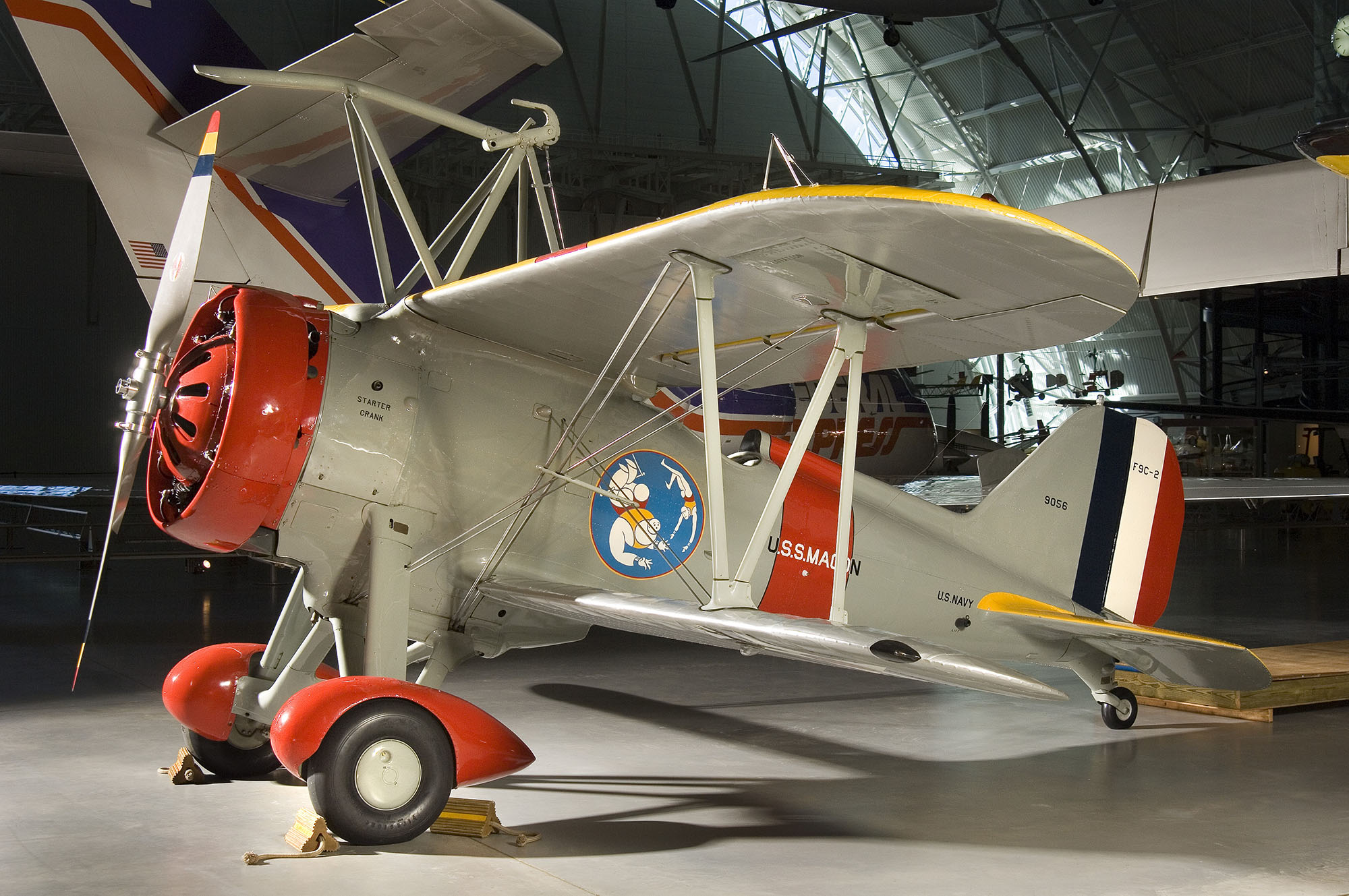
Different configurations competed at the same time. Some designers placed the propeller behind the pilot; others put it at the front. Biplanes used bracing to make light structures sufficiently rigid. Monoplanes reduced some of that external framework but posed their own structural and handling problems. Balloons and dirigibles remained part of the same aviation world, offering capabilities that early airplanes could not simply replace.
The famous firsts matter, but so does the period immediately after them. Flight schools, licensed manufacture, military trials, mechanics, and spare parts carried an invention outward. An aircraft could influence aviation through the pilots trained on it or the designs adapted from it, even after its own performance became outdated. The machines in Washington and Dayton preserve different points along that process. Their differences show how quickly an experimental achievement became an international industry, and how many people had to turn a remarkable flight into a repeatable service.