Air Force Museum
Lt. Erwin R. Bleckley
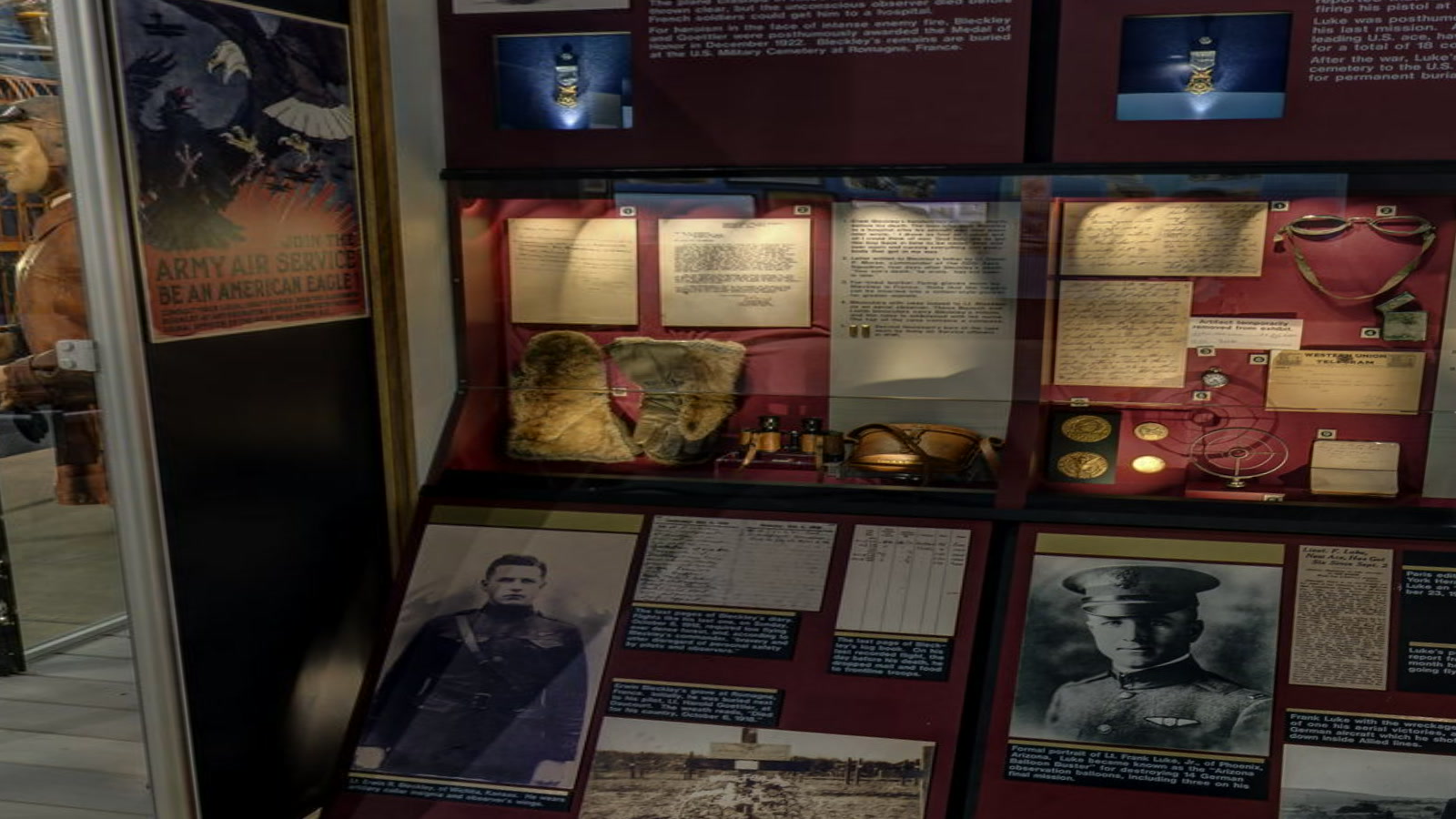
Lieutenant Erwin R. Bleckley served as an observer with the 50th Aero Squadron. On October 6, 1918, he and pilot Harold Goettler made repeated low-altitude flights through intense fire while searching for the surrounded American force remembered as the Lost Battalion.
In depth
Observation under fire
Their aircraft was shot down and both men were killed, but information from the mission helped narrow the unit's position. Bleckley received the Medal of Honor. The story joins maps, visual observation, crew coordination, ground fire, and the ethical weight of accepting extraordinary risk to aid others.
History & service
Erwin R. Bleckley of Wichita, Kan., was commissioned a second lieutenant in the Kansas National Guard Field Artillery in July 1917. He was sent to France in March 1918, and when the Air Service needed artillery officers to serve as aerial observers, Bleckley volunteered. After training, he was assigned to the 50th Aero Squadron for combat duty in August 1918.
Bleckley began flying missions as an observer with pilot Lt. Harold E. Goettler at the outset of the Allied St. Mihiel Offensive on Sept. 12, 1918. On Oct. 6, Bleckley and Goettler took off to search for the so-called "Lost Battalion" of American troops, who were cut off and surrounded by German forces in the Argonne Forest. Finding them, they dropped supplies despite intense ground fire. On their second trip, they flew very low to drop supplies more accurately.
This time their DH-4 aircraft was brought down when rifle and machine gun fire hit both Bleckley and Goettler, the latter dying instantly. The plane crashed in Allied territory and Bleckley was thrown clear, but the unconscious observer died before French soldiers could get him to a hospital.
For heroism in the face of intense enemy fire, Bleckley and Goettler were posthumously awarded the Medal of Honor in December 1922. Bleckley's remains are buried at the U.S. Military Cemetery in Romagne, France.
Details that tell the story
Observer in the 50th Aero Squadron · Flew with Lieutenant Harold Goettler · Mission took place October 6, 1918 · Posthumously received the Medal of Honor
A new invention becomes a public world
Before airplanes became routine transport, public demonstrations helped establish what they could do. Exhibition flights, races, and crossings placed fragile machines before crowds, officials, and potential customers. The audience saw courage and spectacle. Behind the spectacle were less visible questions about reliable engines, controllable wings, suitable landing grounds, and how to recover when the weather changed.
Different configurations competed at the same time. Some designers placed the propeller behind the pilot; others put it at the front. Biplanes used bracing to make light structures sufficiently rigid. Monoplanes reduced some of that external framework but posed their own structural and handling problems. Balloons and dirigibles remained part of the same aviation world, offering capabilities that early airplanes could not simply replace.
The famous firsts matter, but so does the period immediately after them. Flight schools, licensed manufacture, military trials, mechanics, and spare parts carried an invention outward. An aircraft could influence aviation through the pilots trained on it or the designs adapted from it, even after its own performance became outdated. The machines in Washington and Dayton preserve different points along that process. Their differences show how quickly an experimental achievement became an international industry, and how many people had to turn a remarkable flight into a repeatable service.