Air Force Museum
Caproni Ca. 36
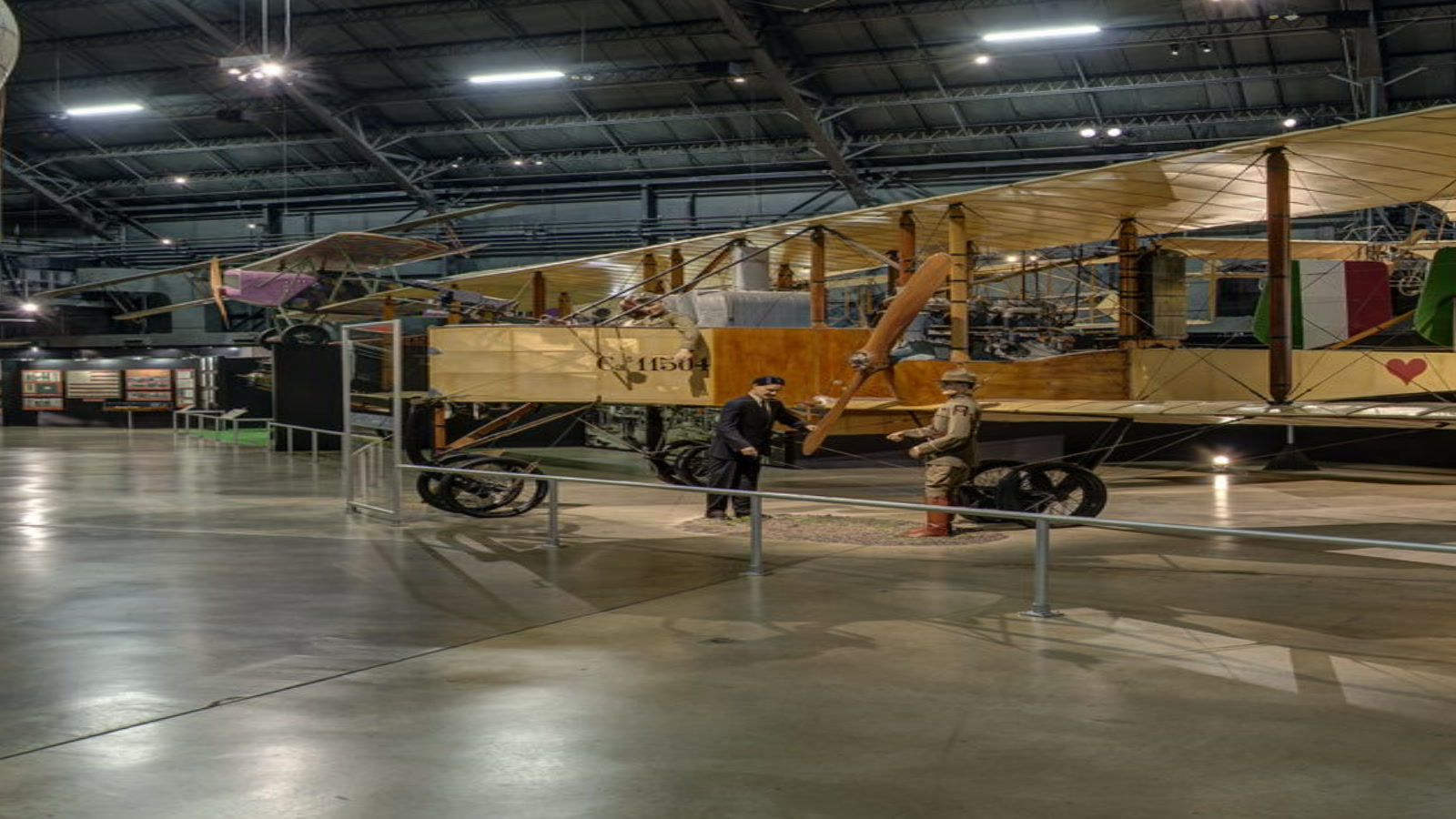
The Italian Caproni Ca. 36 used three engines, twin tail booms, and a central crew nacelle to carry bombs farther than smaller single-engine aircraft. Its wood-and-fabric structure made a large airplane possible with the materials and manufacturing methods of the period.
In depth
Range, payload, and multi-engine flight
American airmen trained on Caproni bombers in Italy, and the United States considered producing related designs. The aircraft exposes the coordination challenge of early heavy bombing: multiple engines, crew stations, navigation, defensive guns, bomb load, and fragile structure all had to work over long distances.
History & service
During World War I, Italian aeronautical engineer Gianni Caproni developed a series of multi-engine heavy bombers that played a key role in the Allied strategic bombing campaign. His bombers were produced not only in Italy, but also in France and the United States.
In late 1914 Caproni designed the Ca. 31, powered by three Gnome rotary engines. The following year, Caproni produced a new version, the Ca. 32. Very similar to the Ca. 31, it had three FIAT 100-hp water-cooled in-line engines. Three months after Italy's entry into WWI, the first Ca. 32s attacked an Austrian air base at Aisovizza, and by the end of the year, regular raids were being mounted against other Austrian targets.
Caproni continued to refine his successful design with the introduction of the Isotta-Fraschini powered Ca. 33. Toward the end of the war the definitive version, the Ca. 36, went into production. Changes from the Ca. 33 were small but included five-section wings that made disassembly and surface transportation easy. Ca. 36s remained in Italian Air Force service as late as 1929.
Restored by museum specialists, the museum obtained the Ca. 36 on display from the Museo Aeronautica Caproni di Taliedo in Italy in 1987.
Details that tell the story
Italian three-engine heavy bomber · Twin-boom configuration · Wood-and-fabric structure · American crews trained on Caproni aircraft in Italy
The aircraft in figures
Armament: Two Revelli 6.5mm machine guns and 1,764 lbs. of bombs · Engine: Three Isotta-Fraschini V.4B 150-hp water-cooled, 6-cylinder · Maximum speed: 87 mph · Range: 372 miles · Ceiling: 14,765 ft. · Span: 74 ft. 7 in. · Length: 36 ft. 3 in. · Height: 12 ft. 7 in. · Weight (loaded): 8,820 lbs. · Fuel capacity: 166 gallons
A new invention becomes a public world
Before airplanes became routine transport, public demonstrations helped establish what they could do. Exhibition flights, races, and crossings placed fragile machines before crowds, officials, and potential customers. The audience saw courage and spectacle. Behind the spectacle were less visible questions about reliable engines, controllable wings, suitable landing grounds, and how to recover when the weather changed.
Different configurations competed at the same time. Some designers placed the propeller behind the pilot; others put it at the front. Biplanes used bracing to make light structures sufficiently rigid. Monoplanes reduced some of that external framework but posed their own structural and handling problems. Balloons and dirigibles remained part of the same aviation world, offering capabilities that early airplanes could not simply replace.
The famous firsts matter, but so does the period immediately after them. Flight schools, licensed manufacture, military trials, mechanics, and spare parts carried an invention outward. An aircraft could influence aviation through the pilots trained on it or the designs adapted from it, even after its own performance became outdated. The machines in Washington and Dayton preserve different points along that process. Their differences show how quickly an experimental achievement became an international industry, and how many people had to turn a remarkable flight into a repeatable service.