Air Force Museum
Escort Excellence
The 332nd Fighter Group's bomber-escort record challenged racist claims while demonstrating the discipline required to protect formations over long missions. Escort fighters had to remain close enough to protect bombers while resisting the temptation to pursue every enemy aircraft. The 332nd Fighter Group, flying red-tailed P-47s and P-51s, became known for staying with the bombers assigned to them.
In depth
The story behind the display
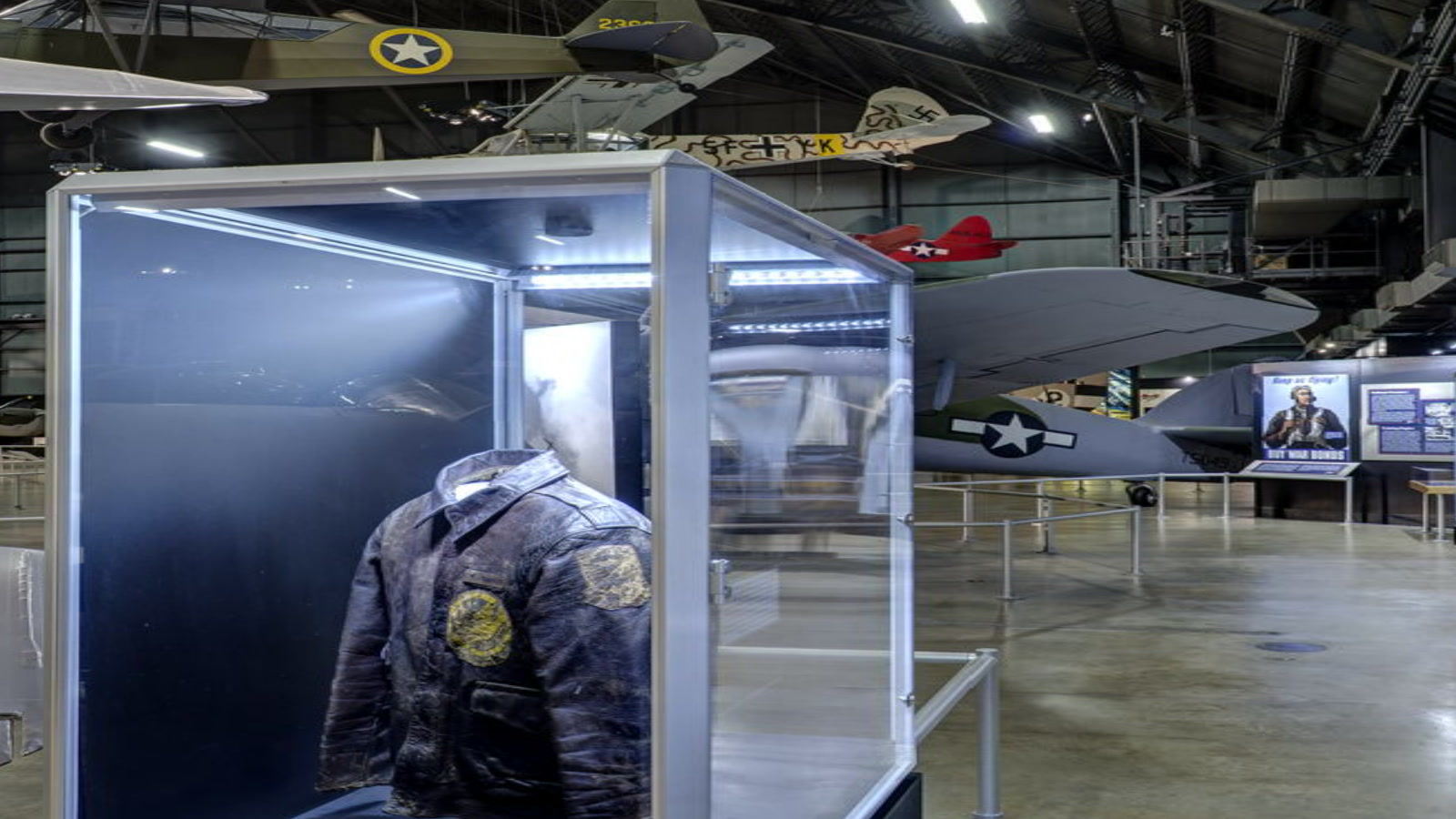
Its record was built by pilots, armorers, mechanics, controllers, weather personnel, and support units working within a segregated military. The group's achievement became evidence in a broader campaign for equal opportunity and helped undermine the assumptions used to justify exclusion.
History & service
While the 99th Fighter Squadron continued to fight its way through Sicily and Italy alongside white units, Benjamin Davis returned to the United States to take command of the new 332nd Fighter Group. Another segregated unit, the 332nd included three fighter squadrons -- the 100th, 301st and 302nd -- equipped with Bell P-39 Airacobras.
In February 1944, the 332nd entered combat for the first time, from its base at Montecorvino, Italy, attacking enemy supply lines. Within a few months, however, the unit exchanged its P-39s for Republic P-47 Thunderbolts to fly escort for 15th Air Force bombers.
In July 1944, the 99th Fighter Squadron, which had been flying close air support missions with its P-40s, joined the three other fighter squadrons of the 332nd Fighter Group, placing all the segregated Tuskegee Airmen on the same base. At that time, the 332nd replaced its P-40s and P-47s with sleek North American P-51 Mustangs. To identify themselves in combat, the 332nd Fighter Group painted the tails of their fighters bright red, which earned them the nickname "Red Tails."
Known as a strict disciplinarian, Col. Davis urged his men to prove themselves in combat as the best reply to racism. They flew 311 missions, of which 179 were escorting bombers, from June 1944 through the end of the war. The Tuskegee Airmen performed with great skill and courage, on one occasion shooting down 13 German fighters. Despite its success, however, the 332nd was often outnumbered. On one mission, Davis led 39 aircraft against more than 100 German fighters, shooting down five for the loss of one.
Tuskegee Airmen faced the best the Luftwaffe had, including the first jet fighters. On March 24, 1945, the 332nd became one of the first Italy-based fighter units to escort B-17s all the way to Berlin and back. Along the way, they met 25 German Me 262 jets. In the ensuing combat, the 332nd shot down three of the eight jets destroyed that day and earned the 332nd a Distinguished Unit Citation.
During the war, Tuskegee trained around 990 pilots and sent 350 overseas. When the war in Europe ended, the Tuskegee Airmen had shot down 112 enemy aircraft, destroyed 150 aircraft on the ground, knocked out more than 600 railroad cars, and 40 boats and barges. Approximately 150 Tuskegee Airmen were killed in combat or in accidents, and 32 became prisoners of war. By any measure, the Tuskegee project proved a resounding success.
Col. Davis returned to the U.S. to command the 477th Medium Bombardment Group, which also trained at Tuskegee, but the war ended in Japan before the group saw action.
Details that tell the story
The 332nd Fighter Group flew from Italy · Red-painted aircraft tails became a visual identifier · Escort success depended on formation discipline · The unit served within a segregated Army Air Forces
Aircraft change the battlefield
In the First World War, aircraft became valuable because they could see beyond the front line. Reconnaissance and artillery observation affected decisions on the ground. Once that information mattered, opposing forces had reason to attack the aircraft gathering it. Fighters, defensive armament, and increasingly specialized missions developed around this contest over observation and freedom of movement.
The aircraft were fragile by later standards, but their crews worked inside a rapidly expanding military system. Training, maintenance, replacement aircraft, photography, communications, and weather reporting supported each sortie. Improvements in engines and armament changed tactics, while the pressures of combat exposed weaknesses that might have taken much longer to discover in peacetime.
Personal stories should be read alongside those systems. A uniform or a named aircraft connects the war to an individual, but the individual depended on many others and operated under constraints that skill could not eliminate. Aircraft from opposing sides show how designers answered similar problems in different ways. The later military collections in Dayton and at Udvar-Hazy reveal what endured: the need to gather information, protect friendly forces, move people and supplies, and coordinate action across distance. The scale changed enormously; the relationship between an aircraft's design and the job it had to perform remained fundamental.