Air Force Museum
Messerschmitt Me 262A Schwalbe
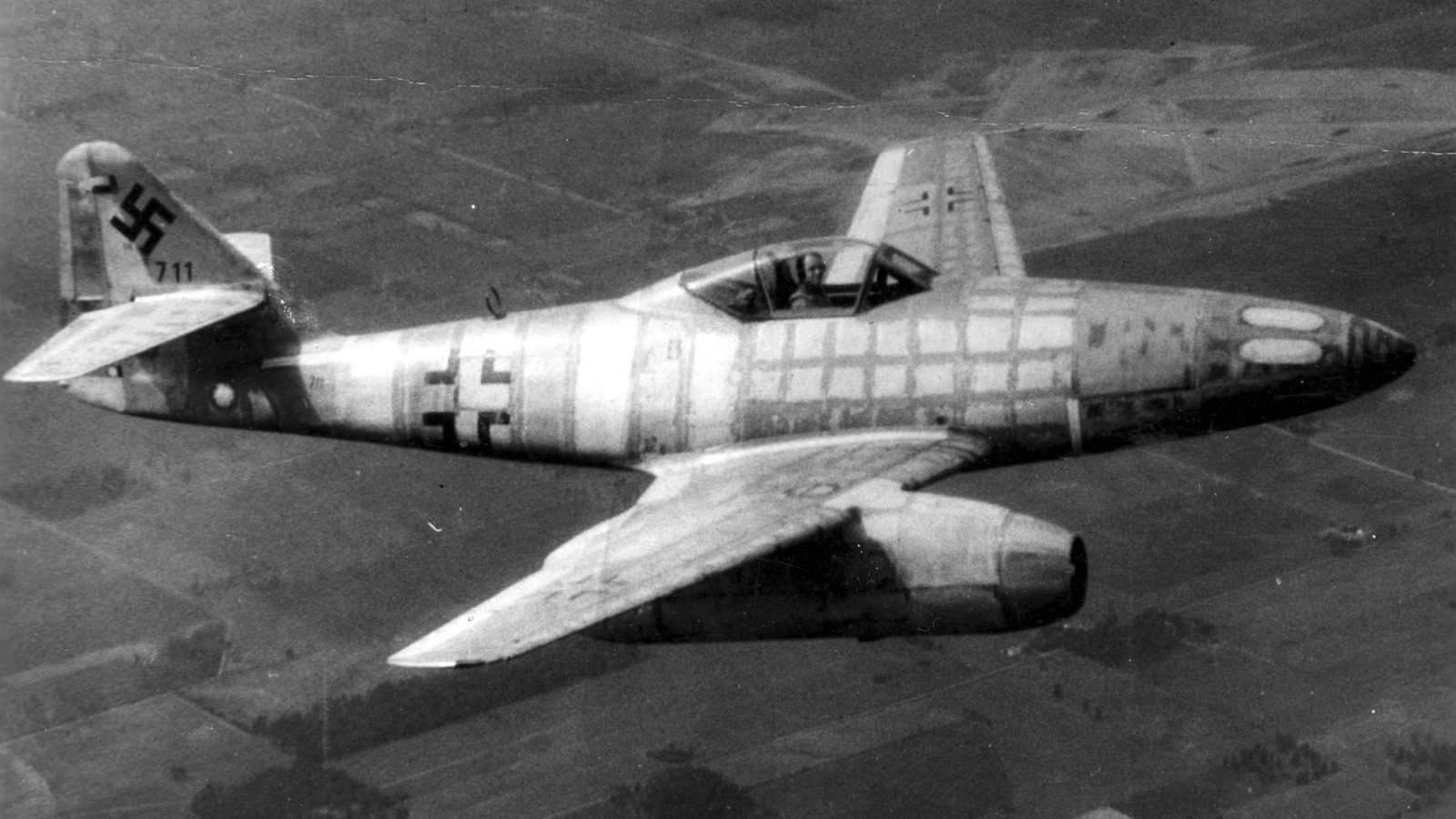
The Me 262 was the first operational jet fighter, offering extraordinary speed but arriving within a collapsing German war system that limited its impact. Powered by two turbojet engines, the Me 262 could fly much faster than Allied piston-engine fighters. Its swept wings, engine installation, and high speed made it one of the clearest signs that military aviation was entering a new technical era.

In depth
The story behind the display
Technical promise did not erase operational limits. Engine life was short, fuel and trained pilots were scarce, airfields were vulnerable, production was disrupted, and Allied forces learned to attack the jets during takeoff and landing. The aircraft shows why a weapon's performance cannot be separated from the system that supports it.
History & service
Developed from a 1938 design by the Messerschmitt company, the Me 262 Schwalbe was the world's first operational turbojet aircraft. First flown under jet power on July 18, 1942, it proved much faster than conventional airplanes. Development problems (particularly its temperamental engines), Allied bombings and cautious Luftwaffe leadership contributed to delays in quantity production.
On July 25, 1944, an Me 262 became the first jet airplane used in combat when it attacked a British photo-reconnaissance Mosquito flying over Munich. As a fighter, the German jet scored heavily against Allied bomber formations. U.S. Army Air Forces bombers, however, destroyed hundreds of Me 262s on the ground. Of the more than 1,400 Me 262s produced, fewer than 300 saw combat.
Most Me 262s did not make it to operational units because of the destruction of Germany's surface transportation system. Many of those that did were unable to fly because of lack of fuel, spare parts or trained pilots.
The Me 262A on display was brought to the United States from Germany in July 1945 for flight evaluation. Restored by the 96th Mobile Maintenance Squadron, Kelly Air Force Base, Texas, in 1976-1979, it is painted without operational unit markings as an aircraft that has just left the production line.
Details that tell the story
First operational jet fighter · Powered by two Junkers Jumo 004 turbojet engines · Entered combat service late in World War II · Speed advantage was constrained by reliability, fuel, training, and logistics
The aircraft in figures
Armament: Four 30mm MK-108 cannons and 1,000 lbs. of bombs · Engines: Two Junkers Jumo 004s of 1,980 lbs. thrust each · Maximum speed: 540 mph · Cruising speed: 460 mph · Range: 650 miles · Ceiling: 38,000 ft. · Span: 41 ft. · Length: 34 ft. 9 in. · Height: 11 ft. 4 in. · Weight: 15,600 lbs.
Aircraft change the battlefield
In the First World War, aircraft became valuable because they could see beyond the front line. Reconnaissance and artillery observation affected decisions on the ground. Once that information mattered, opposing forces had reason to attack the aircraft gathering it. Fighters, defensive armament, and increasingly specialized missions developed around this contest over observation and freedom of movement.
The aircraft were fragile by later standards, but their crews worked inside a rapidly expanding military system. Training, maintenance, replacement aircraft, photography, communications, and weather reporting supported each sortie. Improvements in engines and armament changed tactics, while the pressures of combat exposed weaknesses that might have taken much longer to discover in peacetime.
Personal stories should be read alongside those systems. A uniform or a named aircraft connects the war to an individual, but the individual depended on many others and operated under constraints that skill could not eliminate. Aircraft from opposing sides show how designers answered similar problems in different ways. The later military collections in Dayton and at Udvar-Hazy reveal what endured: the need to gather information, protect friendly forces, move people and supplies, and coordinate action across distance. The scale changed enormously; the relationship between an aircraft's design and the job it had to perform remained fundamental.