Air Force Museum
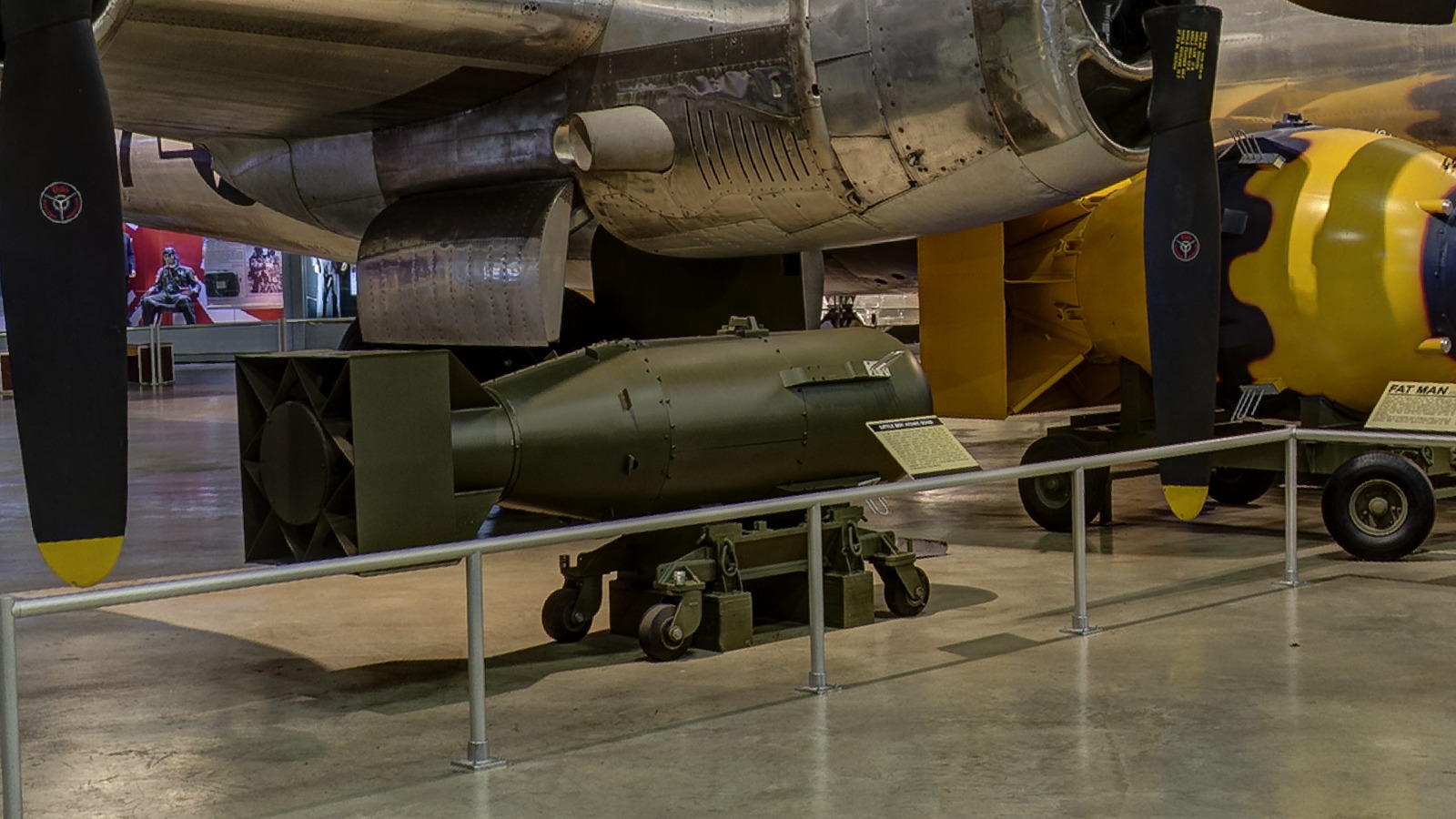
'Little Boy' Atomic Bomb
Little Boy was the uranium weapon used over Hiroshima, beginning the only wartime use of nuclear weapons in history. The weapon used a gun-type design that brought separate masses of uranium-235 together rapidly to create a nuclear chain reaction. Its design differed from the plutonium implosion weapon used three days later over Nagasaki.
In depth
The story behind the display
Dropped from the B-29 Enola Gay, the explosion destroyed much of Hiroshima and killed tens of thousands immediately, with many more deaths from burns, injuries, and radiation. The object must be interpreted through both its engineering and the civilian catastrophe it produced.
History & service
The Mk I bomb, nicknamed "Little Boy," was the first nuclear weapon used in warfare. It was delivered by the B-29 Enola Gay (on display at the Smithsonian National Air & Space Museum), it detonated at an altitude of 1,800 feet over Hiroshima, Japan, on Aug. 6, 1945. The result of the Manhattan Project, begun in June 1942, "Little Boy" was a gun-type weapon, which detonated by firing one mass of uranium down a cylinder into another mass to create a self-sustaining nuclear reaction.
Weighing about 9,000 pounds, it produced an explosive force equal to 20,000 tons of TNT.
When constructed in 1945, the "Little Boy" on display was an operational weapon, but it has been completely demilitarized for display purposes. In 2004 the Department of Energy repaired and repainted the artifact at its Sandia National Laboratories in Albuquerque, N.M.
Details that tell the story
Uranium-235 gun-type weapon · Used over Hiroshima on August 6, 1945 · Carried by the B-29 Enola Gay · Its use marked the beginning of nuclear warfare
Aircraft change the battlefield
In the First World War, aircraft became valuable because they could see beyond the front line. Reconnaissance and artillery observation affected decisions on the ground. Once that information mattered, opposing forces had reason to attack the aircraft gathering it. Fighters, defensive armament, and increasingly specialized missions developed around this contest over observation and freedom of movement.
The aircraft were fragile by later standards, but their crews worked inside a rapidly expanding military system. Training, maintenance, replacement aircraft, photography, communications, and weather reporting supported each sortie. Improvements in engines and armament changed tactics, while the pressures of combat exposed weaknesses that might have taken much longer to discover in peacetime.
Personal stories should be read alongside those systems. A uniform or a named aircraft connects the war to an individual, but the individual depended on many others and operated under constraints that skill could not eliminate. Aircraft from opposing sides show how designers answered similar problems in different ways. The later military collections in Dayton and at Udvar-Hazy reveal what endured: the need to gather information, protect friendly forces, move people and supplies, and coordinate action across distance. The scale changed enormously; the relationship between an aircraft's design and the job it had to perform remained fundamental.